Showing posts with label nuclear. Show all posts

Tuesday, June 1, 2010

Augmenting Thermal Power Plants with Hydropower from Cooling Water

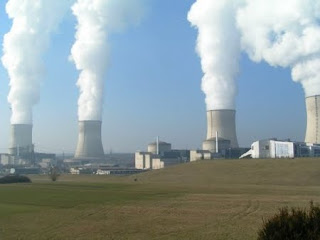
Nuclear power plants discharge a lot of cooling water
Much of our current electrical generation is done by large utilities in what are generically termed thermal power plants. Thermal power plants include those that burn coal, natural gas, biomass, or other fuels. They also include nuclear power plants. The common element to all of these is that they heat water, creating steam which is then used to drive steam turbines which turn the generators that make the electricity.

Once the steam has passed through the turbine it moves into a condenser where it is cooled back into liquid water, and circulated around to be heated again. Many of the condensers use water to cool the steam. Some plants use a closed loop of cooling water, where the cooling water is itself cooled; in nuclear plants this is the purpose of the tall cooling towers. Steam that escapes is replaced by a fresh supply of water, which is why these plants are typically sited near rivers or by the ocean where there is a large continuous water supply.

Other plants use an open loop or once-through water for their cooling, where water is drawn in continuously for cooling, then discharged back into the river or ocean. These discharges are almost always gravity flows rather than pumped, and these discharges of large amounts of water, running continuously in artificial channels, are perfect for Hydrovolts turbines to generate power, augmenting that made by the main part of the plant. Hydrovolts turbines can generate additional power at modest cost by harnessing these untapped flows; the electricity is sent via the existing transmission infrastructure.

Like most other artificial water flows in constructed waterways, little or no permitting is needed because environmental impacts are minimal. As a result, cost is low and speed of implementation is relatively rapid. This is a solution that lets us take a small, but quick step to a better energy future.

Sunday, May 2, 2010

Laissez Failure

BP oil platform burns in the Gulf of Mexico
The slow-motion ecological catastrophe in the Gulf of Mexico is horrifying.

The oil slick is now the size of Ohio, and growing by the hour. Edges of it are now reaching land and all along the Gulf coast residents wait with deep foreboding and growing anger as the dimensions of the disaster become clear.

This is not an oil spill, but an oil spilling, as more ruptures from the sea floor, surfaces, and spreads its devastating reach towards shore. 40% of the coastal wetlands in the United States are under threat, as are the majority of the country's oyster and shrimp fisheries. Local fishermen have moved quickly through the 5 stages of grieving as they face the imminent destruction of their livelihood, economic security, their way of life, and their future.

Emergency response began quickly and broad efforts at mitigation are underway. The Obama Administration formed a National Response Team, Louisiana Governor Bobby Jindal is mobilizing the state's National Guard, and locals are taking to their boats to deploy booms to intercept the sprawling slick. Dealing with the immediate crisis is paramount now, yet soon hard questions must be asked, and honestly answered. The critical questions are:

Why did this happen? How do we prevent it happening again?

Wednesday, March 31, 2010

Our Energy Future - II

Peak Oil graph
Where will our energy come from in the future? Peak oil is upon us, even if the exact date is not yet conclusively known. Nuclear power is at best a transitional step, and quite costly when factoring in construction and external costs. What's left?

How about 100% from renewable sources? A new report by PriceWaterhouseCoopers suggests Europe could be powered entirely by renewable sources, albeit at substantial cost of transition, especially on inter-continental transmission:
A "super-smart" grid powered by solar farms in North Africa, wind farms in northern Europe and the North Sea, hydro-electric from Scandinavia and the Alps and a complement of biomass and marine could render carbon-based fuels obsolete for electricity by 2050, said the report.

The goal is achievable even without the use of nuclear energy, the mainstay of electricity in France.
While the costs and challenges are great, those of clinging to the fossil economy would be much greater. But what is remarkable, of course, is that the modern industrial economy of Europe, roughly the same size as that of the United States, could be run entirely on renewable energy.

Thus, today's announcement by President Obama to expand off-shore oil drilling in the United States is especially disappointing.

Sunday, March 28, 2010

Conservatives Announce Plan to Promote Renewable Energy

Nate Beeler: Energy Policy Stopgap
Conservatives recently announced a 12-point action plan to boost renewable energy and nuclear power. The plan would also entail a substantial change to the energy sector. The plan recognizes the historical abundance of oil and gas in the country as well as the relatively recent rise of concern over pollution, resource depletion, and the green house gases emissions that are fueling climate change.

Some of the specific initiatives include:
  • A Green Investment Bank to provide public funding for new energy technologies
  • Establishing a "floor" price for carbon and an upstream tax
  • Accelerated demonstration projects for energy storage and carbon capture
  • Establishing an "energy internet", including distributed generation and a smart grid
  • Household incentives for energy efficiency
  • Electrifying the transport system
  • Implementing national feed-in tariffs
The current energy approach is "out of date"; what is needed are:

Thursday, March 4, 2010

Who Speaks for Business?

Empty podiumtitl
Who speaks for business? Who advocates for business and articulates their views on public policy? Businesses and their leaders do of course. They just don't always speak with one voice.

For example, a recent survey commissioned by international renewable energy group NTR Foundation and conducted by the Brunswick Group found more than half of the largest US companies wanting an end to the ambiguity surrounding climate change legislation.
About 50 per cent of America’s top business leaders believe a lack of clarity on climate legislation is negatively impacting upon the ability of the US to compete in the global market.

Seventy per cent of the respondents said climate change would be an important part of their commercial decision-making within five years. But almost three in four of the business leaders said security of energy supply was a more “pressing issue” for them than climate change.

Tuesday, February 9, 2010

HCE Day 2

Hal Calborn
Day 2 of the Harvesting Clean Energy Conference kicked off at 8:00 a.m. here in Kennewick. There were quite a few more people in attendance than on Day 1, no doubt due to the full-day schedule, its being a Monday, and there being no distracting sporting events. Hal Calborn, Conference Emcee, summarized one of yesterday's key messages, that the focus on many attendees was on energy security being the key economic and policy driver and the need to create jobs in the burgeoning global clean energy economy. However, "it doesn't mean that climate change is not an issue."


Next up was US Representative Doc Hastings (R-WA) and the contrast of his "special remarks" to those yesterday by US Representative Jay Inslee (D-WA) was stark. Inslee supported the Waxman-Markey and Stimulus bills; Hastings opposed them. Inslee is one Congress' most impassioned and articulate champions of renewable energy and clean technology; Hastings said he is "in favor" of renewables, but spent most of his time advocating for the primacy of oil and gas.

Saturday, December 12, 2009

Our Energy Future


Interest is surging in nuclear power as a solution to our energy future. Why? Advocates argue that nuclear is clean energy, produces no carbon emissions in operation, makes continuous, firm power, and reduces our dependence on foreign oil.

Any currently plausible plan for commercial scale nuclear power relies on conventional uranium-fueled nuclear power plants (UFNPP) that use fission reactors. (Despite decades of research and advocacy for thorium-based and fusion reactors, they remain impractical.) The uranium, like oil, coal or gas, must be extracted from the earth, and is not replenished naturally in human time-scales.

Current nuclear technology cannot be described as renewable; but, given its supposed clean tech benefits, does that matter?

Replacing fossil fuels with nuclear would have an arguably positive effect on the environment by reducing carbon emissions, at least in operation. (The environmental impacts of uranimum mining, plant construction and waste disposal remain problematic.) The economic impacts are troubling, given the enormous cost of nuclear energy compared to all alternatives, and the enormous but nearly impossible-to-quantity costs of waste disposal.

There are other challenges [pdf]:
Nuclear energy must become dramatically more attractive to utilities, governments, and publics around the world. This would require reducing costs, preventing any substantial accident, avoiding terrorist sabotage, finding politically sustainable solutions to nuclear-waste management, and ensuring that nuclear energy does not contribute (and is not seen as contributing) to the spread of nuclear weapons to proliferating states or terrorist groups.
While these challenges are real, they can perhaps be solved given sufficient political skill and technical effort.

Uranium fuel supply, however, is a different kind of challenge.
 
If the United States were to sharply increase its use of nuclear power, from whence would the uranium fuel come? The International Atomic Energy Agency (IAEA) is sanguine, declaring in the announcement of its core study of uranium supply and demand (the "Red Book") that:
... new discoveries and re-evaluations of known conventional uranium resources will be adequate to supply nuclear energy needs for at least 100 years at present consumption level. Growing demand and higher prices have spurred greater investment in exploration and led to larger identified conventional uranium resources over the past two years.
But the present consumption level will almost certainly change, as the IAEA admits:
The demand picture is increasingly complex, with significant nuclear power builds underway in China, India, Korea, Japan and the Russian Federation, and phase-out programmes underway in several European countries. Yet the report notes that new builds along with plant life extensions should increase global installed nuclear capacity in the coming decades, thereby increasing demand for uranium. Projections for 2030 indicate a range of expected growth in demand from a low estimate of 38% to a high case of roughly 80%. Demand, however, is increasing, and will increase more sharply still if current discussions in the US Senate play out.
Thus, when considering only the currently projected increase in demand from this identified capacity growth, global supply might not last even 70 years. Climate change policy globally and partisan politics in the US will likely spur even more growth in UFNPPs and demand for uranium, shortening the timeline further.

A typical UFNPP in the US receives an NRC operating license for 40 years which is routinely renewed for an additional 20 years. To make the economics of nuclear power work, the plants need to operate for 60 years. With the long lag times to permit and build plants, however, the uranium supply will not be secure for the full lifetime of operation for plants yet to be built. This will, of course, have a major impact on the overall economics of any UFNPP project.

The supply of uranium is of two kinds. The IAEA, in its latest summary [pdf] writes of uranium:
Supply exceeded demand until 1990 when that relationship was reversed. The gap between newly mined and processed uranium (primary supply) and uranium requirements that developed after 1990 was filled by secondary supply including highly enriched uranium (HEU) from military stockpiles and inventory drawdown. In 2003, total demand was covered about equally by primary and secondary supply.
In other words, in 2003, only just over half of demand was met by new mining, with about 40% coming from previously mined but unused supply, and on re-purposing uranium originally part of weapons. (This so-called Megatons to Megawatts Program provides about 10% of US uranium supplies by the dismantling of former Soviet warheads. Would that there were more of this sort of swords-to-ploughshares program for weapons of all kinds throughout the world.) While energy security is rightly seen as an increasingly key part of national security, it is unlikely that the weapons stockpile will be cannibalized for its uranium to any great degree. At length, the secondary supply will become exhausted and the primary supply must increase to match demand.

The IAEA supply estimates are not beyond question. Michael Dittmar, a researcher at CERN in Switzerland believes the Red Book numbers are suspicious, if not wholly unreliable [pdf]:
Analysis shows that neither the 3.3 million tons of “assured” resources nor the 2.2 million tons of inferred resources are justified by the Red Book data and that the actual known exploitable resources are probably much smaller.
At The Oil Drum there is disagreement about short-term supply problems, but a recognition that the long-term picture is other than the IAEA picture would have it. Others see shortages of uranium by 2050.

One of the leading uranium consulting entities, Ux Consulting is cautious in its Uranium Market Outlook:
The market that we now find ourselves in is like no other in the history of uranium. Production is far below requirements, which are growing... Supply has become more concentrated, making the market more vulnerable to disruptions if there are any problems with a particular supply source. Another source of market vulnerability is the relatively low level of inventory held by buyers and sellers alike.
So far, this transition has been subject to considerable price volatility. The question is whether this volatility will continue. This will depend on the procurement, inventory, and investment decisions that are made in anticipation to and in reaction to the developing trends. Will governments get into the act, and how might this affect the future market? What other surprises may there be?
The global supply is not uniformly distributed, and any aggregate numbers mask the considerable differences in geographic concentration, economic feasibility and political availability. Much of the future increase in world-wide supply is thought to be coming from Kazakhstan and secondly from Africa and Canada. While the bulls see increased exploration and production making up for the inevitable decline of the secondary supply, the heterogeneous nature of the suppliers should give one pause.

The US supply situation is not favorable. Per the 2007 Red Book, annual uranium demand in the US was 22,890 tonnes. Domestic production, however, was barely 2,000 tonnes. The total identified uranium resource which is feasibly extractable in the US, assuming a resource price of less than $130/kg, is 339,000 tonnes. US domestic uranium supply, assuming 100% extraction, would last less than 15 years at current consumption rates.

Security concerns around nuclear power stem not just from keeping the materials and technologies away from the bad actors, but also on not becoming dependent on others for uranium supply. China, India and other countries are net importers of uranium to feed their ambitious and growing programs. The United States imports almost all of its uranium today, with about half coming from Canada and half from Russia. The gap between demand and supply will only grow as pressures mount to replace dirty coal plants with something else.

The United States continues to have a serious and potentially existential problem with its dependence on oil imports from foreign countries with capricious policies and despotic leaders. Decades in the making, this situation is the result of our failure to transition from an oil-based economy following the Hubbert's Peak in US oil production in the early 1970's. Instead of aggressively finding and adopting a different and indigenous energy source, we chose to become dependent on foreign suppliers.

Today our electricity generation has no significant reliance on foreign supply. An increased reliance on generating electricity by UFNPPs risks repeating the historic mistake of our reliance on foreign oil. What confidence do we have in our uranium supply in 2030? Or 2050? Is there a future risk of a uranium cartel akin to today's OPEC, composed of Kazakhstan, Russia, Niger and others indifferent, corrupted or even hostile to our interests? Perhaps we can rely on Canada and Australia to remain friendly and cooperative, but 40 years is a long time, and climate change will re-order the world in ways we cannot readily predict.

Can we afford to make the same mistake a second time? Nuclear power using uranium may be a brief stepping-stone on the journey to a secure energy future, but it is not the destination.
Saturday, December 13, 2008

Distributed Generation

In the developed parts of the world we are all quite familiar with centralized electricity generation. Megawatts of high-voltage electrical power are created by large coal, gas, nuclear, or other installations and sent over the transmission grid to areas of large demand where it is transformed to lower voltage and distributed to individual homes and businesses.

The alternative is distributed or point-of-use energy generation. Water wheels have been used for thousands of years to create mechanical energy for grinding grain, sawing lumber, and pumping water for drinking or irrigation. Windmills have been used similarly. These and other technologies are still in use in much of the developing world today, along with distributed power from less sustainable sources like diesel generators.

Distributed and point-of-use generation have advantages and disadvantages over centralized power generation. Centralized generation requires an electrical grid, which is both costly and difficult to create since it demands an enormous right-of-way footprint. Our current electrical grid was developed higgledy-piggledy over time and increasingly reveals its growing decrepitude. It is less suitable to the many of the new forms of generation, especially variable renewable energy, like wind, which now comprises 40% of all new generation in the United States.

Restructuring our energy economy is a monumental, but critically needed undertaking. Promoting greater energy efficiency, developing utility-scale renewable energy generation and creation of a new, smart, electrical grid are important certainly, but getting less visibility is the rediscovery and resurgence of distributed energy, especially that based on sustainable sources. Distributed renewable energy generation has a huge potential market where there is no electrical grid, primarily in the developing world, but also in off-grid locations such as remote communities, military and offshore marine uses, and isolated scientific or other installations.

Distributed renewable energy generation will also often make sense even alongside centralized generation and grid distribution for several reasons:
  • Operating cost: where there is no fuel expense the operating cost of distributed energy can be very low, limited only to maintenance and financing. Where excess is generated, it can be reverse-metered and make money.
  • Environment: as the likelihood of the introducing some carbon tax or cap-and-trade system grows, a carbon-neutral solution gains appeal.
  • Security and independence: locally produced and used power is not as subject to disruptions from foreign fuel supplies, labor unrest, hostile state or terrorist action.
There are many distributed generation approaches, both new and re-imagined from older ideas. Apart from small solar and small wind, which are quite widely recognized and have decades of recent installations, there are some intriguing others:

The ones that capture human power are especially tantalizing, since they appear at first to be free and nearly limitless from something otherwise wasted. However, I can't help but wonder if we were drawing energy from all our kinetic activities all day long, wouldn't we get rather hungry? No free lunch (or breakfast or dinner) means that the operating costs are just hidden in another way. Energy that comes from nature, however, be it flowing water, waves, solar, etc. does not require any significant input of human productivity to generate on a day-to-day basis. This is why we're so bullish on in-stream hydrokinetic power, and started our company Hydrovolts to make a product to harvest it.

The biggest disadvantage of distributed energy generation is capital cost. Economies of scale have largely favored centralized generation; to be cost-effective, distributed energy generation solutions must be simple, mass-produced, easily transported and require minimal installation time and expertise. Lots of companies, including ours, are seeking to create just these kinds of products.

The current political and economic debate rightfully focuses on building the energy infrastructure that will both create a current economic stimulus and to lay a foundation for future growth and prosperity. President-elect Obama, as well as many think-tanks, institutes, and progressives--call them the Obama Ohana--cheer large-scale and large-dollar solutions for enormous renewable energy projects and massive smart grid building. I support these, but a similar impetus should also be given to partially decentralizing energy generation. A federal investment bank providing grants and loan guarantees, like a clean energy bank modeled on the very successful Ex-Im Bank, would be a powerful and cost-effective measure to nurture good ideas into the next generation of businesses to solve our nation's energy needs, rebuild our industrial base, and create jobs.

Not all big problems need big solutions. In an era when "too big to fail" should imply too big to exist, it's time to start thinking and acting locally.

Thursday, November 20, 2008

World Changing

Support for renewable energy and hesitancy on nuclear and coal generation of electricity is part of the mandate President-elect Obama received at the polls. Common Dreams reports that this support is global in scope, based on a survey of more than 2,000 residents in 21 disparate countries:

An average of 77 percent of respondents thought policy-makers should require utilities to invest more in alternative energy, with country results ranging from 50 percent support in Russia to 89 percent in South Korea.

With an average agreement of 74 percent, almost the same enthusiasm was shown for greater efforts to make buildings more energy efficient. The lowest support, 54 percent, was found in the Palestinian Territories, while an overwhelming 89 percent of French and British want to see stronger commitments by their governments.

In contrast, fewer than half of the nations polled favour more emphasis on nuclear energy, coal or oil to meet energy demands in the future. Only in Kenya, Argentina, Jordan and Nigeria did researchers find more than 50-percent support for building new coal- and oil-fired power plants.
69% of respondents would bear higher short-term costs if necessary to support alternative energy and energy efficiency.

Sunday, November 2, 2008

Election Offers Distinct Options

Worldwatch observes the importance of Tuesday's election on the future of green jobs, and notes that there are "distinct options":

With less than a week until the United States elects its next president, and at
a time when Americans are losing their jobs in record numbers, the two leading
candidates are suggesting that the financial crisis can be resolved by addressing the country's worsening energy crisis.

Combining job creation and energy policy into one economic stimulus plan is gaining steam among political and environmental leaders worldwide. Yet despite similar rationales, the plans presented by the Democratic and Republican candidates offer distinct options. And not all of the proposed jobs would truly be "green."


I've posted several items on the Green New Deal, and some of the other ballot measures in different states. As is typical of the election season the candidates are never wholly specific about what they will do, but despite the uncertainties of what is promised and what might be delivered, there are plenty of substantive elements voters should consider. While down-ballot races and initiatives certainly matter, the largest impact will come from who we elect as President for the next four years.

John McCain's energy plans heavily emphasize oil and nuclear, adding only a perfunctory nod to other approaches in a so-called "all of the above" policy. Oil is not the way forward. With 3% of the world's reserves and 25% of the world's consumption the United States cannot drill its way to energy security, even if all the oil could be feasibly extracted. Recent reports suggest peak oil may be much closer than previously thought--as soon as 5 years away. Nuclear power has gained adherents and public support; even some environmentalists such as Stewart Brand have softened their opposition in the face of climate change fears. However, nuclear has very long lead times, arduous permitting, unsolved waste disposal problems ("blah blah blah"), and uneconomical costs. Even if McCain succeeds in spurring the construction of 45 new nukes by 2030, it won't come close to solving our problems. Nuclear is not the way forward either. McCain offers nothing new.

Barack Obama's energy plans (PDF) emphasize updating the electrical grid, creating a national Renewable Portfolio Standard (RPS), and investing $150B over 10 years in renewable energy development. Updating the grid is a critical infrastructure need and will allow better integration of variable renewable sources such as wind, as well as allow significantly greater energy efficiency at all levels. The cost for this is potentially astronomical (or should I say economical?) A national RPS is a good idea, and would prevent the kind of sophistry proposed by Washington State gubernatorial candidate Dino Rossi to redefine the term "renewable" in a way that would vitiate any new renewable energy development under the state RPS. There are several problems that will be difficult to resolve, especially deciding what qualifies as renewable, and making it appropriate for windy states like North Dakota, states with big solar resources like Arizona, states with large hydrokinetic resources like Washington, and states with few renewable resources like those in the southeast. Obama's $150B is a good step, but more is needed, the neo-Hooverite objections must be met, and there are questions about how it would square with free trade agreements under the WTO. There are questions about Obama's proposals, yes, but they aren't nearly as fatal as those posed by McCain's proposals, and it is easier to see how answers might be found.

In summary, Obama offers an approach where America can lead in the global energy economy of the future, while McCain offers an almost nostalgic reprise of the policies that got us here. I don't like where we are, and the last thing we need is more foot-dragging in the face of a future that makes the old ways of thinking not only obsolete but dangerous to our economic and environmental health. Whether Obama can deliver, and whether it will make enough difference are questions not yet answerable, but what McCain offers, even if delivered in full, will not suffice.

I will vote for Obama. For the future of our environment, our energy needs and our economic well-being, I urge you to do the same.

Thursday, October 30, 2008

Nuclear spring?

Nuclear power has not, for most of its history, enjoyed much popular support. Three Mile Island and Chernobyl have had a very long half-life in the public's anxiety closet, and waste disposal solutions remain scientifically and politically challenging.

Yet support for nuclear power has shifted, returning closer to what it was before TMI, undergoing what some now call a renaissance. Climate change, energy security are the leading reasons for this change of sentiment. Politicians, leaders that they are, have been quick to follow. John McCain positions nuclear as a co-equal with expanded oil drilling as his energy solution; Barack Obama advocates $15B per year for renewables, but hedges his (political) bets by suggesting a role for both nuclear and greater oil drilling as part of his comprehensive approach to energy.

Our energy policy needs to change--there's little arguing with that, especially after events of the last few months (years.) While many worry about carbon emissions and climate change, and others about supporting foreign oil despots and achieving energy independence, most Americans care primarily these days about economic impacts. (Update: polling.)

What does it cost? A recent analysis by Amory B. Lovins and Imran Sheikh, "The Nuclear Illusion," pegs the cost of electricity from a new nuclear power plant at 14¢ per kilowatt hour, based on costs of fuel, capital, operations and maintenance, and transmission and distribution. The authors claim wind power under a comparable costing analysis to be just half that--7¢ per kilowatt hour. These cost estimates do not include the not insignificant costs of waste disposal, insuring plants against accidents, and decommissioning (cleaning up) the plants when they wear out.

These costs are not trivial:
To get a sense of the costs of nuclear waste disposal, we need not look beyond
the United States, which leads the world with 101,000 megawatts of
nuclear-generating capacity (compared with 63,000 megawatts in second-ranked
France). The United States proposes to store the radioactive waste from its 104
nuclear power reactors in the Yucca Mountain nuclear waste repository, roughly
90 miles northwest of Las Vegas, Nevada. The cost of this repository, originally
estimated at $58 billion in 2001, climbed to $96 billion by 2008. This comes to
a staggering $923 million per reactor -- almost $1 billion each -- assuming no
further repository cost increases. (See data).

The repository is now 19 years behind schedule, and it becomes harder with each passing year to believe that it will ever be built at all. If it does get built through some miracle of political will, the cost will almost certainly be greater than today's estimate. Who will pay? Yep, that's right--the taxpayers.

McCain endorses nuclear and the folly of "drill, baby, drill" as the solution, but his policy fails on virtually any metric you care to pick--climate change, immediacy, security, cost, effectiveness. It looks increasingly like more of the same.

Looking at the statements of the candidates and the sentiments of public opinion, the question is not whether we should invest in our energy future, the question is how much do we invest and where do we get the best value? Investing in more fossil foolishness as we've done for decades will not now produce different results or solve our increasingly urgent problems. Nuclear is not the answer. Clean coal isn't. The only investment that simultaneously addresses energy independence, climate change, and long-term affordability is renewable energy.

The $150B Obama proposes to invest in boosting renewable energy is a step in the right direction, but as an investment in our future it looks downright paltry. Both for a forward-looking energy policy and as a response to the economic neo-Hooverism some now dangerously advocate, there needs to be a substantial investment in renewable energy.

We need a Green New Deal, not retreading tired and failed approaches of yesteryear.

Tuesday, October 28, 2008

Nuclear Power Imminent?

From the NYT via Gristmill regarding the "imminent" spending on nuclear power:

The critics argue that the same money spent elsewhere -- on wind power, or on retrofitting buildings -- could create bigger cuts in carbon dioxide output. Joseph J. Romm, an official in the Energy Department during the Clinton administration, pointed to a recent estimate by Florida Power & Light that a new reactor could cost a steep $8,000 for each kilowatt of capacity -- enough power to run a window air-conditioner. That is at least double what a coal-burning power plant would cost, and Mr. Romm said that it was only the preconstruction estimate of an industry famous for cost overruns. He said the plants would be hard to finance. "I just read that McDonald's was having trouble getting money, and there's not a lot of risk in building a new McDonald's," he said. "Obviously, the risks with a nuclear plant are enormous."He predicted a return to the problem of the 1970s -- high prices for electricity driving electric demand down so much that plants under construction were no longer needed. Some people say they believe more political opposition will emerge once some of the proposed plants move closer to construction.

Support Growing for Nuclear Power

Studies in Germany and the US show increasing public acceptance for expanded nucelar power generation. In the US support is now at a record 74%, driven by electricity cost and concerns about climate change and energy security. (Given nuclear's record, I'm not convinced that nuclear has a good story to tell on cost, given their enormous and routine construction budget overruns.)

(Information from the EEnergy Informer, November 2008 issue--not yet online)
