Showing posts with label Flipwing. Show all posts
Wednesday, June 16, 2010
Hydrovolts Named 2010 Cleantech Open Semifinalist
Monday night, for the second consecutive year, Hydrovolts was named a semi-finalist in the Cleantech Open. The announcement came Monday evening in the Puget Sound Energy building in Bellevue, Washington at a convivial event attended by members of the local entrepreneur, investor, and cleantech communities.
Last year Hydrovolts was one of the winners in the Pacific Northwest Region and went on to win the National Sustainability Award at the finals in San Francisco.
Leading this year's Hydrovolts team are Brian Peithman, Director of Engineering, and James Marvin, Director of Field Operations and Business Development. Hydrovolts continues to focus on irrigation canals and other constructed watercourses for initial turbine deployments, but also sees great value in applying the Flipwing technology to military applications where distributed renewable energy provides many benefits to national security and saves lives.
Labels:
Flipwing,
hydrokinetic,
Hydrovolts,
renewable energy,
Washington
Tuesday, June 1, 2010
Augmenting Thermal Power Plants with Hydropower from Cooling Water
|
Once the steam has passed through the turbine it moves into a condenser where it is cooled back into liquid water, and circulated around to be heated again. Many of the condensers use water to cool the steam. Some plants use a closed loop of cooling water, where the cooling water is itself cooled; in nuclear plants this is the purpose of the tall cooling towers. Steam that escapes is replaced by a fresh supply of water, which is why these plants are typically sited near rivers or by the ocean where there is a large continuous water supply.
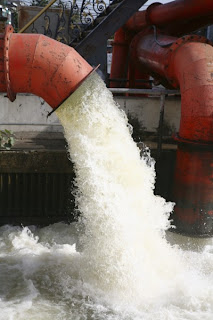
Other plants use an open loop or once-through water for their cooling, where water is drawn in continuously for cooling, then discharged back into the river or ocean. These discharges are almost always gravity flows rather than pumped, and these discharges of large amounts of water, running continuously in artificial channels, are perfect for Hydrovolts turbines to generate power, augmenting that made by the main part of the plant. Hydrovolts turbines can generate additional power at modest cost by harnessing these untapped flows; the electricity is sent via the existing transmission infrastructure.
Like most other artificial water flows in constructed waterways, little or no permitting is needed because environmental impacts are minimal. As a result, cost is low and speed of implementation is relatively rapid. This is a solution that lets us take a small, but quick step to a better energy future.
Labels:
Flipwing,
fossil fuel,
hydrokinetic,
Hydrovolts,
nuclear,
renewable energy
Tuesday, May 25, 2010
Scalable
The Hydrovolts Flipwing Turbine has many compelling advantages compared to other hydro turbines and to other kinds of electricity generators. It has many features, including being complete, compact, modular, safe, simple and scalable.
The Hydrovolts turbine is scalable in two fundamental ways.
First, the Hydrovolts turbine can be built in nearly any size, from very small to quite large. More importantly, the turbine's cross-axis design is rectangular, so it can be built in a broad range of different dimensions. Turbines can be built that are very wide but not very high, or they can be built more squarely. Propeller-type axial turbines always have a circular swept area, so they are ill-suited to water channels that are, for example, broad and shallow. Even with a cowling such turbines are not as adaptable because they cannot scale to arbitrary dimensions like the Hydrovolts turbine.
Second, the typical Hydrovolts turbine is a micro-scale device, and will generate 5-20kW in typical water flows. In very large channels multiple turbines can be deployed side-by-side in the channel, scaling up the power produced by deploying multiple turbines together. Where the water course is deep, turbines can also be positioned one above the other to take advantage of the height of the water column. Turbines can also be spaced one after the other down a water course. Even though any turbine slows the water as it extracts energy, gravity re-accelerates the water as the channel slopes away. Hydrovolts expects turbines typically can be placed 10 per mile, but the maximum rate will depend on the specific watercourse geometry.
Scalable is good. Power from Water.
Labels:
distributed generation,
Flipwing,
Hydrovolts,
renewable energy
Friday, May 14, 2010
At the McKinstry Innovation Center
We moved into the McKinstry Innovation Center on Monday and we're now mostly unpacked. It's a beautiful space--light, airy and spacious. I took a few pictures today that give perhaps a sense of our new office and the various shared workspaces.
The third floor lobby entrance--where innovation begins!
Labels:
Flipwing,
hydrokinetic,
Hydrovolts,
renewable energy,
Washington
Wednesday, May 12, 2010
Distributed Hydropower from Wastewater
The Hydrovolts Flipwing Turbine can generate power in man-made and natural watercourses of many kinds. The initial market is irrigation canals, and there are lots of others, including resource exploration, remote ocean sensors and military uses.
Because of the ingenious cross-axis design of the Flipwing, they can also generate power even in flows that are not clean, or even free of effluvia--flows like those found in sewer and wastewater systems in nearly every community.
There are 16,583 wastewater treatment plants in the United States serving nearly 3/4 of the population. There is growing interest in treating wastewater as a resource rather than something simply to be disposed. The biosolids have obvious application as fertilizer. The sludge can potentially be turned in to energy. Sewage can produce methane for fuel. Washington the Budd Inlet Treatment Plant has a pilot program to do just this. Treatment plant sites also lend themselves to solar installations. There are lots of ways to turn this waste into economic value.
Thursday, April 29, 2010
Distributed Hydropower for Remote Ocean Devices
There are many users who want to place electronic devices in remote ocean locations where power is not available from the electrical grid. These remote ocean devices (often sensors of some kind) are powered by batteries; however, today's state-of-the-art solutions are expensive and inconvenient.
For example, researchers at the University of Washington frequently want to deploy Acoustic Doppler Current Profilers (ADCPs) or other devices to take measurements under water over the course of weeks, months or longer. Running power through a cable from shore is impractical and costly, but the alternative actually used has a stiff price too: a disposable battery that costs $500 and lasts a mere 10 days, after which it must be replaced. In addition to the recurring cost of replacement batteries, there is the enormous cost of a boat and crew to do the replacement--often $1,000 per hour or more. In the deeper ocean farther form shore, boat costs can easily top $100,000 per day.
For small ocean power, the Hydrovolts turbine paired with a rechargeable battery replaces the current disposable battery solution, providing a capital ROI of substantially less than one year.
Sunday, April 25, 2010
Compact
The Hydrovolts Flipwing Turbine is designed to be complete, compact, modular, safe, simple and scalable.
I previously posted about how it is simple and complete.
It's also a compact solution. Other hydrokinetic turbines for micro-generation (i.e. less than 100kW) are much less so. Almost all use some kind of raft and place their generator and electronics above the water line. This solves one problem--how to keep the electronics dry--but introduces others:
Compact is good. Power from Water.
I previously posted about how it is simple and complete.
It's also a compact solution. Other hydrokinetic turbines for micro-generation (i.e. less than 100kW) are much less so. Almost all use some kind of raft and place their generator and electronics above the water line. This solves one problem--how to keep the electronics dry--but introduces others:
- Transmission--The rotor under water must somehow connect to the generator above it. Shafts, belts or chains can be used, but all have drawbacks, including efficiency loss, added maintenance burden, additional points of failure, and more mechanism that can entrain debris or become fouled.
- Efficiency--Vertical axis turbines with a lift design, (e.g. a Darrieus turbine) lose efficiency unless they are perfectly vertical, However, extending the shaft to the surface makes maintaining vertical alignment nearly impossible.
- Adaptability--By using a raft, other turbines must be sited close to the surface.
- Cost--Additional materials and a larger design add to the cost to build, to transport, and to deploy.
- Sustainability--The added cost is not just in money, but also in embodied energy and carbon footprint.
Compact is good. Power from Water.
Labels:
Flipwing,
hydrokinetic,
Hydrovolts,
renewable energy
Tuesday, April 20, 2010
Hydrovolts RFP
Yesterday we put out an RFP for the design and realization of a sensor system on our Alpha-1C prototype.
Summary:
Summary:
Hydrovolts is seeking a Contractor to design and install sensor and data collection capability on a submersible hydrokinetic turbine to measure rotor torque and rpm while operating in water flow rates between 1 and 8 knots of current speed. The deadline for Proposals is April 30, 2010 and the selected Proposal will be announced May 3, 2010 with work to begin immediately.We expect a lot more work of this kind in the future as well; the ideal solution will be reusable on this and future machines. See the RFP for more details or contact Hydrovolts Director of Engineering' Brian Peithman at 206-336-5560.
Thursday, April 8, 2010
Complete
The Hydrovolts Flipwing Turbine is designed to be complete, compact, modular, safe, simple and scalable.
I previously posted about how it is simple.
It's also a complete, ready-to-use product right out of the box. Part of simple deployment, as I wrote last time, is not needing a lot of assembly or complicated hook-ups to other components. The Hydrovolts turbine arrives with all parts necessary to make power. The power cable that comes out of the turbine provides 110V or 220V depending on the prevailing standard. It can be wired straight into an electrical panel. We can even provide it with a simple power strip on the end!
It's complete in the same way that a diesel generator bought from the hardware store is. You buy it, bring it home, start it up, and start plugging things into it. Actually, it's even more complete than that: you never need to bother with fuel.
Complete is good. Power from Water.
Tuesday, March 16, 2010
Hydropower Potential - III
There is significant untapped potential for hydropower around the world, including in the UK and in Europe more generally. There's also great potential in the United States.
In 2006 the US Department of Energy (DOE) Hydropower Division conducted an assessment of the potential for new micro and small hydropower across the USA.The assessment is based on traditional hydropower potential, not hydrokinetic potential, but the values are useful to note. DOE has identified over 500,000 sites with enough water volume and head that can each generate at least 10kW, and DOE has even mapped them online for every state with its Virtual Hydropower Prospector tool. DOE further overlaid various feasibility criteria in its maps and identified approximately 130,000 sites meeting the criteria. At least 20% of these sites would be suitable for at least one Hydrovolts turbine, for a total of 26,000 sites and at least that many turbines.
Saturday, March 13, 2010
Simple
The Hydrovolts Flipwing Turbine is designed to be complete, compact, modular, safe, simple and scalable.
There are several aspects of being simple:
For your amusement, a satirical look at the perils of (large) corporations trying to do a simple design without having a simple objective in mind:
There are several aspects of being simple:
- Simple design. The Flipwing is composed of 4 basic components: the rotor, the generator, the electronics, and the deployment. Each component is built with a minimum of materials and designed to accomplish its sole primary function; respectively: spinning, converting kinetic energy to electricity, making the electricity usable, and keeping the turbine optimally positioned.
- Simple deployment. Being a self-contained floating unit, the Flipwing can be deployed in as little as an hour, and removed just as easily. Hook-up to equipment or to the grid uses equipment and procedures pioneered and long-used by small wind, solar and fossil fuel generators.
- Simple maintenance. Since it easily taken in and out, the Flipwing can be out of the water for routine maintenance and back in without significant downtime. The simple design allows routine cleaning and lubrication to be done using common hand tools and off-the-shelf supplies and equipment.
- Simple value. The Flipwing makes continuous, low-cost and immediately usable power, solving a basic need for business, communities and individuals world-wide.
For your amusement, a satirical look at the perils of (large) corporations trying to do a simple design without having a simple objective in mind:
(h/t Polizeros)
Wednesday, March 10, 2010
Hydropower Potential - II
The potential for Hydropower is enormous throughout the world, including in Europe. France, Italy and Norway have especially good hydropower resources, as does Turkey, from which we have had several purchase and distributor inquiries for turbines. But other countries have great potential too--like in the UK:
A study commissioned by the Government body has concluded that there is vast untapped potential across the England and Wales for generating energy from rivers.
Waterways in Wales, the upper reaches of the Thames, the Humber, the Aire, Severn and the Mersey have been identified as having the most potential.
Labels:
distributed generation,
energy policy,
environment,
Flipwing,
France,
Italy,
Norway,
renewable energy,
Turkey,
UK
Monday, March 1, 2010
The Hydrovolts Turbine - VII
The Hydrovolts Flipwing Turbine had a very successful coming out at the Harvesting Clean Energy Conference a few weeks ago. So, where does it go next?
Moving into the McKinstry Innovation Center in a few months is exciting, but another great reason to be there is the football field-sized workshop just downstairs. We decided there's no reason to wait until May, so we took the turbine straight from the show to the shop.
The talented staff at McKinstry got right to work.
Moving into the McKinstry Innovation Center in a few months is exciting, but another great reason to be there is the football field-sized workshop just downstairs. We decided there's no reason to wait until May, so we took the turbine straight from the show to the shop.
Hydrovolts COO Chris Leyerle arrives at McKinstry
after the drive from Kennewick with the Hydrovolts Flipwing Turbine
The talented staff at McKinstry got right to work.
Labels:
Flipwing,
hydrokinetic,
renewable energy,
Washington
Tuesday, February 16, 2010
Hydropower Potential
Hydrovolts plans to install its first turbines in irrigation canals and other mandmade fresh water flows. There are many other large markets for hydrokinetic technology, including natural rivers and streams throughout the world. Small scale hydropower in the developing world has enormous potential to improve the health, education and quality of life for millions of people. Yet there is also huge potential for Hydrovolts turbines in western industrialized countries:
Graphic: Hugo Ahlenius, UNEP/GRID-Arendal
Thursday, February 11, 2010
HCE Day 3
The Harvesting Clean Energy Conference ended Tuesday. It was an excellent event and I and the rest of the Hydrovolts team really enjoyed ourselves. We made many good contacts and heard from many interesting speakers. The general proceedings finished around mid-day on Tuesday and attendees scattered to one of several field trips.
I regret I missed virtually all of the Tuesday morning talks and sessions and so cannot much report on them. Instead of the conference, I drove 45 minutes away to meet with am irrigation district that has expressed some interest in hosting a demonstration. The meeting with the Board of Commissioners went well, and they asked many good questions. An announcement on this soon, perhaps.
I heard from a friend that Conference Emcee Hal Calborn gave Hydrovolts a shout-out from the podium before the morning keynote as a Cleantech Open winner. We had several people come ask us about the Cleantech Open. I strongly encourage entrepreneurs to enter this year and others to volunteer their time and expertise. Being a part of the Cleantech Open has paid and continues to pay enormous dividends to Hydrovolts.
Thanks, Hal!
My notes from earlier in the conference: Day 1 and Day 2.
As things were winding down I heard that this might be the last year for the Conference. Only 10 years and already at the end? Say it ain't so! We'll be back next year, and that was what I heard from a lot of others as well. Why argue with success?
Tuesday afternoon Brian Peithman ("the Hydrovolts Engineering Department") and I made sure the Flipwing Turbine demonstration unit was properly secured to the flat-bed truck and I drove it back west. The turbine spent the night parked in front of my house in Bellevue's Somerset neighborhood, where it aroused some interest from the neighbors. A few had heard it about from the TV, and had many questions, including whether it was going to stay on the street for a while. Yesterday morning, however, I drove it to its new home, a great location with great resources and great people, and where we will be able to advance the Hydrovolts mission dramatically. I can't say just yet more about this, but look for an announcement next week.
Friday, February 5, 2010
The Hydrovolts Turbine - VI
The Hydrovolts Flipwing Turbine demonstration unit has had a couple of in-water tests and made power over the past few weeks. Testing was done in the Ballard ship canal under tow to simulate the turbine in water flows of different velocities.
We put casters on the bottom so we could wheel it down the road from the shop at SteadyFlux, and right down the boat ramp into the water. After ballasting the tanks and maneuvering the boat, we were underway on the first tow test:
Thursday, January 28, 2010
Broad Agreement on Supporting Hydrokinetic Power
Hydrovolts CEO Burt Hamner was one of several leaders to testify yesterday before the Washington State House Technology, Energy & Communications (TEC) Committee on HB 2869 [pdf]. The bill would provide "an investment cost recovery incentive for hydrokinetic energy" as we reported last week.
Organizations that frequently stake out opposing positions were united in their support. It's rare that utilities, business advocacy groups and environmental groups all agree, but it happened in Olympia as Puget Sound Energy, The Association of Washington Business and Climate Solutions all spoke in favor.
Members of the TEC appeared broadly supportive of the measure. If all goes well, HB 2869 will be reported out of the committee next week, and will be sent on to the House Ways and Means Committee.
Contact your state legislators and ask them to support HB 2869, and please forward this message to other supporters of renewable energy and ask for their support as well.
UPDATE: fixed typo
Saturday, January 23, 2010
The Hydrovolts Turbine - V
Work is well along on the full-size Hydrovolts Flipwing demonstration unit shown in the video made by King5 news last week. More pictures:
The box-like structure is hermetically sealed, and will provide buoyancy, allowing the turbine to float in the water.
The flotation end cap has not been attached to this end.
The four rings at the corners of the frames will be used to tow the unit through the water at carefully regulated speeds, simulating the performance of the turbine when fixed in position in a watercourse flowing at those same speeds. The data will be used for further power optimization.
Temporary struts and cords hold some of the Flipwing blades up or open to show how they will move in position when in a water current. The middle and bottom blades are shown flipped open.
Tow tests are scheduled for this week.
More video of various turbine tests can be found on the Hydrovolts YouTube channel.
Learn more about the Hydrovolts Flipwing turbine on our web site or other posts in this blog.
Wednesday, January 20, 2010
Washington Production Incentives for Hydrokinetic Power

Under HB 2869 canals in Washington State could generate renewable energy from Hydrovolts turbines with a capital payback of less than 2 years
Representative John McCoy, Chair of the Washington House Technology, Energy & Communications (TEC) Committee has introduced HB 2869 [pdf], to provide "an investment cost recovery incentive for hydrokinetic energy." Similar incentives are currently only available for electricity generation from solar and wind.
The bill would amend the language of RCW 82.16.110-120 to add a hydrokinetic energy system manufactured in Washington State to the list of sources of "customer-generated electricity" that qualify for the incentive program. According to the bill, a "hydrokinetic energy system" means
a device that generates electricity from waves or directly from the flow of water in ocean currents, tides, inland waterways, nonfish-bearing canals, or irrigation districts, that does not require the impoundment or diversion of water. [emphasis added]The proposed hydrokinetic incentives are $0.15/kWh for hydrokinetic energy systems, and increasing to $0.36/kWh if manufactured in Washington State. Since the maximum benefit per installing customer is $5,000 per year; the impact on utilities will be relatively minor for several years at least.
The benefit to customers would be significant, accelerating the typical capital payback period from a Hydrovolts turbine from 4 years to less than 2.
These incentives would be available until June 30, 2020, the same as from other sources, unless extended.
The bill has been referred to the TEC Committee, and a public hearing is scheduled for January 27. The legislature in Olympia has an extremely heavy lift ahead of it to bridge a multi-billion dollar budget gap, which means many other worthy bills will struggle for attention. This bill is one that merits consideration and enactment, since its budget cost is de minimus and the benefits in stimulating clean technology, sustainability and job creation are compelling.
Please contact your state legislators and urge support for this worthy legislation, and forward this message to other supporters of renewable energy and ask for their support as well.
UPDATE: fixed wacky formatting issues
Monday, January 18, 2010
Hydrovolts Featured on Seattle's KING 5 TV
Local NBC affiliate KING 5 television broadcast a 2-minute piece on Hydrovolts during this evening's newscast:
Environmental reporter Gary Chittim interviewed Hydrovolts CEO and Co-founder Burt Hamner Thursday in Ballard. As seen in the video, Burt manually turns the Company's small prototype to show how the spinning rotor can make power, in this case to light a conventional 60-watt bulb. Laughs Burt, "I feel like a trained seal!" In the water the turbine spins continuously, and power output is much more stable.
Hydrovolts Director of Engineering Brian Peithman is also shown with the small prototype during an in-water test from last summer. With the larger demonstration unit Burt explains the Flipwing's blade configuration which allows it to spin underwater. Hydrovolts advisor and UW Professor Bruce Adee shows the test tank that he and some of his students used for measurement and performance validation.
The demonstration unit is being built under contract with Steady Flux, and will undergo initial in-water tests within the week.
More video of various turbine tests can be found on the Hydrovolts YouTube channel.
Learn more about the Hydrovolts Flipwing turbine on our web site or other posts in this blog.
Environmental reporter Gary Chittim interviewed Hydrovolts CEO and Co-founder Burt Hamner Thursday in Ballard. As seen in the video, Burt manually turns the Company's small prototype to show how the spinning rotor can make power, in this case to light a conventional 60-watt bulb. Laughs Burt, "I feel like a trained seal!" In the water the turbine spins continuously, and power output is much more stable.
Hydrovolts Director of Engineering Brian Peithman is also shown with the small prototype during an in-water test from last summer. With the larger demonstration unit Burt explains the Flipwing's blade configuration which allows it to spin underwater. Hydrovolts advisor and UW Professor Bruce Adee shows the test tank that he and some of his students used for measurement and performance validation.
Hydrovolts CEO Burt Hamner crouches to check the hinge mechanism
of one of the Flipwing rotor blades. Steady Flux principal Brian Bloudek
and Hydrovolts Director of Engineering Brian Peithman look on.
of one of the Flipwing rotor blades. Steady Flux principal Brian Bloudek
and Hydrovolts Director of Engineering Brian Peithman look on.
The demonstration unit is being built under contract with Steady Flux, and will undergo initial in-water tests within the week.
More video of various turbine tests can be found on the Hydrovolts YouTube channel.
Learn more about the Hydrovolts Flipwing turbine on our web site or other posts in this blog.
Labels:
canals,
Flipwing,
hydrokinetic,
India,
renewable energy
Subscribe to:
Posts (Atom)