Showing posts with label sustainability. Show all posts

Thursday, June 10, 2010

Putting Litter to Use

Trash Hotel in Rome
A hotel made from trash:
The Corona Save the Beach Hotel, designed by German artist HA Schult, is open until June 7 near Rome's Castel Sant'Angelo, which is located along the Tiber river.
This is not Schult's first such effort:
"In the ocean, the trash from all continents meets one another. The trash from Africa meets the trash from Europe, meets the trash from South America," Schult said, pointing to the guitars and shoes plastered across the building.

"The environmental problem is a global problem. We are living in a planet of garbage," said Schult, whose most famous work is "Trash People," an installation of 1,000 human figures made out of trash.

"Trash People" was installed under the Brooklyn Bridge in New York, in front of the Giza Pyramids in Egypt, in Red Square in Moscow, at La Defense in Paris, and along the Great Wall of China.

Sunday, June 6, 2010

Permitting Insanity

Cape Wind location
Why does it take more than 9 years and endless anguish to allow wind turbines in Nantucket Sound, but deepwater oil drilling routinely has environmental impact studies waived, supposedly because massive oil spills are unlikely? The oil industry has received approvals with potentially severe environmental impacts in as little as 10 minutes. Contrast the (over-)abundance of caution for wind and the cozy practice of superficial scrutiny for oil. Recent events make the dissonance especially jarring.

The Cape Wind offshore wind farm is closer than ever to the start of construction. Just more than a week after the explosion of BP's Deepwater Horizon platform, US Interior Secretary Ken Salazar gave formal approval, saying:
After careful consideration of all the concerns expressed during the lengthy review and consultation process and thorough analyses of the many factors involved, I find that the public benefits weigh in favor of approving the Cape Wind project at the Horseshoe Shoal location. With this decision we are beginning a new direction in our Nation’s energy future, ushering in America’s first offshore wind energy facility and opening a new chapter in the history of this region.

Saturday, May 22, 2010

Deepwater Horizon Causes and Lessons

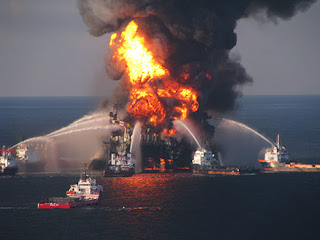
Deepwater Horizon oil platform on fire
Many investigations lie ahead. President Obama has appointed a commission of inquiry. Industry shills have been hard at work for a month, unhampered by pesky facts. In the interim one of the most detailed analyses I have yet seen is posted at The Oil Drum. The author, a long-time oil and gas geologist, notes that the causes and lessons may change as more facts come to light. The analysis is aided by contibutions from offshore oil industry engineers, bit is also colored in its conclusions by their understandable bias towards perpetuating the industry that sustains their professional standing and provides their economic livelihood.

The principal conclusion pulls no punches:
What can be addressed now is the larger issue that a flawed, risky well plan for the MC 252 well was approved by the MMS, and BP, Anadarko and Mitsui management. Similar or identical plans were undoubtedly approved and used by many operators on other wells drilled in the Gulf of Mexico. A plan that does not include enough cement to overlap the final and previous casing strings, and that does not require running a cement-bond log to ensure the integrity of the seal is a defective plan. The fact that there have not been blowouts on previous wells does not justify the approval and use of an unsafe plan.
Similar or identical plans. There are currently 3,858 other offshore platforms in the Gulf of Mexico, each of which can have as many as 20 wells.

Offshore oil drilling is not the solution to our energy problems. It is a reckless attempt to perpetuate our failing energy system, a system which cannot be sustained. It stands in the way of advancing real energy solutions. Time grows short.

Thursday, May 20, 2010

Ice to Eskimos

Benson Bubbler in downtown Portland Oregon
In 2008 the average American consumed 30 gallons of bottled water, primarily from single-serving, single-use plastic bottles. That's 320 12-ounce bottles, or nearly one every day. It's obsessive.

There are many reasons not to drink bottled water.

Bottled water costs more than gasoline. It costs up to 10,000 times more than tap water. It uses 2,000 time as much energy. It has 100 times the life cycle costs.

Monday, May 10, 2010

Micro Loans for Micro Power

Installation of Solar Home System in Bangladesh
Hundreds of thousands of people have electricity because of distributed generation from small renewable energy systems financed by micro lending:
The Solar Home System (SHS) dissemination programme in Bangladesh is considered to be one of the most successful of its kind in the world, bringing power to rural areas where grid electricity supply is neither available nor expected in the medium term.
The program started in January 2005 and nearly 350,000 SHSs were installed by last summer, most of which had a rated power output of 50W. Systems came with 3-4 compact flourescent light bulbs. Owners benefit from lighting, especially in their kitchens and courtyards, and also use the systems to charge batteries, power radios, and even run 12V televisions. While statistics are lacking, it appears that some owners are using the power in their small stores and restaurants, boosting their income.

This is a great program beautifully suited to regions without existing electrical grid infrastructure, and has the potential to have a lasting and powerfully positive impact on the energy poverty that afflicts much of the developing world. Even small amounts of electricity can change lives for the better by providing lighting for reading, heating and cooking that doesn't burn nasty fuels with toxic byproducts, and the ability to create a business, boosting the local economy.

Such an approach could work with micro hydropower too.

Sunday, May 2, 2010

Laissez Failure

BP oil platform burns in the Gulf of Mexico
The slow-motion ecological catastrophe in the Gulf of Mexico is horrifying.

The oil slick is now the size of Ohio, and growing by the hour. Edges of it are now reaching land and all along the Gulf coast residents wait with deep foreboding and growing anger as the dimensions of the disaster become clear.

This is not an oil spill, but an oil spilling, as more ruptures from the sea floor, surfaces, and spreads its devastating reach towards shore. 40% of the coastal wetlands in the United States are under threat, as are the majority of the country's oyster and shrimp fisheries. Local fishermen have moved quickly through the 5 stages of grieving as they face the imminent destruction of their livelihood, economic security, their way of life, and their future.

Emergency response began quickly and broad efforts at mitigation are underway. The Obama Administration formed a National Response Team, Louisiana Governor Bobby Jindal is mobilizing the state's National Guard, and locals are taking to their boats to deploy booms to intercept the sprawling slick. Dealing with the immediate crisis is paramount now, yet soon hard questions must be asked, and honestly answered. The critical questions are:

Why did this happen? How do we prevent it happening again?

Friday, April 30, 2010

Hydrovolts is a B Corporation

Certified B Corporation Seal
Hydrovolts has achieved certification from B Labs as a B Corporation--one of only 285 companies in the United States, and one of only 10 in Washington State.

Certification as a B Corporation attests to the values of a business, including those summarized in the B Corporation Declaration of Interdependence:
We envision a new sector of the economy which harnesses the power of private enterprise to create public benefit.

This sector is comprised of a new type of corporation, the B Corporation, which is purpose-driven and creates benefit for all stakeholders, not just shareholders.

Thursday, April 22, 2010

Energy Security

Earth Day turned 40 today. For many Earth Day is an occasion to think green, hope for a less polluted future, advocate for renewable energy and perhaps push for a solution to climate change.

Others dismiss Earth Day as a symbol of mushy-minded ecomania that elevates the environment over the economy. It's a false choice, but the notion that doing something about the environment will cost the economy persists. Those who are skeptical about climate change are generally the same as those who are negative about renewable energy.

However, there are other reasons to support and promote renewable energy, and a big one is energy security. If it's renewable we don't need to rely on the supply of something like oil or uranium that has to come from somewhere else, possibly a country or region hostile to us.

Energy security matters. Most casualties in Iraq and Afghanistan come from the necessity of fuel transport--the supply chain is long and highly vulnerable.

Failing to make the speediest transition to renewable energy is bad policy for many reasons. It costs lives. It costs money. It funds those hostile to us. And it's futile, because the current energy model is not sustainable. Even the military recognizes that we need to get beyond oil because we're running out of the stuff.

Friday, April 16, 2010

Rapa Nui's Descent into Darkness

The moai, or stone heads of Easter Island
Many people insist, with all manner of justifications, that we can not, we should not, change the way we generate or use energy because we're not running out of oil, the climate isn't changing, and we aren't destroying our ecosystems everywhere one looks. Cornucopia forever.
What did the Easter Islander who cut down the last palm tree say while he was doing it?

[snip]

In fact, the question can be asked more broadly: “What were the thought processes and discussions amongst the inhabitants of Easter Island leading up to the removal of the last remnants of forest?” This could be seen, perhaps, as a hypothetical exploration, rooted in a real historical event, of “the psychology of resource depletion denial.”
A foreshadowing of the looming twilight of the Oil Age. The way of life on Easter Island wasn't negotiable either. The result?
As the forests shrunk in area and the annual percentage rate of depletion steadily increased, at some point, someone must have realised that the situation was not sustainable and said as much. The island is not that big and what was happening at one end would have been common knowledge at the other end.

Yet the inhabitants continued on. The forest dwindled to nothing and the soil washed away, depleted. Crop yields dropped. Felling trees destroyed animal habitat and then the animals. Food became scarce, leading to famine, inter-tribal warfare and eventually cannibalism. The population crashed in a mass die-off.

Tuesday, April 13, 2010

The World's Only Carbon-Negative Country

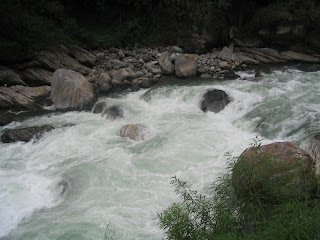
River in Bhutan
Low fossil fuel use and a strong policy to protect forests makes it unique:
Run on Buddhist principles of respect for nature, Bhutan is the only country among 194 U.N. members to have formally told the United Nations this year that it is now "climate negative" -- soaking up more greenhouse gases more than it emits.
Bhutan, a tiny Buddhist kingdom in the Himalayas is also noteworthy as the only country in the world that calculates its Gross National Happiness.

Tuesday, April 6, 2010

Arid Sea

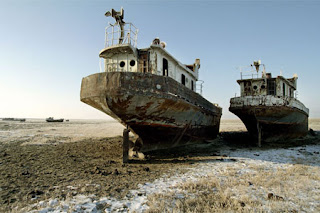
Abandoned and land-locked ships where the Aral Sea once was
How does one of the most massive bodies of water in the world vanish?

In the case of the Aral Sea, with sickening speed. What was once the world's 4th largest freshwater lake now is just 10% of its former size.

The causes are several: misguided economic development that ends up destroying, not creating jobs and economic vitality. Unsustainable practices. Grasping behaviors suggesting this may be an early harbinger of water wars to come.

Yet another example of the tragedy of the commons. The practices that are destroying the Aral Sea are not dissimilar to those that are destroying the oceans. Or the mountains. Or our climate.

Sunday, April 4, 2010

I Guess They Didn't Need a Weatherman

Strata SE1 artist's depiction of integrated wind turbines
Interesting.

A London developer will complete construction this June on the Strata SE1, which it claims "is the first development in the world where wind turbines have been integrated within the fabric of the building."

How much power will these turbines make?
The three five bladed nine metre diameter wind turbines are rated at 19kW each and are anticipated to produce 50MWh of electricity per year... approximately 8% of Strata SE1's estimated total energy consumption.
Hmm. To achieve 50MWh of output, the turbines must generate a continuous average over the year of about 1.9kW each. So Brookfield Europe, the developer, apparently infers that the actual generation will be a mere 10% of the "rated" output, which is really rather poor. A nice round figure of 10% also sounds like a guess:

Thursday, March 4, 2010

Who Speaks for Business?

Empty podiumtitl
Who speaks for business? Who advocates for business and articulates their views on public policy? Businesses and their leaders do of course. They just don't always speak with one voice.

For example, a recent survey commissioned by international renewable energy group NTR Foundation and conducted by the Brunswick Group found more than half of the largest US companies wanting an end to the ambiguity surrounding climate change legislation.
About 50 per cent of America’s top business leaders believe a lack of clarity on climate legislation is negatively impacting upon the ability of the US to compete in the global market.

Seventy per cent of the respondents said climate change would be an important part of their commercial decision-making within five years. But almost three in four of the business leaders said security of energy supply was a more “pressing issue” for them than climate change.

Saturday, February 13, 2010

Climate Insurance

Polar bears threatened by thaw across the Arctic
On Monday at the Harvesting Clean Energy Conference Claudio Stockle made the reasonable observation that the severely negative outcomes of climate change, if they occur which are happening everywhere one looks, demand action just for their possibility: it is "prudent to start taking some action, not to ignore it."

Just the day before Kurt Cobb made a similar point in discussing the need for "vigorous preparations" on climate change, even if the worst scenario is only 5% likely:
If you were told that the trans-Atlantic flight you were about to board only crashes 5 percent of the time, would you still board that plane? My guess is that you would change your reservations. Even with a 95 percent chance of surviving the flight, you would find the risk of death too high.

Thursday, January 28, 2010

Broad Agreement on Supporting Hydrokinetic Power

Hydrovolts CEO Burt Hamner was one of several leaders to testify yesterday before the Washington State House Technology, Energy & Communications (TEC) Committee on HB 2869 [pdf]. The bill would provide "an investment cost recovery incentive for hydrokinetic energy" as we reported last week.

Organizations that frequently stake out opposing positions were united in their support. It's rare that utilities, business advocacy groups and environmental groups all agree, but it happened in Olympia as Puget Sound Energy, The Association of Washington Business and Climate Solutions all spoke in favor.

Members of the TEC appeared broadly supportive of the measure. If all goes well, HB 2869 will be reported out of the committee next week, and will be sent on to the House Ways and Means Committee.

Contact your state legislators and ask them to support HB 2869, and please forward this message to other supporters of renewable energy and ask for their support as well.

UPDATE: fixed typo

Wednesday, January 20, 2010

Washington Production Incentives for Hydrokinetic Power


Under HB 2869 canals in Washington State could generate renewable energy from Hydrovolts turbines with a capital payback of less than 2 years

Representative John McCoy, Chair of the Washington House Technology, Energy & Communications (TEC) Committee has introduced HB 2869 [pdf], to provide "an investment cost recovery incentive for hydrokinetic energy." Similar incentives are currently only available for electricity generation from solar and wind.

The bill would amend the language of RCW 82.16.110-120 to add a hydrokinetic energy system manufactured in Washington State to the list of sources of "customer-generated electricity" that qualify for the incentive program. According to the bill, a "hydrokinetic energy system" means
a device that generates electricity from waves or directly from the flow of water in ocean currents, tides, inland waterways, nonfish-bearing canals, or irrigation districts, that does not require the impoundment or diversion of water. [emphasis added]
The proposed hydrokinetic incentives are $0.15/kWh for hydrokinetic energy systems, and increasing to $0.36/kWh if manufactured in Washington State. Since the maximum benefit per installing customer is $5,000 per year; the impact on utilities will be relatively minor for several years at least.

The benefit to customers would be significant, accelerating the typical capital payback period from a Hydrovolts turbine from 4 years to less than 2.

These incentives would be available until June 30, 2020, the same as from other sources, unless extended.

The bill has been referred to the TEC Committee, and a public hearing is scheduled for January 27. The legislature in Olympia has an extremely heavy lift ahead of it to bridge a multi-billion dollar budget gap, which means many other worthy bills will struggle for attention. This bill is one that merits consideration and enactment, since its budget cost is de minimus and the benefits in stimulating clean technology, sustainability and job creation are compelling.

Please contact your state legislators and urge support for this worthy legislation, and forward this message to other supporters of renewable energy and ask for their support as well.

UPDATE: fixed wacky formatting issues

Monday, January 11, 2010

Sustainability


Chris Leyerle and Burt Hamner receive the CTO National
Sustainability Award from CTO Sustainability Chair Julia Hu
and Michael Closson of CTO Founding Partner Acterra

One of the requirements of the Clean Tech Open business plan competition was a detailed sustainability section in the business plan. Hydrovolts won the Sustainability Award both at the regional level and national level in the competition.

Sustainability is not just in the product or the process of making it, but also in the broader impact on all stakeholders, including investors, employees, vendors and the communities in which each operate. A key part of sustainability is also in communicating to stakeholders and working collaboratively to share best practices as broadly as possible.

In that spirit we are pleased to make the award-winning sustainability portion of our business plan available for review and, we hope, inspire others in their sustainability efforts.

Download the PDF here.

We welcome comments, questions and suggestions on how to make it better.

Saturday, December 19, 2009

Distributed Hydropower for Resource Exploration


Hydrovolts turbines provide distributed generation from hydropower, a great benefit to those who live in remote areas where no grid exists to deliver centrally produced electricity. These people need a distributed, i.e. locally produced and used, energy generation technology which works when and where they need it, and is portable, rugged, and cost-effective.

Another example of an off-grid need for electricity is remote resource exploration, such as for mining. Almost all mining operations use quite a bit of water; feasibility of a particular mine site is dependent in part on the availability of a reliable water supply, generally from a natural watercourse such as a river. Consequently, such sites are well-suited for power generation using a Hydrovolts turbine.

The existing solution in almost all cases is a diesel generator. It has the advantage of providing steady power when and where needed, but has several serious drawbacks, including smell and noise, but most especially cost. In most remote locations the fuel must be brought in by truck, sometimes on very bad roads that can take days to navigate. In extreme cases, fuel must be flown in by helicopter. As a result, the effective cost of the generated electricity can be $1.00/kWh and up, compared to the average US retail price of $0.11/kWh, and less than $0.02/kWh from a Hydrovolts turbine.

Many companies engaged in resource exploration, including mining companies, are acutely sensitive to the needs and values of the communities in which they operate. Commonly such companies will build infrastructure (sometimes as part of their operations) which they will leave to community ownership upon project completion. According to one potential Hydrovolts customer, such infrastructure helps satisfy the "social license" companies crave to smooth the acceptance of their operations by local populations. In creating a "prideful and positive experience" they gain support of communities, reduce conflict and lower costs. Mining companies seek a social license when starting a new project or entering a new community not only because it is a best practice in sustainability, but because it increases the prospects for a successful project:
In 2003 Pierre Lassonde drew attention to the observation that “Without local community support, your project is going nowhere.” He described social license as “…the acceptance and belief by society, and specifically our local communities, in the value creation of our activities, such as we are allowed to access and extract mineral resources. … You don’t get your social licence by going to a government ministry and making an application or simply paying a fee. … It requires far more than money to truly become part of the communities in which you operate” (Lassonde 2003). A primary objective of gaining a Social License is to minimize project risk.
Hydrovolts turbines are an excellent choice for mining companies in the exploration phase of projects, as they are easily and rapidly deployed at modest cost. Hydrovolts turbines in larger numbers are also appropriate to the production phase, where they can save in overall capital costs as well as reduce costs during operation. Companies leaving the turbines behind for community would cement the social license and generate the goodwill and positive reputation that could aid in future projects. Creative partnering may also allow sharing the capital cost with NGOs or even the community itself.