Showing posts with label wind. Show all posts

Sunday, June 6, 2010

Permitting Insanity

Cape Wind location
Why does it take more than 9 years and endless anguish to allow wind turbines in Nantucket Sound, but deepwater oil drilling routinely has environmental impact studies waived, supposedly because massive oil spills are unlikely? The oil industry has received approvals with potentially severe environmental impacts in as little as 10 minutes. Contrast the (over-)abundance of caution for wind and the cozy practice of superficial scrutiny for oil. Recent events make the dissonance especially jarring.

The Cape Wind offshore wind farm is closer than ever to the start of construction. Just more than a week after the explosion of BP's Deepwater Horizon platform, US Interior Secretary Ken Salazar gave formal approval, saying:
After careful consideration of all the concerns expressed during the lengthy review and consultation process and thorough analyses of the many factors involved, I find that the public benefits weigh in favor of approving the Cape Wind project at the Horseshoe Shoal location. With this decision we are beginning a new direction in our Nation’s energy future, ushering in America’s first offshore wind energy facility and opening a new chapter in the history of this region.

Friday, June 4, 2010

Hydropower Potential - IV

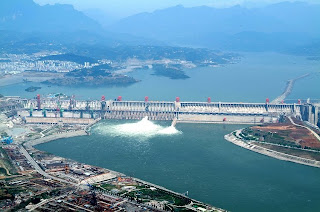
China's Three Gorges Dam, largest hydropower facility in the world
Alternative Energy eTrack aggregates multiple databases, news sources, insight from industry executives and other sources to produce data on the potential of various kinds of renewable energy. While the service is by subscription, some of the data sometimes appears elsewhere. For example, take this list of the top 10 countries for hydropower:
1. China - 179,056 MW
2. Brazil - 81,955 MW
3. United States - 78,054 MW
4. Canada - 75,287 MW
5. Russia - 46,756 MW
6. India - 39,546 MW
7. Norway - 29,317 MW
8. Japan - 22,089 MW
9. France - 20,850 MW
10. Sweden - 16,266 MW
It's interesting data for several reasons.

First, China's capacity is more than double that of the number two country, Brazil.

Second, all of the so-called BRIC countries (Brazil, Russia, India, and China) are in the top six; there is a good correlation of the world's fast-growing and significant economies with hydropower capacity to supply the electrical power these countries need to sustain their growth. The significant investment in renewable generation merits recognition at least as much as the opprobrium over their investment in dirty fossil energy.

Third, hydro dwarfs other renewables in the US, with only wind at the same order of magnitude:
Wind 35,296 MW
Biomass 9,391 MW
Geothermal 3,153 MW
Solar (PV) 1,488 MW
Biogas 1,047 MW
Solar (CSP) 900 MW
Fourth, comparing this data to the capacities cited by the US Energy Information Administration (EIA) shows that there has been little added hydro capacity since 2008, the last year available, but a healthy increase in wind capacity and substantial percentage increases in solar and biomass/biogas.

Finally, comparing these numbers to the overall US generating capacity of just more than a terrawatt (1,000,000 MW) shows how relatively paltry is the contribution of renewable sources to our electrical generation.

There is still a long way to go.

Sunday, May 2, 2010

Laissez Failure

BP oil platform burns in the Gulf of Mexico
The slow-motion ecological catastrophe in the Gulf of Mexico is horrifying.

The oil slick is now the size of Ohio, and growing by the hour. Edges of it are now reaching land and all along the Gulf coast residents wait with deep foreboding and growing anger as the dimensions of the disaster become clear.

This is not an oil spill, but an oil spilling, as more ruptures from the sea floor, surfaces, and spreads its devastating reach towards shore. 40% of the coastal wetlands in the United States are under threat, as are the majority of the country's oyster and shrimp fisheries. Local fishermen have moved quickly through the 5 stages of grieving as they face the imminent destruction of their livelihood, economic security, their way of life, and their future.

Emergency response began quickly and broad efforts at mitigation are underway. The Obama Administration formed a National Response Team, Louisiana Governor Bobby Jindal is mobilizing the state's National Guard, and locals are taking to their boats to deploy booms to intercept the sprawling slick. Dealing with the immediate crisis is paramount now, yet soon hard questions must be asked, and honestly answered. The critical questions are:

Why did this happen? How do we prevent it happening again?

Thursday, April 29, 2010

Distributed Hydropower for Remote Ocean Devices

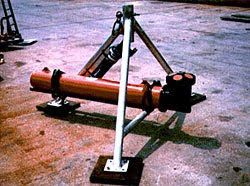
Acoustic Doppler Current Profiler
There are many users who want to place electronic devices in remote ocean locations where power is not available from the electrical grid. These remote ocean devices (often sensors of some kind) are powered by batteries; however, today's state-of-the-art solutions are expensive and inconvenient.

For example, researchers at the University of Washington frequently want to deploy Acoustic Doppler Current Profilers (ADCPs) or other devices to take measurements under water over the course of weeks, months or longer. Running power through a cable from shore is impractical and costly, but the alternative actually used has a stiff price too: a disposable battery that costs $500 and lasts a mere 10 days, after which it must be replaced. In addition to the recurring cost of replacement batteries, there is the enormous cost of a boat and crew to do the replacement--often $1,000 per hour or more. In the deeper ocean farther form shore, boat costs can easily top $100,000 per day.

For small ocean power, the Hydrovolts turbine paired with a rechargeable battery replaces the current disposable battery solution, providing a capital ROI of substantially less than one year.

Sunday, April 4, 2010

I Guess They Didn't Need a Weatherman

Strata SE1 artist's depiction of integrated wind turbines
Interesting.

A London developer will complete construction this June on the Strata SE1, which it claims "is the first development in the world where wind turbines have been integrated within the fabric of the building."

How much power will these turbines make?
The three five bladed nine metre diameter wind turbines are rated at 19kW each and are anticipated to produce 50MWh of electricity per year... approximately 8% of Strata SE1's estimated total energy consumption.
Hmm. To achieve 50MWh of output, the turbines must generate a continuous average over the year of about 1.9kW each. So Brookfield Europe, the developer, apparently infers that the actual generation will be a mere 10% of the "rated" output, which is really rather poor. A nice round figure of 10% also sounds like a guess:

Wednesday, March 31, 2010

Our Energy Future - II

Peak Oil graph
Where will our energy come from in the future? Peak oil is upon us, even if the exact date is not yet conclusively known. Nuclear power is at best a transitional step, and quite costly when factoring in construction and external costs. What's left?

How about 100% from renewable sources? A new report by PriceWaterhouseCoopers suggests Europe could be powered entirely by renewable sources, albeit at substantial cost of transition, especially on inter-continental transmission:
A "super-smart" grid powered by solar farms in North Africa, wind farms in northern Europe and the North Sea, hydro-electric from Scandinavia and the Alps and a complement of biomass and marine could render carbon-based fuels obsolete for electricity by 2050, said the report.

The goal is achievable even without the use of nuclear energy, the mainstay of electricity in France.
While the costs and challenges are great, those of clinging to the fossil economy would be much greater. But what is remarkable, of course, is that the modern industrial economy of Europe, roughly the same size as that of the United States, could be run entirely on renewable energy.

Thus, today's announcement by President Obama to expand off-shore oil drilling in the United States is especially disappointing.

Wednesday, January 27, 2010

Electricity in the Developing World

The need for electricity throughout the developing world is immense and will continue to grow. Unlike in the industrialized countries, much of the developing world does not have large centralized power plants and transmission lines to carry that power to widely-spread users. Nor are they likely to ever have such a system:
Building out the power grid can be prohibitively expensive, which is why in many countries, like Haiti, less than three quarters of the population have grid access. Pike Research’s Clint Wheelock says just for the transmission portion alone it can cost at least $500,000 per mile. And that’s without the distribution portion and any kind of the grid intelligence (smart grid) that is getting all of the investment this year.

Monday, February 9, 2009

Technology Won't Save Us This Time

Let's look through the seat cushions nextFor a while many of us thought (hoped) that renewable energy would remain a bright spot of investment and innovation, even as other sectors of the economy stagnated, shriveled or sickened. However, the broader economic disease is spreading and renewable energy companies have caught the contagion.

Finavera has seemingly exited the wave energy business, a direct result of the lack of partners and especially funding for the AquaBuOY technology it acquired from Seattle-area AquaEnergy years ago.

After blowing hot and cold for the six months, the the wind industry has now joined the downturn.

Now Bluewater Wind is on the ropes following news that its parent company, Australian conglomerate Babcock and Brown is being forced into liquidation. After a lengthy and tempestuous courtship, Bluewatwer inked the first power purchase agreement (PPA) for offshore wind just this past summer with Delmarva, at a price of less than $0.11/kWh. While there is no word (yet) about the future of Bluewater, the Delmarva deal, or the PPA for the project, their collective future appears dim, another domino in the continuing unwinding. How the project could have ever been feasible at that astonishingly low rate will now likely never be known.

The lack of constancy on tax incentives (like the PTC) has been a drag on renewable energy investment for many years. Without the certainty of those incentives key financing strategies such as flip LLCs [pdf] become too risky, and the tax equity investors pull out. Without these investors renewable energy deals don't get done:

The pool of so-called "tax equity investors" has dwindled to around a half-dozen, from more than 20 in 2007. Key players such as Merrill Lynch and Lehman Brothers no longer exist. Others, including the likes of John Deere (DE) and Prudential (PRU), have backed out of the market, if only temporarily, according to research by Hudson Clean Energy, a private equity firm specializing in green energy. "This will be a constraining factor because the population of sophisticated buyers for these credits is too small," says Oerlikon's O'Brien.

The shortage of buyers couldn't have come at a worse time. To hit Obama's goals for new renewable energy, the industry will have to mobilize far more capital than it has had to before. This year, the tax equity market is expected to hit $11.1 billion and would have to rise to around $43 billion in 2012 to build all the capacity being called for. Yet in 2007, when the market had more than 20 buyers, investors bought up $5.4 billion in tax equity. Last year, just eight investors handled about $5.5 billion in 2008. "Between now and 2012, [tax equity] markets would have to grow four- or fivefold," says Arno Harris, CEO of Recurrent Energy, a renewables developer in San Francisco.

The ecosystem of creative fast-growing technology companies have pulled the economy out of the last several recessions:

In the 1970s microchips helped jump-start the economy. In the 1980s personal computers unleashed a wave of consumer and business spending. And in the 1990s the Internet gained steam just when the economy was at its bleakest, creating new companies, jobs, and investment opportunities. Even in 2001, when hundreds of dot-com companies went bust in the space of a year, a couple of guys were already working on a startup that would make money on web searches. (That would be Google.)

Technology won't save us this time, at least not all by itself, because of the tumorous growth of dysfunction in the core structures of the economy. Renewable energy could be the engine to lead the recovery, but first there must be capital investment. Attempts to "unfreeze" the credit markets have been a dismal failure, and further (but wiser) efforts in that direction, while worthy, will be insufficient. Tax cuts, refundable credits and such ilk are not the answer. A direct injection of capital to the renewable energy sector is essential for the inextricably linked needs of our future energy and economic health.

There is no time to waste; this is not a typical recession.

Sunday, February 8, 2009

Finavera Waves Goodbye

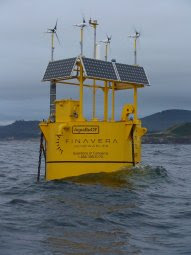
Finavera AquaBuOYFinavera Renewables appears to have given up on wave energy, focusing instead on its more successful wind project development business.

Friday it announced that it is abandoning its Makah Bay wave project off Washington state. According to the company's press release [pdf]:

The decision allows the Company to focus its resources on enhancing its near-term wind project portfolio and provide shareholders with a clearer path to revenue in this challenging economic environment.
The company goes on to say that it is "actively" seeking financial and technical partners for its AquaBuOY technology and is retaining all its intellectual property rights. However, after the unfortunate sinking of the AquaBuOY near Reedsport, Oregon in November 2007, and the rejection by the California Public Utilities Commission of its Humboldt County project in October last year, this week's news leaves Finavera with little motion on the wave front.

MendoCoastCurrent reports that the Company requested it be allowed to surrender its license for the project back to the Federal Energy Regulatory Commission (FERC). The reason cited by the company reflected a lack of investor and partner confidence:
Due to the current economic climate and the restrictions on capital necessary to continue development of this early-stage experimental Project, the Project has become uneconomic. Efforts by Finavera to transfer the license were not successful. Therefore, Finavera respectfully requests that the Commission allow it to surrender its license for the Project.

The investment prospects for Finavera have undulated plenty over the years. In November Finavera announced a private placement of equity primarily for its wind business and shortly after struck a deal with GE to arrange financing for some of its BC wind projects. The extension of its previously issued and now underwater warrants strongly suggested investor impatience with the pace and direction of the company's progress.

In its press release Finavera concludes by clarifying its plans as a company:

The immediate primary focus remains the continued development of the Company’s wind projects in BC and Ireland through partnerships and/or joint venture arrangements. In the medium term, the Company plans to execute on its project finance agreements and bring the wind energy assets to commercial operation. In the longer term, the Company will continue to assemble a diversified mix of revenue producing, renewable energy assets.

Only "in the longer term" would the company pursue anything other than wind. If there are no internal prospects and no external partners for the AquaBuOY technology, then development will likely cease, clearing the way for competitors such as the Pelamis, already in commercial operation, to prevail.

Thursday, February 5, 2009

Wind Gusts

GNU public licenseMassive loans are necessary to finance renewable energy projects, particularly for wind, and such loans are in very short supply. The resultant slowing presages a serious loss of industry momentum, from which restarting may be costly, lengthy, and difficult. Immediate action is urgently needed to prevent a serious stall.

Many projects have consequently been postponed or cancelled, and the pall is now spreading through the supply chain:

“I thought if there was any industry that was bulletproof, it was that industry,” said Rich Mattern, the mayor of West Fargo, N.D., where DMI Industries of Fargo operates a plant that makes towers for wind turbines. Though the flat Dakotas are among the best places in the world for wind farms, DMI recently announced a cut of about 20 percent of its work force because of falling sales.
World wind turbine leader Vestas recently announced it had 15% excess manufacturing capacity due to slowing orders. The change happened quickly according to Ditlev Engel, the Danish company's chief executive:

"Six months ago everyone (in the investment community) said we were not doing enough to meet demand growing at an expected 40% this year. "Now people are saying 'Why have you put in place plans for a 40% increase in capacity when growth levels are only going to be 25%?'," he explained.
After the election of Barack Obama, there was a great rush to ramp up in the United States, due to expectations of a wind boom based on the rhetoric of the campaign. The bankers, however, despite an historically broad spread between their borrowing and lending rates, are simply not lending.

The change in economic climate has spurred layoffs at Clipper Wind, the second-largest US turbine manufacturer.

A major layoff today at Clipper Windpower's Cedar Rapids turbine works sent dozens of stunned workers home. Employees leaving the plant said they were told that their terminations were due to slowing market conditions, including difficulty by wind developers to access tax equity and project debt financing. The layoff affected about 90 of the company's 830 employees worldwide, according to Mary Gates, Clipper director of global communications. Gates said "a good number of the layoffs" took place at Clipper's production facility, which employs nearly 390. Gates said some wind developers have asked to defer delivery of wind turbines into 2010 and 2011.
The weather vane of the wind industry in the US has been spinning wildly for a while now. President Obama has been very clear about the importance of wind energy in his vision for the future energy economy, starting during his campaign, in his inaugural address, and more recently. Extending the PTC for wind is essential. Wind is one of several renewable energy technologies that need improvement to the electrical grid to accommodate their variability.

Most important, the President needs to halt the quid of showering lenders with billions of taxpayer dollars without the quo of having them lend. $200B of TARP support has gone ... where exactly? Much ink has been spilled and uncountable electrons have been shot angrily about the Internet decrying inconceivably stupid PR debacles such as junkets to resorts or casinos.

Lost in that uproar is the real grotesquerie: banks have used huge sums of that money to acquire other banks. Too big to fail just got bigger. Wasn't this kind of financial legerdemain part of the problem that got us to this ugly pass? Using astronomicaleconomical sums of cash to execute mergers and acquisitions produces no new goods and services and no stimulus to the enervated economy. Instead, it leads to layoffs, the opposite effect of what's needed, and paid for in part by taxes from those losing their jobs.

While not apparently illegal, thanks to the unfathomable negligence and panicked gullibility of the Bush Congress, it is ethically horrifying and economically indefensible. For the sake of the economy's health, for a modicum of justice for the shafted workers, and for our green energy future, put those billions to a productive use, and finance the continued growth of the wind industry.

Saturday, December 13, 2008

Distributed Generation

In the developed parts of the world we are all quite familiar with centralized electricity generation. Megawatts of high-voltage electrical power are created by large coal, gas, nuclear, or other installations and sent over the transmission grid to areas of large demand where it is transformed to lower voltage and distributed to individual homes and businesses.

The alternative is distributed or point-of-use energy generation. Water wheels have been used for thousands of years to create mechanical energy for grinding grain, sawing lumber, and pumping water for drinking or irrigation. Windmills have been used similarly. These and other technologies are still in use in much of the developing world today, along with distributed power from less sustainable sources like diesel generators.

Distributed and point-of-use generation have advantages and disadvantages over centralized power generation. Centralized generation requires an electrical grid, which is both costly and difficult to create since it demands an enormous right-of-way footprint. Our current electrical grid was developed higgledy-piggledy over time and increasingly reveals its growing decrepitude. It is less suitable to the many of the new forms of generation, especially variable renewable energy, like wind, which now comprises 40% of all new generation in the United States.

Restructuring our energy economy is a monumental, but critically needed undertaking. Promoting greater energy efficiency, developing utility-scale renewable energy generation and creation of a new, smart, electrical grid are important certainly, but getting less visibility is the rediscovery and resurgence of distributed energy, especially that based on sustainable sources. Distributed renewable energy generation has a huge potential market where there is no electrical grid, primarily in the developing world, but also in off-grid locations such as remote communities, military and offshore marine uses, and isolated scientific or other installations.

Distributed renewable energy generation will also often make sense even alongside centralized generation and grid distribution for several reasons:
  • Operating cost: where there is no fuel expense the operating cost of distributed energy can be very low, limited only to maintenance and financing. Where excess is generated, it can be reverse-metered and make money.
  • Environment: as the likelihood of the introducing some carbon tax or cap-and-trade system grows, a carbon-neutral solution gains appeal.
  • Security and independence: locally produced and used power is not as subject to disruptions from foreign fuel supplies, labor unrest, hostile state or terrorist action.
There are many distributed generation approaches, both new and re-imagined from older ideas. Apart from small solar and small wind, which are quite widely recognized and have decades of recent installations, there are some intriguing others:

The ones that capture human power are especially tantalizing, since they appear at first to be free and nearly limitless from something otherwise wasted. However, I can't help but wonder if we were drawing energy from all our kinetic activities all day long, wouldn't we get rather hungry? No free lunch (or breakfast or dinner) means that the operating costs are just hidden in another way. Energy that comes from nature, however, be it flowing water, waves, solar, etc. does not require any significant input of human productivity to generate on a day-to-day basis. This is why we're so bullish on in-stream hydrokinetic power, and started our company Hydrovolts to make a product to harvest it.

The biggest disadvantage of distributed energy generation is capital cost. Economies of scale have largely favored centralized generation; to be cost-effective, distributed energy generation solutions must be simple, mass-produced, easily transported and require minimal installation time and expertise. Lots of companies, including ours, are seeking to create just these kinds of products.

The current political and economic debate rightfully focuses on building the energy infrastructure that will both create a current economic stimulus and to lay a foundation for future growth and prosperity. President-elect Obama, as well as many think-tanks, institutes, and progressives--call them the Obama Ohana--cheer large-scale and large-dollar solutions for enormous renewable energy projects and massive smart grid building. I support these, but a similar impetus should also be given to partially decentralizing energy generation. A federal investment bank providing grants and loan guarantees, like a clean energy bank modeled on the very successful Ex-Im Bank, would be a powerful and cost-effective measure to nurture good ideas into the next generation of businesses to solve our nation's energy needs, rebuild our industrial base, and create jobs.

Not all big problems need big solutions. In an era when "too big to fail" should imply too big to exist, it's time to start thinking and acting locally.

Sunday, November 16, 2008

Solving the Variability of Renewable Power

An oft-repeated problem with renewable sources such as wind, solar, wave, and tidal is that they are variable. When the wind is not blowing or the sun is not shining then they don't produce power; conversely, there are times where more power could be produced than could be used. This variability, often exacerbated by its unpredictability, has significant implications, especially for utility-scale generation that is connected to the electrical grid.

Current grid management is, in its simplest form, the matching of electrical generation and electrical use, the matching of supply and load. Electrical grid managers are able largely to rely on the load profile, the historical variation of the load over time. There are two basic techniques today to match generation and load: generate additional electricity from various sources when needed (the usual approach) or reduce demand (demand response, much less common.) A detailed explanation can be found here:

The power utilities are able to predict to a reasonable accuracy (generally to within one or two percent) the demand pattern throughout any particular day. This means that the free market in electricity is able to schedule just enough base load in advance. Any remaining imbalance would then be due either to inaccuracies in the prediction, or unscheduled changes in supply (such as a power station fault) and/or demand. Such imbalances are removed by requesting generators to operate in so called frequency response mode (also called frequency control mode), altering their output continuously to keep the frequency near the required value.

The grid frequency is a system-wide indicator of overall power imbalance. For example, it will drop if there is too much demand because generators will start to slow down slightly. A generator in frequency-response mode will, under nominal conditions, run at reduced output in order to maintain a buffer of spare capacity. It will then continually alter its output on a second-to-second basis according to the needs of the grid.

This spinning reserve is a significant expense to the power utilities as often fuel must be burned or potential power sales lost to maintain it. The kind of generation used for fast response is usually fossil fuel powered which produces emissions of between 0.48 and 1.3 tonnes of CO2 equivalent for every megawatt hour (MWh) generated. Thus a significant environmental burden, in the form of increased greenhouse gas emissions, is associated with this imbalance.
Most forms of generation are unsuitable as peaking power plants (peaker plants, spinning reserves) because they cannot be efficiently started/stopped or operated on an intermittent or sudden demand basis. As a practical matter, only natural gas turbine generation can serve as peaker plants. This is the core reason why T. Boone Pickens, Chesapeake Energy and others are so interested in wind power--it will increase demand for natural gas.

Thus the paradox: the desire to add renewable sources of electrical generation is motivated in part by the need to mitigate climate change; however, the addition of variable renewable sources increases the need for spinning reserves, which currently adds to the carbon problem.

What to do? What other than natural gas, with its carbon footprint problems, could serve as a spinning reserve or, more broadly, as a peaking power plant or some kind of load following capability from storage that would enable near-instantaneous supply increases to respond to changes in the electrical demand?

An alternative is grid energy storage. With the growing interest in and development of electric vehicles, especially plug-in hybrid electric vehicles (PHEVs) some have suggested that a growing array of distributed batteries in PHEVs could serve as a source of additional electricity in periods of high demand.

The concept, called vehicle to grid (V2G), is based on the fact that your car is typically not being used 90 percent of the time. "What if it could work for you while it sits there?" said Jeff Stein from the University of Michigan.

The National Science Foundation has granted a research team lead by Stein $2M to explore the possibility of V2G technology using PHEVs. There are many problems to be solved, however. The cars would need to be plugged into a socket not just when being charged, but also so electricity could be drawn back out. How would this be controlled? No PHEV owner will be happy to wake up in the morning and find the battery (half-)drained after being plugged in all night, presumably charging. There are (potentially significant) efficiency losses in charging/discharging batteries, and the life of the batteries would likely be shortened by an arbitrary cycle where complete charge or discharge may not occur. Lastly, there would need to be substantial elements of a future smart grid deployed to even allow this distributed storage to be harnessed in a centralized way. Interestingly, there is already a test of this concept underway at the University of Colorado (Boulder) by Xcel Energy. Other tests are also underway by Southern California Edison, Austin Energy, Duke Energy, Wisconsin Power, Excel Energy, and Pacific Gas & Electric, amongst others.

Hydro is another mostly green approach. Here in Washington state we get about 70% of our electricity from conventional (big dam) hydroelectric power, which has the ability to serve as a peaker plant by letting more or less water flow out of the reservoirs and through the turbines. There is competition for the water, however, especially from irrigation, but also from navigation and fisheries concerns, so the degree to which these dams can serve as peaker plants is somewhat limited.

Pumped storage hydroelectricity is another storage mechanism that might be explored, and may be very well-suited in coastal settings with large amounts of ocean energy generation (offshore wind, wave, etc.) Some of the drawbacks of this form of energy storage would be mitigated by a reservoir built for the purpose, rather than the use of a pre-existing (freshwater) lake.

Storage could also be achieved via flywheel arrays, hydrogen generation, compressed air, or other techniques.

Longer term, an updated, expanded, and smarter electrical grid is necessary. Wind generation is more variable the more local the scale and geographic reach of the turbine array. As more wind generation comes on line in greater density and over a more diverse, interconnected geographic area, local variations even out and become less significant. Offshore wind, despite its higher cost has several significant advantages over onshore wind; a large one is greater wind (power) on a steadier basis. Large coastal arrays (example) would take out some of the variability.

Finavera Seeks Investor Funding

It's a tough time to be raising investor money, and no company is doing that unless they really need it.

Finavera Renewables Inc. has announced that it plans to raise US $1,002,000 through a non-brokered private placement of 20,040,000 units at a price of $0.05 per unit. Each unit consists of one common share and one-half of a share purchase warrant, with each full warrant exercisable at $0.10 for 12 months from the date of closing of the private placement.
The money will be used primarily for the company's wind rather than wave projects, particularly in the Peace River area of British Columbia where the company has 12 projects with a total potential of 1.5GW. Finavera has tested wave devices in Oregon and Washington, and recently suffered a setback by the California Public Utilities Commission on its PPA with PG&E.
The company also announced that is has applied to extend the term of all 21,000,000 share purchase warrants issued pursuant to a December 2007 private placement. The warrants, exercisable at US $0.15 per share and initially issued for a term of twelve months, have been extended an additional year.
Sounds like the investors are restless.

Saturday, November 15, 2008

AWEA--Not in Kansas Any More

Denise Bode was named by the American Wind Energy Association (AWEA) Friday as its next CEO, and will take over from Randall S. Swisher on January 2, 2009. Swisher headed the AWEA for the past 19 years.

Not surprisingly, the AWEA press release was effusive:

Bode, who is currently CEO of the American Clean Skies Foundation, is a nationally recognized energy policy expert and served for nine years on the Oklahoma Corporation Commission. Her experience in the energy field is extensive and includes seven years as President of the Independent Petroleum Association of America (IPAA) and nine years on the staff of then–U.S. Senator David Boren (D-OK) as his legal counsel, focusing on the areas of energy and taxation.

“Denise Bode is an extremely dynamic and well-respected leader on energy issues in Washington, D.C.,” said Swisher, “and brings a wealth of knowledge and experience to AWEA. We are very fortunate to have such a talented and able individual available to lead the Association at a time when renewable energy stands on the threshold of dramatically expanding its contribution to America’s energy supply.”
No doubt space considerations were the reason to leave out a few other parts of Bode's energy credentials, particularly her service on George W. Bush's Energy Transition Advisory Team. In that role perhaps she also participated in Dick Cheney's still-secret energy task force which is thought to have largely shaped administration energy policy for the past 8 years. (That policy, so favorable to the Fossil Industry, represents an enormous lost opportunity that will now be much harder to accomplish.) Bode has also been a lecturer at the Heritage Foundation and the Federalist Society.

Bode is currently the CEO of the American Clean Skies Foundation (ACSF), a position she has held from its founding last year. What is the ACSF? It may not have an agenda, but its backers in the natural gas industry sure do. The appointment of Bode suggests opportunism by a still-committed Fossil Industry to co-opt a new political mandate and shape it for their own benefit. The AWEA press release includes an endorsement from her current employer:
“We were very lucky to have Denise’s leadership to get ACSF established as a real player in the debate on energy and the environment,” said Aubrey K. McClendon, Chairman and Founder of the American Clean Skies Foundation.
ACSF has certainly been running ads extolling natural gas, but the extent to which it has been a "player in the debate" is subjective at best. Bode's position at the helm, however, had little to do with luck. ACSF was founded by Aubrey McClendon, billionaire owner of Chesapeake Energy, one of the country's largest producers and sellers of natural gas. Source Watch lists Bode and McClendon as the "personnel" of the foundation, and their relationship extends back many years. Together McClendon and Bode have sought to advance the purpose of ACSF: to advocate for "clean-burning" natural gas and to attempt to position natural gas as a "natural partner" for truly clean renewable energy, like wind.

McClendon was one of the members of the Professional Basketball LLC, a group lead by fellow Oklahoman Clayton Bennett who prevailed on a gullible Starbucks CEO Howard Schultz to sell them the Seattle SuperSonics, Seattle's NBA team owned by Schultz. The group publicly insisted that "It is our desire to have the Sonics and Storm stay in Seattle," but McClendon, in an unguarded moment, let slip the truth: "We didn't buy the team to keep it in Seattle." Not for speaking the truth, but for revealing the lie, smarmy carpetbagger David Stern, the NBA commissioner, fined McClendon $250,000. After a year of making unreasonable demands for large taxpayer subsidies and fending off lawsuits, they took their new plaything back to Oklahoma.

McClendon was also one of the chief financiers, along with his good friend T. Boone Pickens, of the Swift Boat Veterans for Truth, the "independent" group that played such an instrumental role in besmirching John Kerry in the 2004 presidential election. The smear group's claims proved to be exaggerations and outright lies, but achieved their intended effect.

McClendon has also helped fund and direct political campaigns of people who can help him pursue his business interests. His support ranges from his pal Picken's eponymous Plan, to their joint (but failed) effort to foist Proposition 10 on California voters two weeks ago. McClendon also contributed to Bode's unsuccessful run for Oklahoma's 5th congressional seat in 2006. (She lost in the Republican primary to the then Lieutenant-Governor.)

So why am I writing so much about Aubrey McClendon when he's not actually becoming the head of AWEA? Because he doesn't need to personally run AWEA to get what he wants. McClendon's history shows that he backs and funds liars who shill for him and his political and business interests. With the plunge in natural gas prices, the broader economy and general confidence, McClendon's fortunes have declined both economically and politically. There may be a cautionary morality tale in all this; however, the tale is not over and McClendon, as Fortune noted, is too combative to simply give up.

For her part, Bode was enthusiastic on taking control of one of the country's leading voices for renewable energy:

I am thrilled by my new opportunity of working with the AWEA team to grow wind power in the U.S. I am particularly proud of the role I played as Oklahoma Corporation Commissioner to bring commercial wind power to Oklahoma.
We can perhaps give Bode some of the benefit of the doubt; her advocacy of wind energy does go back several years, even if her motivations are less apparent. As recently as this past April she showed her first priority:
Bode, former Oklahoma Corporation commissioner who is now CEO of the American Clean Skies Foundation, told about 1,100 oil and gas producers at a Texas Alliance of Energy Producers’ luncheon Wednesday that the natural gas industry needs to “elbow our way into the debate on energy.”
The sharp end of the elbow is encapsulated by their preferred term "clean-burning." In reality, natural gas does not and can not burn "cleanly" but only "cleaner," emitting about half the greenhouse gases of dirty coal. Suggesting our clean and environmentally sustainable future should use gas rather than coal is literally a half-measure. Traveling at full speed or at half-speed on the wrong road still takes one to the wrong destination.

Of greater concern than the elevation of an unabashedly pro-fossil workhorse like Bode to head a renewable energy advocacy organization is the man behind the curtain, to whom, based on the wizardry of his earlier successes, we should be paying very close attention.

Sunday, November 9, 2008

Fish Need a Smart Grid

First birds, then bats, and now...salmon? KUTA Portland reports:
At the end of June, there was an unexpected surge in wind power and too much energy was created for the regional grid to handle. To compensate, the dams cut their power by spilling more water. Spilling more water is dangerous for fish because water plunging from the dams into the river becomes saturated with air. Air is mostly nitrogen and salmon do not like nitrogen saturation.
The problem stems in part from load balancing between multiple generation sources, some of which, like wind are variable and do not produce firm power. Elliot Mainzer with the Bonneville Power Administration observed that they were caught "just a little bit off guard" due to the rapid growth of wind power generation and the larger swings in electrical generation as more wind capacity came on line. Very little new transmission capability has been built in the Northwest in the past 15 years making it hard to send excess green electrons out of the region.
In August, the Bonneville Power Administration asked gas and coal-fired facilities to look at 'generation increases or generation decreases.' In short, they asked if the facilities would be willing to produce less power when wind turbines are producing at high levels. The rub with that is that anyone who owns a coal or gas-fired electricity plant made a huge investment and is essentially being asked to cut their income.
While this approach may work in the short-term, it is not sustainable. Better integration of variable sources such as wind, solar and wave/tidal will be needed as more of these renewable sources become operational on a significant scale. Significant infrastructure investment is needed to upgrade the national grid and incorporate smart grid technology.

PSE Gets Approval to Expand Wind Farm

Kittitas County commissioners approved a requested expansion of Puget Sound Energy's Wild Horse Wind Farm by 22 additional turbines last week. The approval adds about 960 acres owned by PSE and an additional 300 acres leased from Washington State's Department of Natural Resources (DNR) and the Department of Fish and Wildlife to the current 8,600 acre project. Final approval from the state Energy Facility Site Evaluation Council (EFSEC) is still needed prior to construction. The EFSEC previously approved a maximum of 158 turbines for the site. The 22 new turbines would cost approximately $66M and add another 40-50MW to the current maximum output of 229MW.

The 127-turbine project is widely viewed as amongst the most successful of the Eastern Washington wind farms, but the approval Tuesday was not without opposition.
The unanimous OK from commissioners came despite comments from representatives of the Kittitas Audubon Society. Hal Lindstrom of Ellensburg, a local Audubon member called on commissioners to not take action on the agreement until a conservation easement is approved between PSE and the state wildlife
department.

The easement would make all PSE project land off-limits for other types of development other than alternative power production. Also asking for the conservation easement is the nonprofit Friends of Wildlife & Wind Power and the Kittitas County Field and Stream Club, according to Lindstrom who was contacted after the meeting.

David Bowen, PSE’s municipal liaison manager for Kittitas County and Central Washington, contacted later said a draft conservation easement is now under review by the state Fish and Wildlife Commission, and it’s hoped to be approved soon.

Lindstrom also said there was a need for a supplemental Environmental Impact Statement on the project area expansion, and that it should be publicly reviewed and approved first before the county acts.

PSE officials said the draft supplemental EIS is expected to be released for public review next week, with deadlines for public comment.

A Fresh Wind in the US

The post-election speculation is well underway, with predictable positions on one side arguing for a rapid implementation of the Obama energy plan, and on the other cautioning that not much can or should be done. FWIW, I've stated my opinion several times and, while no one can say with certainty what will happen, bets are already being made, and they suggest the start of a new boom.

BP is coming ashore in the US:

A spokesperson for BP told New Energy Finance: "We have decided to focus our investment on onshore wind assets in the US, where we have been extremely successful and have built up a portfolio that, if fully developed, could amount to as much as 15GW. We will not be pursuing opportunities in wind outside the US, and if we have ongoing ventures in other countries, we will review them." He stressed that the move did not represent a change in BP's level of investment in wind "at all".
Clearly not:
Clipper Windpower and BP are teaming up to build the 5,050-megawatt Titan wind farm, the world’s largest, in eastern South Dakota. Already under development, Titan will generate five times as much electricity as the state’s 780,000 residents currently use. This project includes building a transmission line along an abandoned rail line across Iowa, feeding electricity into Illinois and the country’s industrial heartland.
BP is not the only legacy energy company reallocating their wind energy attention. Shell pulled out of the London Array back in May, disappointing its partner E.ON. Said Paul Golby, UK CEO:
The current economics of the project are marginal at best - with rising steel prices, bottlenecks in turbine supply and competition from the rest of the world all moving against us.
At the time oil was at $120 a barrel and heading up. With oil now almost half that and trending down, all renewable energy projects, including wind, have come under pressure. Illiquid credit markets, a global recession and a lower cost of energy are combining to inhibit new energy project investment generally. Yet wind is clearly experiencing little more than a lull.

A BP spokesman, talking about the US said “It’s a big place and it’s got a lot of wind,” and BP found the existing regulatory frameworks in the U.S. "helpful" in boosting development through incentives. Shell does too:
Shell and BP are competing in the US to build the world’s largest wind farms. ‘Many are now recosting their plans and are attracted by other countries who are tempting them with tax breaks and a freedom to build what they want practically anywhere,’ said one analyst.
That seems a bit over the top given the growing opposition to wind farms in the US, but there's little doubt that public opinion is changing in ways that should make development of large scale wind projects easier to do. That the US environment is perceived as more favorable than the UK's is also odd considering that the Production Tax Credit (PTC) for wind received only a one year extension, while UK's Crown Estate has pledged to pay for half the pre-construction cost of offshore wind. One big reason for companies abandoning the UK market is grid connection:
Some companies in Scotland have been told to join a 13-year queue and are being asked for deposits of millions of pounds before the grid will agree to connect them. Currently, 115 Scottish renewable schemes, totalling 9GW of mostly wind power, are waiting to plug into the grid before they can supply electricity. Some already have planning permission but have to wait many years to connect.
Creating a smart grid with more capacity between windy plains and energy-hungry cities appears to be a high priority for the incoming Obama administration. Wind companies will also welcome a longer-term PTC which will make the financial planning more certain.

The prospects for wind now appear increasingly bright despite lingering concerns over the global economy, as turbine manufacturers, wind developers and the public at large perceive ever more clearly which way the wind is blowing:
The market for wind is very strong, with more than £40bn invested worldwide last year, demand for turbines going through the roof as countries rush to meet climate change targets, and the very few manufacturers producing turbines now looking only for large orders. Emerging Energy Research, a leading research and advisory firm analysing clean energy markets, expects the international wind power industry to increase 500 per cent over 12 years.

Vestas, the world’s biggest turbine maker, now has a £6bn order book and its turbine prices have risen 74 per cent in the past three years. China plans 100GW of wind power by 2020, a ten-fold increase from today. Texas alone plans more wind power than is expected to be installed in Britain in the next 20 years. The net result is that prices are escalating and orders for equipment taking longer and longer.

‘Everyone wants wind power. If you ordered today you could possibly get a turbine in 2011. But you would have to be a serious order,’ said an Enercon spokesman. ‘It is a very good time for wind.’
The boom has begun. Will it become a bubble? Do we care? Perhaps it's normal. At least we will be solving some real problems (energy security and climate change) in a sustainable way, even if some of the economic benefits prove eventually to be more transitory. Caveat investor, after all.

Monday, November 3, 2008

Construction Costs per Watt

Bizjournals.com:
SolFocus Inc., a provider of concentrator photovoltaic solar energy solutions, said
Monday it signed a $103 million agreement to install more than 10 megawatts of
CPV solar energy projects in several sites across southern Spain by the end of
2010.

Mountain View-based SolFocus' said its CPV systems use a combination of
"high-efficiency PV cells and advanced optics to provide high solar energy
yields at competitive costs for commercial, industrial, and utility
applications."

$10.30 per watt in construction costs? Could it really be spendier than offshore wind?

I'm hunting for reliable numbers on the typical per-watt construction costs of different kinds of commercial-scale electrical generation technologies, so far with little success. I've looked through the mountains of data at the Energy Information Administration, googled at length on the Handy-Whitman index (amongst other terms)--without much success.

Any readers have suggestions on where to find this data?

Sunday, November 2, 2008

Wind Actually "Feeling Much Better"

The WSJ avers that the wind industry, like the poor sod in Monty Python is "not dead yet" (only a flesh wound?) Sure, there's a pulling back, but worst-case total projected capacity additions next year of 6GW are still larger than all but four other countries' entire installed capacity. The WSJ projects consolidation:
The biggest impact of the credit crunch, then, is likely to be a be change in how the wind-power market develops rather than how fast it grows. Smaller players are being squeezed, and consolidation is on the horizon.

The probable hunters? Companies with lots of cash and predictable tax exposure who can take full advantage of clean-energy tax credits, NEF says. That includes the usual suspects like utilities, especially European power companies. But it could also include another group of companies with healthier-than-ever balance sheets which are looking for a place to put their cash: U.S. oil majors.

Of course the small players have been squeezed for several years as the turbine manufacturers, faced with a favorable supply/demand imbalance increasingly favored large "frame agreements" that provided large number of turbines to their biggest customers. Smaller players wanting a few or even a mere dozen or so turbines couldn't get orders filled.

Smaller players may end up having an easier time since the enormous funding needed by large projects is not as easily available now, but much smaller amounts may be easier to get, especially if funded through municipalities using their tax-free bonding authority.

Nonetheless, the WSJ is probably right that consolidation will occur; this is a normal stage in the development of any new industry. The oil "majors" are likely players, especially BP, Shell, Conoco and others already interested. The question is will they start to play to develop the industry and make money at it, or to retard its advance while they milk their obscene oil profits for many more years?

Election Offers Distinct Options

Worldwatch observes the importance of Tuesday's election on the future of green jobs, and notes that there are "distinct options":

With less than a week until the United States elects its next president, and at
a time when Americans are losing their jobs in record numbers, the two leading
candidates are suggesting that the financial crisis can be resolved by addressing the country's worsening energy crisis.

Combining job creation and energy policy into one economic stimulus plan is gaining steam among political and environmental leaders worldwide. Yet despite similar rationales, the plans presented by the Democratic and Republican candidates offer distinct options. And not all of the proposed jobs would truly be "green."


I've posted several items on the Green New Deal, and some of the other ballot measures in different states. As is typical of the election season the candidates are never wholly specific about what they will do, but despite the uncertainties of what is promised and what might be delivered, there are plenty of substantive elements voters should consider. While down-ballot races and initiatives certainly matter, the largest impact will come from who we elect as President for the next four years.

John McCain's energy plans heavily emphasize oil and nuclear, adding only a perfunctory nod to other approaches in a so-called "all of the above" policy. Oil is not the way forward. With 3% of the world's reserves and 25% of the world's consumption the United States cannot drill its way to energy security, even if all the oil could be feasibly extracted. Recent reports suggest peak oil may be much closer than previously thought--as soon as 5 years away. Nuclear power has gained adherents and public support; even some environmentalists such as Stewart Brand have softened their opposition in the face of climate change fears. However, nuclear has very long lead times, arduous permitting, unsolved waste disposal problems ("blah blah blah"), and uneconomical costs. Even if McCain succeeds in spurring the construction of 45 new nukes by 2030, it won't come close to solving our problems. Nuclear is not the way forward either. McCain offers nothing new.

Barack Obama's energy plans (PDF) emphasize updating the electrical grid, creating a national Renewable Portfolio Standard (RPS), and investing $150B over 10 years in renewable energy development. Updating the grid is a critical infrastructure need and will allow better integration of variable renewable sources such as wind, as well as allow significantly greater energy efficiency at all levels. The cost for this is potentially astronomical (or should I say economical?) A national RPS is a good idea, and would prevent the kind of sophistry proposed by Washington State gubernatorial candidate Dino Rossi to redefine the term "renewable" in a way that would vitiate any new renewable energy development under the state RPS. There are several problems that will be difficult to resolve, especially deciding what qualifies as renewable, and making it appropriate for windy states like North Dakota, states with big solar resources like Arizona, states with large hydrokinetic resources like Washington, and states with few renewable resources like those in the southeast. Obama's $150B is a good step, but more is needed, the neo-Hooverite objections must be met, and there are questions about how it would square with free trade agreements under the WTO. There are questions about Obama's proposals, yes, but they aren't nearly as fatal as those posed by McCain's proposals, and it is easier to see how answers might be found.

In summary, Obama offers an approach where America can lead in the global energy economy of the future, while McCain offers an almost nostalgic reprise of the policies that got us here. I don't like where we are, and the last thing we need is more foot-dragging in the face of a future that makes the old ways of thinking not only obsolete but dangerous to our economic and environmental health. Whether Obama can deliver, and whether it will make enough difference are questions not yet answerable, but what McCain offers, even if delivered in full, will not suffice.

I will vote for Obama. For the future of our environment, our energy needs and our economic well-being, I urge you to do the same.