Showing posts with label ocean energy. Show all posts

Sunday, June 13, 2010

Wooden Turbines

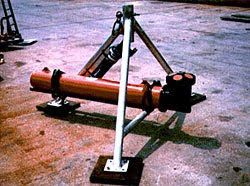
Floating tidal turbine with wooden blades
Norwegian company Hydra Tidal plans to test a tidal turbine next month. While many are pursuing different kinds of tidal energy devices, this one is unique for its turbine blades made of wood. Says company founder and R&D director Svein D. Henriksen:
“Wood is a porous, homogeneous material — so it has better mechanical and hydrological characteristics than today’s conventional materials such as composites and steel. The major challenge is the actual assembly process, but we believe we have found a good solution.” He points out that using wood in turbine blades is also an environmentally sound choice, especially in a lifecycle perspective.
That wood is porous doesn't seem very significant, especially since the pine they plan to use is laminated. Many other materials are "homogeneous" too and the lifecycle advantages are rather minor. At 23 meters long, blade durability may be an issue too, and frequent replacement of weaker blades is no lifecycle or environmental boon. The allegedly better mechanical and hydrological aspects are not further described.

The plan to use floating deployment (as Hydrovolts does) is smart as it is faster, simpler, much cheaper, and doesn't need specialized boats. Still, the technology itself doesn't seem particularly different otherwise, apart from the wooden blades. So, why wood?
80% of the [turbine] can be recycled after its life span, which is more than 30 years. For example, our turbines are made out of glued wood. This material can handle tough ocean environments and they last very long. After the turbines' life end, they can be chopped and used in a bio energy power plant for example.

Hydra Tidal has, in cooperation with Harstad University College and Kunnskapsparken Nord AS(Science/Competence park), made a report about CO2 emissions in connection with the production of a complete Morild power plant. CO2 emissions are 40% lower than that of onshore wind power.
They've done some very clever things in Norway with renewable energy, so it will be worth watching to see how this turns out.

Sunday, June 6, 2010

Permitting Insanity

Cape Wind location
Why does it take more than 9 years and endless anguish to allow wind turbines in Nantucket Sound, but deepwater oil drilling routinely has environmental impact studies waived, supposedly because massive oil spills are unlikely? The oil industry has received approvals with potentially severe environmental impacts in as little as 10 minutes. Contrast the (over-)abundance of caution for wind and the cozy practice of superficial scrutiny for oil. Recent events make the dissonance especially jarring.

The Cape Wind offshore wind farm is closer than ever to the start of construction. Just more than a week after the explosion of BP's Deepwater Horizon platform, US Interior Secretary Ken Salazar gave formal approval, saying:
After careful consideration of all the concerns expressed during the lengthy review and consultation process and thorough analyses of the many factors involved, I find that the public benefits weigh in favor of approving the Cape Wind project at the Horseshoe Shoal location. With this decision we are beginning a new direction in our Nation’s energy future, ushering in America’s first offshore wind energy facility and opening a new chapter in the history of this region.

Sunday, May 2, 2010

Laissez Failure

BP oil platform burns in the Gulf of Mexico
The slow-motion ecological catastrophe in the Gulf of Mexico is horrifying.

The oil slick is now the size of Ohio, and growing by the hour. Edges of it are now reaching land and all along the Gulf coast residents wait with deep foreboding and growing anger as the dimensions of the disaster become clear.

This is not an oil spill, but an oil spilling, as more ruptures from the sea floor, surfaces, and spreads its devastating reach towards shore. 40% of the coastal wetlands in the United States are under threat, as are the majority of the country's oyster and shrimp fisheries. Local fishermen have moved quickly through the 5 stages of grieving as they face the imminent destruction of their livelihood, economic security, their way of life, and their future.

Emergency response began quickly and broad efforts at mitigation are underway. The Obama Administration formed a National Response Team, Louisiana Governor Bobby Jindal is mobilizing the state's National Guard, and locals are taking to their boats to deploy booms to intercept the sprawling slick. Dealing with the immediate crisis is paramount now, yet soon hard questions must be asked, and honestly answered. The critical questions are:

Why did this happen? How do we prevent it happening again?

Thursday, April 29, 2010

Distributed Hydropower for Remote Ocean Devices

Acoustic Doppler Current Profiler
There are many users who want to place electronic devices in remote ocean locations where power is not available from the electrical grid. These remote ocean devices (often sensors of some kind) are powered by batteries; however, today's state-of-the-art solutions are expensive and inconvenient.

For example, researchers at the University of Washington frequently want to deploy Acoustic Doppler Current Profilers (ADCPs) or other devices to take measurements under water over the course of weeks, months or longer. Running power through a cable from shore is impractical and costly, but the alternative actually used has a stiff price too: a disposable battery that costs $500 and lasts a mere 10 days, after which it must be replaced. In addition to the recurring cost of replacement batteries, there is the enormous cost of a boat and crew to do the replacement--often $1,000 per hour or more. In the deeper ocean farther form shore, boat costs can easily top $100,000 per day.

For small ocean power, the Hydrovolts turbine paired with a rechargeable battery replaces the current disposable battery solution, providing a capital ROI of substantially less than one year.

Wednesday, March 31, 2010

Our Energy Future - II

Peak Oil graph
Where will our energy come from in the future? Peak oil is upon us, even if the exact date is not yet conclusively known. Nuclear power is at best a transitional step, and quite costly when factoring in construction and external costs. What's left?

How about 100% from renewable sources? A new report by PriceWaterhouseCoopers suggests Europe could be powered entirely by renewable sources, albeit at substantial cost of transition, especially on inter-continental transmission:
A "super-smart" grid powered by solar farms in North Africa, wind farms in northern Europe and the North Sea, hydro-electric from Scandinavia and the Alps and a complement of biomass and marine could render carbon-based fuels obsolete for electricity by 2050, said the report.

The goal is achievable even without the use of nuclear energy, the mainstay of electricity in France.
While the costs and challenges are great, those of clinging to the fossil economy would be much greater. But what is remarkable, of course, is that the modern industrial economy of Europe, roughly the same size as that of the United States, could be run entirely on renewable energy.

Thus, today's announcement by President Obama to expand off-shore oil drilling in the United States is especially disappointing.

Sunday, February 22, 2009

Salazar's Oil

Even-handed on energy?The appointment of former US Senator Ken Salazar (D-CO) as Interior Secretary provoked some ambivalence in both environmental and industry circles. A strong-willed and outspoken westerner, Salazar is seen as industry-friendly while still being environmentally concerned, although just not enough so to completely please either side. In office, his early actions appear consistent with his reputation. For his part, the Secretary has neither fully charmed nor alarmed. Is he a centrist such as President Obama believes will further his so-called post-partisan approach to governing?

Oil Shale


Salazar, who halted leases for oil and gas development on some federal lands in Utah earlier this month, said that while the administration will focus on energy efficiency and renewable sources, there is still room for conventional fuels. Oil shale, he added, still has "great potential," and he may revise rules on harvesting that energy source "in the near term." "We intend to move forward with a comprehensive energy plan," Salazar told a bipartisan group of Western governors huddled in Washington for a national summit. "You should take away from this conference in Washington that the Obama administration is not against developing any of those resources. … Let's put everything on the table."
Last November Salazar's predecessor as Secretary, Dirk Kempthorne, rushed through regulations under the Bureau of Land Management (BLM) to encourage oil shale development in the so-called Green River Formation, a two million acre tract of federal land straddling Colorado, Utah and Wyoming that optimists in the Fossil Industry think may contain perhaps 800 billion barrels of "recoverable" oil. As I noted at the time, Salazar was strongly opposed, concerned about scarring the land of his home state and calling the projected royalties to the government "a pittance."

He further criticized the hastiness of the decision in light of the failure by BLM to analyze the potential environmental impacts, and the additional and enormous resource contention that would ensue over dwindling water supplies:

These regulations are premature and flawed. The Bush Administration has fallen into the trap of allowing political timelines to trump sound policy. Over and over again the Administration has admitted that it has no idea how much of Colorado’s water supply would be required to develop oil shale on a commercial scale, no idea where the power would come from, and no idea whether the technology is even viable on a commercial scale.
Now he blandly calls the Bush attempt to ramrod rules merely "misplaced" and seeks simply to assess the "legal options" the Interior Department has available to it and to make his own decisions over the course of the next 6 months. Shale shills are pleased to agree: "It's foolish to dismiss any options at this point," says Utah Gov. Jon Huntsman Jr.

Offshore Oil

While giving encouragement to one oil faction, Salazar has disappointed another. Two weeks ago he put the brakes on the offshore oil and gas leasing rules promulgated by the Bush administration on its last day in office:

At a news conference in Washington, Salazar said he will move to slow the "headlong rush" to "drill, drill, drill." Salazar said Bush's midnight five year plan, which covers the years from 2013 through 2017, accelerated by two years the regular process for creating a new plan for the outer continental shelf. It "was a process rigged to force hurried decisions based on bad information," he said. "It was a process tilted toward the usual energy players while renewable energy companies and the interests of American consumers and taxpayers were overlooked." "It opened up the possibility for oil and gas leasing along the entire eastern seaboard, portions of offshore California, and the far eastern Gulf of Mexico - with almost no consideration of state, industry, and community input and, in the case of the Atlantic coast, with very limited information about the nature of offshore resources," the secretary said. Despite the sweeping proposal to open up as many as 300 million acres to new offshore oil and gas leasing, the Bush administration's notice called for the completion of scoping meetings and public hearings on the new plan for the outer continental shelf by March 23 - less than 45 days from today.
As with the oil shale, Salazar also wants a 180-day fact-finding period to reconsider the Bush decisions and intends to re-open the decision to additional comments.


The Bush administration was so intent on opening new areas for oil and gas offshore that it torpedoed offshore renewable energy efforts... This rulemaking will allow us to move from the oil and gas only approach of the previous administration to the comprehensive energy plan that we need.
Notwithstanding the intention to continue the current leasing plan, and to not reinstate any offshore drilling ban, American Petroleum Institute (API) President Jack Gerard whined:

The accelerated Outer Continental Shelf five-year plan process, which the secretary placed on hold today, was designed to address the critical energy concerns facing Americans. The draft plan already received a record 120,000 comments from states, environmental groups, industry, labor groups and members of the public - with 87,000 of those comments supporting expanded and expeditious development... Secretary Salazar's announcement means that development of our offshore resources could be stalled indefinitely.
It's not easy to please Gerard or the API. After 8 years of being given everything they wanted, their response to being told "no" is akin to a toddler denied a 9th consecutive treat. The tantrum is about not getting it right now, rather than tomorrow, as a more responsible parent might do (if he behaves!) Gerard's fear-mongering about the urgent need for energy ignore both the reduced demand at present and the inability of offshore oil to ever amount to more than the proverbial drop in the bucket. It's drill now, ask questions later.

But environmentalists are pleased with the Obama administration's new approach to offshore energy resources. Wesley Warren, director of programs for the Natural Resources Defense Council, said, "By committing to a thorough review, Salazar is demonstrating bold leadership that will offer America a new energy future that provides clean domestic energy and cuts our dependence on foreign oil."

Centrism?

The simple reading that API and others make on these developments is that the Obama Administration is hostile to oil and gas and is using review in the manner that the Bush Administration did: study and delay, doing nothing for as long as possible while greenlighting the activities of preferred industries and friendly businesses.

It's possible that the same plan is underway here, only with the sides reversed, but the approach is already too different for this interpretation. Salazar says his Department of the Interior is acting to fulfill President Barack Obama's commitment to "a government that is open and inclusive and that makes decisions based on sound science and the public interest." Salazar shows a strong preference for deliberate decision-making based on collecting all available information and using the facts to guide an even-handed application of law and policy, a significant departure from the practices of the past 8 years.
In not banning offshore oil outright, and in holding out the prospect of oil shale development, the Obama Administration goes against its supposed joined-at-the-hip environmental allies and offers the Fossil Industry a fair hearing on the merits. They may not have merit (I believe) but there will be an honest appraisal based on science rather than ideological cant. It's refreshing.
Indeed, after more review, there will likely be further offshore drilling. Said Obama:

Offshore drilling as part of a comprehensive energy strategy may make sense. In isolation, it's short-sighted. I hold out for a more comprehensive strategy before I sign off on whole-hog drilling offshore.
Colorado Governor Bill Ritter, long-aligned with Salazar on oil shale says its development should be considered but

...we should just be prudent in how we develop it. It's heartening to me that [Salazar is] going to be thoughtful and that he'll only allow oil shale to be developed when the technology is such that we can also protect our air and our water and our wildlife.
Whether all this amounts to merely a symbolic break with the secretive and science-hostile Bush Administration or a genuine and good-faith open-mindedness remains to be seen. We'll know for sure in much less than the six month period of review.

Thursday, February 12, 2009

FERC Preliminary Permits

FERCWe got a lot of comments on the applications Grays Harbor Ocean Energy Company submitted to the Federal Energy Regulatory Commission (FERC) for preliminary permits. Many were submitted to the FERC on their website; others were posted to various community sites or other blogs. Many of these comments objected to the harm the commenters anticipated would occur from the building and operation of marine energy projects as described in the permit applications.

Most of these objecting comments reveal a lack of understanding of the FERC hydrokinetic process and especially the purpose and scope of a preliminary permit. The FERC outlines the process and notes a key facet of a preliminary permit:

These permits do not authorize construction. Rather, they give the developer priority to study a project at the specified site for the duration of the permit.
The preliminary permit is different from the license required to actually build and operate a project. A developer first obtains a preliminary permit to study a site; the permit is generally good for 36 months and requires reports to the FERC twice a year. A permit holder may subsequently apply for a pilot license, good for five years, which allows the construction and testing of a single demonstration unit to further assess project impacts and feasibility. A full license requires extensive studies, coordination with other permitting agencies, and intensive stakeholder engagement throughout the process.

The FERC has expanded on what comments are relevant to a preliminary permit application when ordering their issuance. For example [pdf]:

The majority of the comments filed addressed the construction of the project, including the cable to shore, and potential impacts the project might have on fish and wildlife, aesthetics, and navigation. As noted, a preliminary permit does not authorize a permittee to undertake any construction. Furthermore, the purpose of a preliminary permit is to study the feasibility of the project, including studying potential impacts. The issues raised in the comments are premature at the permit stage, but can properly be addressed in the licensing process.
The FERC also addressed in its Order of Rehearing on the Humboldt and Mendocino preliminary permits [pdf] how it generally does not consider environmental impacts in its decision to issue a preliminary permit:

By its terms, a preliminary permit gives the permit holder no land-disturbing or other property rights, nor does it authorize the placement of any test devices. This being the case, we generally do not consider environmental issues in issuing permits.

The FERC adds that because they result in "no environmental impacts" preliminary permits are only denied for a limited number of reasons:

Because the issuance of a permit can have no environmental impacts, there are few reasons for the Commission to deny a permit application. The Commission will deny a permit where it selects one competing permit application over another. As a matter of policy, the Commission has decided not to issue permits where there is a legal bar to issuing a license for the proposed project. We have also denied permits where we had completed an environmental analysis in a previous proceeding and decided that environmental considerations had made the site in question appropriate for hydropower development, and where a permit applicant was unfit to be a licensee.

Thus comments on potential threats to wildlife, views, quietude and the rest, while raising matters of legitimate concern, do so prematurely, as the preliminary permit is specifically designed to formally evaluate and investigate those concerns. That's what it is for.

Tuesday, February 10, 2009

Troubled Waters for FERC and MMS

Take no prisoners!The Federal Energy Regulatory Commission (FERC) is getting aggressive.

I posted previously how the FERC, seemingly impatient over endless negotiations with the Minerals Managment Service (MMS) went ahead and unilaterally asserted their jurisdiction over the OCS.

My co-founder at The Grays Harbor Ocean Energy Company, Burt Hamner, recognized the importance of this and the opportunity created, and quickly filed applications for 7 marine energy projects in 6 states. The FERC published and opened the applications for comment with surprising speed. At the end of January, just before the comment period closed, the MMS filed a protest to all the applications, arguing that the FERC lacks jurisdiction on the OCS.

Now the FERC has issued its first preliminary permit entirely outside state waters to a subsidiary of Ocean Power Technologies (OPT) in a move clearly in further defiance of the MMS. The FERC order [pdf] permits Oregon Wave Energy Partners II, LLC to study the feasibility of installing 200-400 PowerBuoys producing up to 100MW. The proposed project site is "located in the Pacific Ocean about 3 to 6 miles off the coast of Lincoln County, Oregon."

The MMS filed a protest against the issuance of this permit which the FERC evidently rejected early in its order:

The portion of the proposed project beyond 3 nautical miles from shore would be located on the Outer Continental Shelf (OCS). In its comments, MMS questioned the Commission’s jurisdiction over hydropower projects located on the OCS.

Section 4(f) of the FPA authorizes the Commission to issue preliminary permits for the purpose of enabling prospective applicants for a hydropower license to secure data and perform acts required by FPA section 9 which in turn sets forth the material that must accompany an application for license. The purpose of a preliminary permit is to preserve the right of the permit holder to have first priority in applying for a license for the project that is being studied. Because a permit is issued only to allow the permit holder to investigate the feasibility of a project while the permittee conducts investigations and secures necessary data to determine the feasibility of the proposed project and to prepare a license application, it grants no land-disturbing or other property rights.

Regarding the specific MMS objections to its claim of OCS jurisdiction, the FERC was terse, believing that the MMS had raised no new issues or avenues of argument not previously addressed:

As to the comments from MMS questioning the Commission’s jurisdiction to issue permits for hydropower projects on the OCS, the Commission explained in detail why its jurisdiction extends to projects located on the OCS in Pacific Gas & Electric Company. [125 FERC ¶ 61,045 (2008) [pdf]]

The PG&E decision cited above by the FERC rejected reconsideration of the earlier issuance of preliminary permits March 13, 2008 for two substantially similar projects in California off Humboldt and Mendocino counties. These wave projects were a collaborative effort by PG&E and Finavera and the sites encompassed both state and federal waters, straddling the 3-mile territorial sea boundary. (Both projects are now in question due to decisions by regulators and by Finavera.)

The FERC appears to be leaving the door open to the preliminary permit not necessarily trumping the MMS claim to preside over the issuance of leases. In the PG&E decision the FERC states:

Although the Commission’s authority to issue preliminary permits derives from its licensing authority, Interior’s rehearing request is at least arguably not ripe for review. The PG&E preliminary permits, themselves, do not affect the OCS. As discussed earlier, the issuance of the preliminary permits to PG&E does not authorize the placement of any test devices on the Pacific Ocean, including on the waters above the OCS.

It will be interesting to see whether the FERC uses similar reasoning in considering the issuance of pilot or operating permits (which would generally entail "land-disturbing rights") and whether their issuance will be conditioned on any approval by the MMS.

As they have now done in several applications before the FERC, the MMS responded to the Grays Harbor Ocean Energy Company applications with a protest. The protest appears to rehash many of the arguments made earlier and reiterates as strongly as a lawyer's treatise can do, that the MMS really really disagrees with the FERC on the latter's interpretation of key parts of the Federal Power Act and the Energy Policy Act of 2005. Trying to follow all the back-and-forth makes my head hurt, in part because it's starting to sound like a shouting match over what Congress meant when it left something out, and why it used broad rather than specific language, and whether something should be interpreted inclusively or more narrowly, and the precise definition of terms defined variously not in the laws at issue but in other laws to which they (more or less) allude.

There's plenty of scope for interpretation and litigation, and there seems little likelihood of the FERC and the MMS coming to agreement on their own.

Irrespective of the legal merits of the FERC and MMS positions a few things appear unarguably true:
  1. FERC has a permitting process and is using it to issue permits; MMS on the other hand has been promising to issues rules allowing applicants to start the permitting process on the OCS, and yet, 5 months after the close of public comment on the proposed rules, has yet to either issue any or give any guidance on which one might rely as to when they will do so.
  2. The standard MMS leasing approach puts everything to competitive auction, which fits the needs of marine energy project developers very poorly. Having undergone the time and expense of identifying a promising site and technological approach, others can swoop in and outbid for the site, leaving those who have pioneered the opportunity no compensation and no recourse.
  3. MMS leases are ill-suited also because lease payments start immediately rather than at commissioning, when a project starts producing power, hence revenue, to pay the rent. Where years of studies, analysis, stakeholder engagement (and quite likely lawsuits) await, such a fee structure is punitive, especially to a nascent industry, and will have the effect of arming opponents with a financial cudgel wielded by the tactics of delay.
  4. The ongoing spat between these two federal agencies serves no purpose beyond titillating the insatiable urge of the bureaucrat to aggregate authority. Meanwhile, the regulatory uncertainty creates confusion and further freezes any funding to advance renewable marine energy projects, in contradiction to President Obama's vision, policy and reasonable common sense.
It's worth also asking the question: exactly what minerals are the Minerals Management Service managing when it comes to marine renewable energy? The original purpose of MMS was to ensure that the public, through the government, received royalties for the extraction of mineral wealth from public lands, i.e. to compensate the public for the depletion of a finite and non-renewable resource for private gain. There's no meaningful way in which wind or waves are depleted. Charging rent for the exclusive use of some bit of ocean may make sense, but there's no compelling reason to task the MMS as landlord merely because they know how to cash the rent checks.

There needs to be one lead agency for marine renewable energy and it makes the most sense to have that be the agency that regulates and understands energy, not one that is concerned with mining and drilling. The FERC should be the lead agency on the OCS and the MMS should mind/mine their other business.

Since much of the current argument between the agencies is over differing interpretations of the statutes and the Congressional intent the best solution would be to replace those statutes with an updated Energy Policy Act. Our new energy economy and Obama's policies demand that such an Act be crafted anyway. In what may be an extended meantime, however, the Administration should take charge, at least by getting Secretaries Stephen Chu at Energy and Ken Salazar at Interior to talk to each other and make their staffs play nice. Both men clearly grasp the need for renewable energy and Salazar's comments today struck the right tone when he rejected the flawed Bush midnight regulations emphasizing a "headlong rush" to "drill, drill, drill" on the OCS in favor of a policy that would incorporate

...the great potential for wind, wave, and ocean current energy [in] our offshore energy strategy... [The Bush approach] was a process rigged to force hurried decisions based on bad information. It was a process tilted toward the usual energy players while renewable energy companies and the interests of American consumers and taxpayers were overlooked.

Resolving the turf battle between the FERC and the MMS is also a national interest which cannot be overlooked a moment longer.

Monday, February 9, 2009

Technology Won't Save Us This Time

Let's look through the seat cushions nextFor a while many of us thought (hoped) that renewable energy would remain a bright spot of investment and innovation, even as other sectors of the economy stagnated, shriveled or sickened. However, the broader economic disease is spreading and renewable energy companies have caught the contagion.

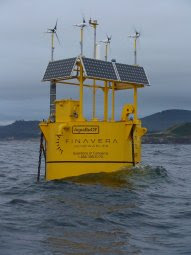
Finavera has seemingly exited the wave energy business, a direct result of the lack of partners and especially funding for the AquaBuOY technology it acquired from Seattle-area AquaEnergy years ago.

After blowing hot and cold for the six months, the the wind industry has now joined the downturn.

Now Bluewater Wind is on the ropes following news that its parent company, Australian conglomerate Babcock and Brown is being forced into liquidation. After a lengthy and tempestuous courtship, Bluewatwer inked the first power purchase agreement (PPA) for offshore wind just this past summer with Delmarva, at a price of less than $0.11/kWh. While there is no word (yet) about the future of Bluewater, the Delmarva deal, or the PPA for the project, their collective future appears dim, another domino in the continuing unwinding. How the project could have ever been feasible at that astonishingly low rate will now likely never be known.

The lack of constancy on tax incentives (like the PTC) has been a drag on renewable energy investment for many years. Without the certainty of those incentives key financing strategies such as flip LLCs [pdf] become too risky, and the tax equity investors pull out. Without these investors renewable energy deals don't get done:

The pool of so-called "tax equity investors" has dwindled to around a half-dozen, from more than 20 in 2007. Key players such as Merrill Lynch and Lehman Brothers no longer exist. Others, including the likes of John Deere (DE) and Prudential (PRU), have backed out of the market, if only temporarily, according to research by Hudson Clean Energy, a private equity firm specializing in green energy. "This will be a constraining factor because the population of sophisticated buyers for these credits is too small," says Oerlikon's O'Brien.

The shortage of buyers couldn't have come at a worse time. To hit Obama's goals for new renewable energy, the industry will have to mobilize far more capital than it has had to before. This year, the tax equity market is expected to hit $11.1 billion and would have to rise to around $43 billion in 2012 to build all the capacity being called for. Yet in 2007, when the market had more than 20 buyers, investors bought up $5.4 billion in tax equity. Last year, just eight investors handled about $5.5 billion in 2008. "Between now and 2012, [tax equity] markets would have to grow four- or fivefold," says Arno Harris, CEO of Recurrent Energy, a renewables developer in San Francisco.

The ecosystem of creative fast-growing technology companies have pulled the economy out of the last several recessions:

In the 1970s microchips helped jump-start the economy. In the 1980s personal computers unleashed a wave of consumer and business spending. And in the 1990s the Internet gained steam just when the economy was at its bleakest, creating new companies, jobs, and investment opportunities. Even in 2001, when hundreds of dot-com companies went bust in the space of a year, a couple of guys were already working on a startup that would make money on web searches. (That would be Google.)

Technology won't save us this time, at least not all by itself, because of the tumorous growth of dysfunction in the core structures of the economy. Renewable energy could be the engine to lead the recovery, but first there must be capital investment. Attempts to "unfreeze" the credit markets have been a dismal failure, and further (but wiser) efforts in that direction, while worthy, will be insufficient. Tax cuts, refundable credits and such ilk are not the answer. A direct injection of capital to the renewable energy sector is essential for the inextricably linked needs of our future energy and economic health.

There is no time to waste; this is not a typical recession.

Sunday, February 8, 2009

Finavera Waves Goodbye

Finavera AquaBuOYFinavera Renewables appears to have given up on wave energy, focusing instead on its more successful wind project development business.

Friday it announced that it is abandoning its Makah Bay wave project off Washington state. According to the company's press release [pdf]:

The decision allows the Company to focus its resources on enhancing its near-term wind project portfolio and provide shareholders with a clearer path to revenue in this challenging economic environment.
The company goes on to say that it is "actively" seeking financial and technical partners for its AquaBuOY technology and is retaining all its intellectual property rights. However, after the unfortunate sinking of the AquaBuOY near Reedsport, Oregon in November 2007, and the rejection by the California Public Utilities Commission of its Humboldt County project in October last year, this week's news leaves Finavera with little motion on the wave front.

MendoCoastCurrent reports that the Company requested it be allowed to surrender its license for the project back to the Federal Energy Regulatory Commission (FERC). The reason cited by the company reflected a lack of investor and partner confidence:
Due to the current economic climate and the restrictions on capital necessary to continue development of this early-stage experimental Project, the Project has become uneconomic. Efforts by Finavera to transfer the license were not successful. Therefore, Finavera respectfully requests that the Commission allow it to surrender its license for the Project.

The investment prospects for Finavera have undulated plenty over the years. In November Finavera announced a private placement of equity primarily for its wind business and shortly after struck a deal with GE to arrange financing for some of its BC wind projects. The extension of its previously issued and now underwater warrants strongly suggested investor impatience with the pace and direction of the company's progress.

In its press release Finavera concludes by clarifying its plans as a company:

The immediate primary focus remains the continued development of the Company’s wind projects in BC and Ireland through partnerships and/or joint venture arrangements. In the medium term, the Company plans to execute on its project finance agreements and bring the wind energy assets to commercial operation. In the longer term, the Company will continue to assemble a diversified mix of revenue producing, renewable energy assets.

Only "in the longer term" would the company pursue anything other than wind. If there are no internal prospects and no external partners for the AquaBuOY technology, then development will likely cease, clearing the way for competitors such as the Pelamis, already in commercial operation, to prevail.

Monday, December 8, 2008

Grays Harbor Ocean Energy Company

The Grays Harbor Ocean Energy Company (GHOEC) has filed applications for preliminary Federal Energy Regulatory Commission (FERC) permits for hydrokinetic power at seven sites in six US states.

These filings are starting to get more visibility and comment and several people have asked us for more information on what we are doing, what our plans are, and why we are taking this approach. We have also upset a few people, primarily over two things: for not having engaged in more advance consultation, and for (some fear) having some kind of nefarious agenda.

In this post I will strive to provide some explanatory background along with more information about our plans and intentions. Your comments and constructive criticisms are welcome; please comment on this post or send email to info@graysharboroceanenergy.com.

Background

My business partner Burt Hamner and I founded GHOEC a year ago initially to pursue utility-scale ocean energy near Grays Harbor County in Washington State. Burt earlier had directed a feasibility study (12MB PDF) for Tacoma Power in Puget Sound's Tacoma Narrows to assess the viability and feasibility of tidal power. The study's conclusion is that tidal power in Tacoma Narrows would not be feasible for a decade or longer, and Tacoma Power sensibly declined to proceed further.

Although the study's result was disappointing--we had hoped to proceed with a demonstration project there--the need for renewable energy persists, so we looked at where to go next, and, as a result formed two companies, Hydrovolts and GHOEC. Hydrovolts seeks to take the concept of utility scale tidal turbines and build them much smaller--at kilowatt scale--for distributed and point-of-use generation. GHOEC sought to find solutions other than tidal power for large-scale renewable energy generation in Washington State.

During the assessment for Tacoma Power it became clear that the outer coast of Washington State has very strong wave and wind resources, and few were exploring them. Natural Currents LLC received a preliminary permit for tidal energy in Willapa Bay in March 2007 (P-12729) and Finavera Rewnewables continues to pursue wave energy in Makah Bay, having received the nation's first (and so far only) commercial operating license from FERC. (FERC permits and comments can be found here.) GHOEC filed an application for a preliminary FERC permit on 10/28/07 to assess the ocean energy potential near Grays Harbor; given the potential of the resource, we were surprised that no one else had previously done this.

Interestingly, AquaEnergy (later bought by Finavera) earlier looked at offshore energy in Grays Harbor, but discontinued their efforts because the ocean was too deep for their particular wave device. This may be the origin of the idea that the Washington coast is too deep for ocean energy devices in general; as we talked to various renewable energy people and companies we kept hearing that the ocean of Washington State was "too deep." However, the ocean current on the Pacific Coast moves south-to-north, and the Columbia River discharges at least a million tons of sediment into that current every year. So, while the outer continental shelf (OCS) is very narrow off California and much of Oregon, it gets quite large from near the mouth of the Columbia and to the north. 10 miles from shore the ocean is only about 150 feet deep, meaning that there is a very large area suitable for many kinds of marine renewable energy devices, and offshore wind turbines of the largest size could be placed far enough out to perhaps entirely mitigate concerns about views and noise.

The FERC Role

The FERC issued our preliminary permit P-13058 on 7/30/08. (Press Release.) This preliminary permit gives us the right to assess the potential for wave power at the two sites detailed in the application and described in detail on our web site. It does not permit the placement of anything in the water; that can only occur under a FERC pilot or operating license, and only after acquiring many other permits from the various local, state and federal authorities. What the FERC permit and FERC process do, however, is provide a detailed framework for proceeding. It removes ambiguity on what is required and ensures formal involvement of all stakeholders, including environmentalists, fishers and crabbers, local officials, tribes, property owners, and others. The FERC system also grants the first applicant for a hydropower site priority development rights. Says the FERC:
Section 4(f) of the Federal Power Act authorizes the Federal Energy Regulatory Commission to issue preliminary permits for the purpose of enabling prospective applicants for a hydropower license [covers wave power but not wind power] to secure the data and perform the acts required by FPA section 9.3 which in turn sets forth the material that must accompany an application for license. The purpose of a preliminary permit is to preserve the right of the permit holder to have the first priority in applying for a license for the project that is being studied. Because a permit is issued only to allow the permit holder to investigate the feasibility of a project while the permittee conducts investigations and secures necessary data to determine the feasibility of the proposed project and to prepare a license application, it grants no land-disturbing or other property rights.
We are very interested in offshore wind, and the wind off Washington State is amongst the best in the world for generating wind energy. Wind is not much mentioned in any of our FERC permit applications for a very simple reason: FERC has no jurisdiction over offshore wind on the OCS or anywhere else. In our application for the Grays Harbor demonstration project we had originally included information on our plans to test wind energy using a single turbine; the FERC sent the application back and requested we remove all references to this. The FERC didn't even want to hear about it. In our newest applications there is also only passing mention of wind energy, and this is based on our experience in filing applications with FERC according to their rules and requirements.

The Minerals Management Service Role

Historically, Minerals Management Service (MMS) of the Department of the Interior has overseen the leasing of federal lands (and waters) for resource extraction. It grants leases through a competitive auction for everything from oil and gas drilling to metals and mineral mining. The Energy Policy Act of 2005 (PDF) also gave the MMS jurisdiction over renewable energy projects on the OCS. The MMS and the FERC have been negotiating how to cooperate on offshore renewable energy projects ever since. They had publicly announced their intention to sign a MOU, but there is still no completed agreement. MMS completed the comment period on their proposed rules in September and has indicated that they will release final rules before the end of the year (now only weeks away.)

I posted earlier about FERC asserting jurisdiction over hydrokinetic projects on the OCS and the state of affairs between the two agencies. There are excellent summaries of the inter-agency squabble here and here. Final resolution by mutual agreement may yet happen, but intervention by Congress or adjudication by courts is looking more and more likely.

The GHOEC Approach

We believe our energy future requires offshore renewable generation from wind and wave. The best places to do these kinds of energy projects is farther out, beyond the limit of state waters--10-15 miles from shore.

The GHOEC technology solution for ocean renewable energy includes a mobile jackup platform that supports wave energy and wind turbines. The MMS does not yet have a process or rules to pursue energy projects on the OCS. When FERC asserted jurisdiction on hydropower projects on the OCS they provided a way to proceed. The Company therefore applied for FERC preliminary permits to assess wave energy from the sites identified. If the FERC issues preliminary permits the Company will proceed with site studies. The results of the studies, local consultations, partnering discussions and other factors will guide GHOEC in its decision of whether or not to proceed with the next phase of FERC permitting. We expect that resolution will be achieved on the issues between the FERC and the MMS and expect to pursue whatever applicable rules and procedures established by MMS, just as we will comply with those of all other authorities at every governmental level.

We are not hiding our interest in pursuing offshore wind or engaged in some kind of devious Trojan horse activity. Formal applications and responses to FERC are done according to their rules; we strive to present the full and accurate picture of what we are doing and planning on our web site. We also encourage interested or concerned parties to submit comments to FERC or directly to us. Commenting on the FERC applications is easy--when you have the docket number of the application go to FERC Online and follow the directions.

Finally, all of this is still at a very preliminary stage and many things could change as we go forward. We have not selected any particular wave or wind technology and recognize that considerable work lies ahead in figuring which, if any, would be suitable. Those alluded to in the applications or on our web site are provisional; any proposed solution will require careful and competent study in many areas, including suitability for any particular site.
We do like the three-legged jackup platform, adapted by Offshore Wind Power Systems of Texas from use in the Gulf of Mexico oil and gas industry. There are many advantages to this platform, including:
  • There are no cables/wires underwater which threaten whales
  • It has a smaller ocean floor footprint than cable systems
  • It can be placed/removed in as little as a single day
  • There is no driving of piles and thus none of the noise that pile-driving causes
  • The structures are simple enough that they can be manufactured locally using facilities that exist in any marine industry in any reasonably-sized port.
  • The core design withstands force 5 hurricanes and 60-foot swells

There are, of course, also many questions, which is why more studies need to happen before this or anything else is put in the water. Our approach is to proceed deliberately, following the rules, and doing the work of careful assessment and study using qualified experts and the insight and knowledge of local groups. If at any point it becomes clear that any project under consideration cannot be made viable, feasible, and environmentally compatible we will stop. Bookmark the page, print it out, memorialize this how you want. It is a commitment on our part.

Consultation

The first that many local authorities and stakeholders learned of our plans was by a notice from a federal agency or a piece in the news. That is not what we wanted, and we are sincerely sorry for the shock and for any offense.

Just as with our removal of most mentions of wind turbines in our applications to the FERC, so to with our consultations: we acted based on our experience with the application for the project in Grays Harbor. Burt wrote an open letter explaining how we were surprised by the pace of the process:

I wish to extend my apologies for surprising state and local officials and organizations in the states where we have proposed projects. The FERC acted on our applications faster than I think it has ever acted for any applicant before, and, frankly, it caught it us off guard. We have not had time to contact the political, energy and ocean leaders in our project areas.

We applied for the preliminary FERC permit for the Grays Harbor project on October 28, 2007. The FERC opened the application for public comment five months later, and issued the permit on July 30, 2007, nine months after we applied. The seven recent permit applications were applied for on October 21, 2008 and the FERC opened them for public comment on November 28, 2008, a mere five weeks later. We simply did not expect (and did not have advance notice) that seven applications would all be opened for comment so quickly. Naively, we assumed that we could begin that process in January rather than during the holiday season, and be fully engaged prior to the FERC's action. We were clearly wrong to assume this and regret the negative impression of our intentions it has created. Burt wrote:
We have been preparing to contact the officials in the states affected by our applications in January and February, after the holidays and the Presidential transition and the new Federal agency heads are in place. I personally called FERC and asked them to open the public comment period in January or February, because opening it in December is rather unfair to the public - the holiday season is a big distraction and I don't think the public and agencies really get a "normal" 60-day comment period if it opens on November 28. A proposal for offshore energy development of course greatly concerns state and local officials and the affected public and interest groups. We have great experience in stakeholder consultation and the permitting processes and we like the FERC system, unlike almost every other developer, because it requires and directs an extensive consultation process with every stakeholder. We will follow that process and contact state and local leadership in our site areas beginning in January 2008. We have already contacted a few key people in each state. We look forward to receiving "official" comments on our applications to FERC during the 60-day period, and of course we want any feedback at any time to help us understand local concerns and learn how we can advance this tremendous opportunity in open partnership and collaboration.
Again, we welcome your comments, either directly to us or to FERC (use the docket number of the application and go to FERC Online.)

Sunday, November 16, 2008

Solving the Variability of Renewable Power

An oft-repeated problem with renewable sources such as wind, solar, wave, and tidal is that they are variable. When the wind is not blowing or the sun is not shining then they don't produce power; conversely, there are times where more power could be produced than could be used. This variability, often exacerbated by its unpredictability, has significant implications, especially for utility-scale generation that is connected to the electrical grid.

Current grid management is, in its simplest form, the matching of electrical generation and electrical use, the matching of supply and load. Electrical grid managers are able largely to rely on the load profile, the historical variation of the load over time. There are two basic techniques today to match generation and load: generate additional electricity from various sources when needed (the usual approach) or reduce demand (demand response, much less common.) A detailed explanation can be found here:

The power utilities are able to predict to a reasonable accuracy (generally to within one or two percent) the demand pattern throughout any particular day. This means that the free market in electricity is able to schedule just enough base load in advance. Any remaining imbalance would then be due either to inaccuracies in the prediction, or unscheduled changes in supply (such as a power station fault) and/or demand. Such imbalances are removed by requesting generators to operate in so called frequency response mode (also called frequency control mode), altering their output continuously to keep the frequency near the required value.

The grid frequency is a system-wide indicator of overall power imbalance. For example, it will drop if there is too much demand because generators will start to slow down slightly. A generator in frequency-response mode will, under nominal conditions, run at reduced output in order to maintain a buffer of spare capacity. It will then continually alter its output on a second-to-second basis according to the needs of the grid.

This spinning reserve is a significant expense to the power utilities as often fuel must be burned or potential power sales lost to maintain it. The kind of generation used for fast response is usually fossil fuel powered which produces emissions of between 0.48 and 1.3 tonnes of CO2 equivalent for every megawatt hour (MWh) generated. Thus a significant environmental burden, in the form of increased greenhouse gas emissions, is associated with this imbalance.
Most forms of generation are unsuitable as peaking power plants (peaker plants, spinning reserves) because they cannot be efficiently started/stopped or operated on an intermittent or sudden demand basis. As a practical matter, only natural gas turbine generation can serve as peaker plants. This is the core reason why T. Boone Pickens, Chesapeake Energy and others are so interested in wind power--it will increase demand for natural gas.

Thus the paradox: the desire to add renewable sources of electrical generation is motivated in part by the need to mitigate climate change; however, the addition of variable renewable sources increases the need for spinning reserves, which currently adds to the carbon problem.

What to do? What other than natural gas, with its carbon footprint problems, could serve as a spinning reserve or, more broadly, as a peaking power plant or some kind of load following capability from storage that would enable near-instantaneous supply increases to respond to changes in the electrical demand?

An alternative is grid energy storage. With the growing interest in and development of electric vehicles, especially plug-in hybrid electric vehicles (PHEVs) some have suggested that a growing array of distributed batteries in PHEVs could serve as a source of additional electricity in periods of high demand.

The concept, called vehicle to grid (V2G), is based on the fact that your car is typically not being used 90 percent of the time. "What if it could work for you while it sits there?" said Jeff Stein from the University of Michigan.

The National Science Foundation has granted a research team lead by Stein $2M to explore the possibility of V2G technology using PHEVs. There are many problems to be solved, however. The cars would need to be plugged into a socket not just when being charged, but also so electricity could be drawn back out. How would this be controlled? No PHEV owner will be happy to wake up in the morning and find the battery (half-)drained after being plugged in all night, presumably charging. There are (potentially significant) efficiency losses in charging/discharging batteries, and the life of the batteries would likely be shortened by an arbitrary cycle where complete charge or discharge may not occur. Lastly, there would need to be substantial elements of a future smart grid deployed to even allow this distributed storage to be harnessed in a centralized way. Interestingly, there is already a test of this concept underway at the University of Colorado (Boulder) by Xcel Energy. Other tests are also underway by Southern California Edison, Austin Energy, Duke Energy, Wisconsin Power, Excel Energy, and Pacific Gas & Electric, amongst others.

Hydro is another mostly green approach. Here in Washington state we get about 70% of our electricity from conventional (big dam) hydroelectric power, which has the ability to serve as a peaker plant by letting more or less water flow out of the reservoirs and through the turbines. There is competition for the water, however, especially from irrigation, but also from navigation and fisheries concerns, so the degree to which these dams can serve as peaker plants is somewhat limited.

Pumped storage hydroelectricity is another storage mechanism that might be explored, and may be very well-suited in coastal settings with large amounts of ocean energy generation (offshore wind, wave, etc.) Some of the drawbacks of this form of energy storage would be mitigated by a reservoir built for the purpose, rather than the use of a pre-existing (freshwater) lake.

Storage could also be achieved via flywheel arrays, hydrogen generation, compressed air, or other techniques.

Longer term, an updated, expanded, and smarter electrical grid is necessary. Wind generation is more variable the more local the scale and geographic reach of the turbine array. As more wind generation comes on line in greater density and over a more diverse, interconnected geographic area, local variations even out and become less significant. Offshore wind, despite its higher cost has several significant advantages over onshore wind; a large one is greater wind (power) on a steadier basis. Large coastal arrays (example) would take out some of the variability.

Thursday, October 30, 2008

First Offshore Wind Turbine Operating in Germany

The first offshore wind turbine in Germany started producing power on Tuesday. Environment Minister Sigmar Gabriel turned on the first turbine at the future Hooksiel complex near the coastal city of Wilhemshaven. "Offshore wind power is of key importance for our future energy supply and a decisive factor in achieving our expansion goals for renewable energy," Gabriel said.

The 5MW pilot project located a mere 500m from the beach is a proof-of-prototype for an eventual 80 turbines to be placed 100km off the North Sea island of Borkum. Construction on that facility is planned to commence in 2009.

Germany joins Denmark, the United Kingdom, Sweden, Ireland and the Netherlands as the only countries generating offshore wind energy. Plans for offshore wind are underway in many places in Europe and in the United States. Offshore wind has been slower to catch on due to its higher costs, but this is changing due to continuing demand growth, the lack of additional land-based sites with good wind, and the development of new platform technologies.

Last year 14% of German electrical supply came from renewable sources, up from 11.5% in 2006. Germany has a 30% target by 2020--the most ambitious goal in the European Union.
By 2030 they aim to provide 15 percent of households with electricity produced at offshore wind farms, the equivalent of around 25,000 megawatts.

Tuesday, October 28, 2008

Overcoming Wave Farm Opposition

From my favorite local NPR station, KUOW 94.9 FM:

Harnessing the power of ocean waves to make electricity is all the rage
among Northwest politicians and conservationists. Oregon State University and
the University of Washington just got a big grant to work on wave and tidal
energy. Even the Presidential candidates are all for it as part of the quest for
"energy independence." But the possible effects on fishing, crabbing and whales
make some coastal residents uneasy. Correspondent Tom Banse reports backers of
wave energy have some persuading to do.

Monday, October 27, 2008

1GW of Ocean Power by 2015

A Greentech Media report announced today predicts installed wave/tidal power capacity will grow from less than 10MW today to 1GW by 2015. The report also states that about $500M has been invested thus far in ocean energy technology research and development, but projects this to quadruple over the same time period to $2B. An additional $2B will be invested on deploying ocean energy farms.

(There's apparently lots more good stuff in the report, including time lines, supply chains, technology comparisons, policy drivers, utility influences, etc.; but since it costs $2,995 I can't afford to read it. Anyone want to lend it to me?)

Friday, October 24, 2008

UK to Pay Half of Pre-Construction Costs of Offshore Wind

Wow.

Wind Power Flagging?

The United States added more wind capacity in 2007 than any other country in the world--over 5,000MW. This year, the new additions will break records again--more than 7,500MW. Can it continue? The Wall Street Journal, quoting the American Wind Energy Association, is doubtful:
Next year won’t be so sweet, the AWEA says, for two big reasons. First, the financial crisis is making it tough for lots of developers to get the cash to build new wind farms. And even though the industry’s prayers were answered with a last-minute, one-year extension of tax credits for wind energy, the tax breaks came late, in the last-gasp Congressional bailout package. That means construction on new wind farms will get a slow start next year.

There are other reasons for concern not cited by the Journal. One is growing opposition to wind projects from the local NIMBY factions and also from those who oppose wind farms on principal (for whom some have coined the terms BANANA--Build Absolutely Nothing Anywhere Near Anyone--and NOPE--Not On Planet Earth.) More on this in a later post.

Another reason is our increasingly creaky and ad hoc transmission and distribution electrical grid. With generation typically far from the load, the power must be moved. Here in Washington most wind generation is in the eastern half of the state and must use one of two corridors over the mountain passes. Both of these routes are at or very close to capacity today, so new wind farms cannot send power to a hungry Puget Sound area unless more wires are strung, a very expensive option.

These last two problems might be overcome by offshore wind. The larger problems of tight credit and, shall we say, gusty support for renewable wind energy will require stronger and better focused political leadership than we've seen the last few years. Dithering on making the smart and necessary energy choices would be an enormous missed opportunity for both our environment and our economy. The renewable energy industry in the United States demands bold leadership. Let's boldly demand it.

Thursday, October 23, 2008

Finavera and PG&E denied wave permit

PG&E had worked out a deal with Finavera Renewables for a wave project off Humboldt County in a PPA that would have paid an astonishing 23 cents per kWh. But the California Public Utilities Commission rejected it:

The commission determined that the project isn't viable, that Finavera's bid doesn't compare to others in PG&E's renewable energy portfolio and that the contract price for the power isn't reasonable.
Putting a brave face on it, PG&E says it is still committed to wave energy and will go forward with other projects: "We believe the rejection of this contract won't hinder further wave development." UPDATE: Finavera's trying to be brave too.

The lack of viability was based in part on the fact that Finavera's wave devices are “precommercial” and that an earlier buoy sunk off of Reedsport, Oregon. Approving the proposed project right now “is not the best way to move this wave technology towards commercialization.”

Reality check for state regulators. If this is a good reason to turn down such a project, how will any project get permits? Shouldn't regulators be encouraging development rather than insisting that all technology be somehow perfected before being placed in the water? Athena may have sprung fully armed from the head of Zeus, but technology isn't birthed fully ready for commercial battle. How do they expect that technology will become ready without getting wet?

Saturday, October 18, 2008

FERC press release

Here is the full press release from FERC:


FERC Asserts Jurisdiction over Outer Continental Shelf Hydroelectric Projects
The Federal Energy Regulatory Commission (FERC) today said it has jurisdiction over hydroelectric projects located on the Outer Continental Shelf (OCS), pointing to laws that define the Commission’s role.

FERC addressed the jurisdictional question, raised by the U.S. Department of the Interior (Interior), in the context of a rehearing order on two preliminary permits issued to Pacific Gas & Electric Co. to study the feasibility of developing wave energy projects in the OCS off the California coast. The projects are the Humboldt Project off the coast of the Samoa Peninsula in Humboldt County near Eureka, and the Mendocino Project off the coast of Fort Bragg in Mendocino County.

"I am confident that today’s decision puts to rest any questions about FERC’s jurisdiction over hydroelectric projects on the OCS," FERC Chairman Joseph T. Kelliher said. "This will allow applicants, local, state and federal agencies, and other interested groups to work together more effectively and expeditiously to develop appropriate projects that utilize our renewable ocean resources."

Commissioner Philip Moeller said the development of viable hydrokinetic resources needs a streamlined process like FERC’s. "It is indisputable that renewable energy is a valuable resource and hydrokinetic projects could harness a vast resource of new hydropower," he said. "Instead of legal battles, my preference, and this Commission's, has been to reach out to federal agencies and states to work in a cooperative manner to the same goal: timely development of a new renewable power resource in a responsible manner after input from all affected stakeholders."
Interior has asserted that FERC only has jurisdiction to issue licenses and preliminary permits for projects within state waters, which for most states is defined as extending three miles offshore. Projects beyond state waters are considered to be located in the OCS.

But FERC says the Federal Power Act (FPA) gives it two bases of authority to issue preliminary permits and licensees for hydroelectric projects located on the OCS. First, the law expressly grants FERC jurisdiction to license in "navigable waters" without limitation as well as in "streams or other bodies of water over which Congress has jurisdiction." That, FERC said, means the Commission has jurisdiction over hydropower projects such as those being studied under the permits issued in these proceedings.

The second authority is for those projects located on "reservations" of the United States. FERC concludes that the OCS is land owned by the United States, qualifying it to be a "reservation" under the FPA. "The Supreme Court of the United States has consistently held that the United States owns the submerged lands off its shores, beginning from the low-water mark," FERC said.


Finally, FERC addressed comments by Interior about the meaning of the Energy Policy Act of 2005 (EPAct 2005) as it relates to the jurisdiction question for hydroelectric projects located on the OCS. Interior asserted that EPAct 2005 intended for Interior to be the lead federal regulatory authority over wave and ocean current energy projects in the OCS.

In today’s order, FERC notes that EPAct 2005 does not limit the scope of its authority over hydroelectric power or withdraw FERC jurisdiction over projects in the OCS. "To the contrary, Congress expressly preserved the Commission’s comprehensive hydroelectric licensing authority under the FPA by including two saving clauses….," FERC said.

FERC Chairman Kelliher stressed today that FERC recognizes the role of Interior, which through the Minerals Management Service (MMS) manages lands on the OCS. There is no conflict with FERC’s role as the licensing agency, he said.

"We have proposed a Memorandum of Understanding (MOU) with MMS that carefully delineates the roles of the two agencies in a manner that respects both our licensing, and Interior’s resource, roles," Kelliher said. "We stand ready to enter into the MOU to clarify those roles."

A preliminary permit gives the holder of a permit priority over the site for three years while the holder studies the feasibility of developing the site. It does not authorize construction of any kind. A license authorizes construction and operation of a hydroelectric facility.

Today’s order also finds that although two local governments, the City of Fort Bragg and Mendocino County, asserted that they did not receive personal notification from FERC of the filing of the preliminary permit applications, only Mendocino County acted in a timely manner once it received actual notice of the application in order to preserve its right to intervene. As a result, Mendocino County’s request for late intervention is granted. However, the order finds that Mendocino has not provided grounds for the Commission to revoke the Mendocino Project permit or to reopen that proceeding. The order also denies motions for late intervention in both proceedings by FISH Committee.

An MMS spokesperson, reached yesterday, had no comment.

Friday, October 17, 2008

FERC asserts itself on OCS hydrokinetic projects

Just when you thought it was safe to go back in the water, the Federal Regulatory Energy Commission (FERC) of the Department of Energy yesterday issued a ruling which makes a detailed case for FERC to regulate "hydroelectric" energy on the entire Outer Continental Shelf (OCS), not just within the 3-mile territorial limit:

In short, based on our review of the statutory language, relevant case law, and pertinent legislative history of the FPA [Federal Power Act], we find that the FPA provides the Commission with two bases of authority under section 4(e) to issue preliminary permits and licenses for hydroelectric projects located on the OCS, or the submerged lands extending ten miles from the coastal baseline in the case of this rehearing. The first is the authority to license hydroelectric projects located on "streams or other bodies of water over which Congress has jurisdiction" under the Commerce Clause and the second is the authority to issue hydroelectric licenses for projects located on "reservations" of the United States. Second, we find that FPA section 23(b)(1) makes it unlawful for any person to develop these projects without a Commission license, because of their proposed location on both "navigable waters" and U.S. "reservations."


(This conclusion appears as section 56 on page 27; their argument leading to this conclusion begins on page 15: "The Commission’s Jurisdiction on the Outer Continental Shelf ")

Which federal agency has or should have jurisdiction over ocean energy? EPACT05 tried to segregate the roles: FERC would have jurisdiction over all hydrokinetic projects within the 3-mile territorial limit, and MMS would continue to oversee leasing for energy developers on the OCS. Obviously this was an imperfect decision for a lot of reasons both practical (most projects, especially cables, will straddle this arbitrary line) and philosophical (what minerals are being managed there anyway?)

EPACT05 didn't resolve matters, but seemed rather to set the battle lines to come. For a few years now FERC and the Minerals Management Service (MMS) of the Department of the Interior have each laid claim based on their respective areas of expertise and involvement. I have been to several panel discussions where representatives of the two agencies speak temperately about finding a modus vivendi that would encourage ocean energy. They have been working on a MOU to define their respective roles; FERC's latest salvo suggests that a final MOU won't see light of day.

Meanwhile we've all been waiting for the MMS to issue final rules for leasing portions of the OCS for ocean energy projects. The comment period closed in September; according to remarks from Maureen Bornholdt of MMS at the AWEA Offshore Wind conference, final rules are expected before the end of the year. The differences between the preliminary rules and the submitted comments make guessing the final rules difficult. This pre-emptive strike by FERC will make those rules more interesting still. Will their issue be delayed? Probably, because MMS will need to respond to FERC.

More uncertainty is clearly harmful to the industry. There's uncertainty regarding the PTC (extended a feckless one year.) There's uncertainty regarding financing for projects (both from the short PTC period and the global credit squeeze.) Now there's even more regulatory uncertainty. The determination of project developers to go ahead anyway is remarkable in the face of so many challenges. What could we do if Congress took the time and initiative to directly address renewable energy and provide a crisp, comprehensive framework that provided clarity and confidence? A robust manufacturing industry, economic benefits, and a better energy future for our country awaits.