Judge Feldman not only held numerous oil and gas interest stocks, but was trading them up to and including the morning of his fateful decision, and doing so out of an admitted realization that he had an appearance of ethical conflict. Feldman owned and was trading Exxon stock, a company whose Gulf of Mexico rigs were losing money at the rate of a half million dollars a day due to the moratorium, during the entire time he was assigned the case. Yet, failing to disclose his appearance of conflict on the record or recuse, Feldman nevertheless proceeded to issue a questionable decision clearly benefitting the oil and exploration industry he is so invested in.So why, when the Government appealed this decision, did they not raise the glaring conflicts of interest?
[snip]
Even more distressing is the fact that it has now been revealed from Judge Feldman’s 2009 financial disclosure, literally just filed and only released this week after demand resulting from his questionable ruling, that Feldman is very heavily invested in Blackrock Financial products. Blackrock is, of course, the single biggest shareholder in BP.
Showing posts with label politics. Show all posts
Monday, June 28, 2010
Crude Behaviors
The Obama Administration's attempt to halt deepwater oil drilling temporarily with a six-month moratorium is, unsurprisingly, under attack. Federal district court judge Martin Feldman of the Eastern District of Louisiana overturned it last week, but his motives are clearly suspect:
Labels:
energy policy,
fossil fuel,
Lousiana,
politics,
regulation
Tuesday, June 22, 2010
Eight Is Enough
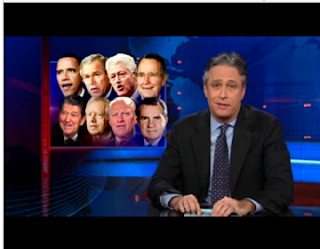
Jon Stewart in one of his typically acerbic pieces on the promise of oil independence:
Coming on the heels of President Obama's speech on the BP spill, and with video clips detailing 4 decades of imprecations and high-minded exhortations from 8 presidents, Stewart complains, roughly, "Fool me once, shame on you. Fool me twice, shame on me. Fool me 8 times, I am a freaking idiot."
We fail to demand real action from our leaders, or to hold them accountable for mouthing bromides. With our current president, I fear the audacity hope has become the folly of wishful thinking. As Pogo said, originally in a poster for Earth Day 1970, "We have met the enemy, and he is us."
Video here.
(h/t earth2tech)
Coming on the heels of President Obama's speech on the BP spill, and with video clips detailing 4 decades of imprecations and high-minded exhortations from 8 presidents, Stewart complains, roughly, "Fool me once, shame on you. Fool me twice, shame on me. Fool me 8 times, I am a freaking idiot."
We fail to demand real action from our leaders, or to hold them accountable for mouthing bromides. With our current president, I fear the audacity hope has become the folly of wishful thinking. As Pogo said, originally in a poster for Earth Day 1970, "We have met the enemy, and he is us."
Video here.
(h/t earth2tech)
Saturday, June 19, 2010
Faint Hope
President Obama's lack of conviction on climate and energy policy is now undeniable. His vacillating remarks on off shore oil drilling over the past few months illustrate his lack of leadership on this, the most critical issue of his presidency.
Eric Pooley over at Grist has an excerpt from his forthcoming book which lucidly surveys the Obama Administration's timeline of timidity. He concludes:
Pooley hopes that public anger will prod a sclerotic Congress into passing a climate bill. However, public anger is attenuating from the steady trickle of bad news and is increasingly eager to look for other targets, particularly within the federal government. The oil lobby and their drill shills in the chattering classes are working hard, incredibly, to recast the oil disaster as an example of why government involvement is bad. (The argument, in defiance of both reason and evidence is roughly: Regulatory oversight failed, thus regulation is worthless, and so government should do nothing, except perhaps foot the bill.) The mob is searching for scapegoats of which to make an example, and the focus is punitive rather than constructive. It is absurd to hope that the public, exhausted from bad news, beset by economic gloom, incited by partisan hacks, and frustrated by collective impotence will spur a Congress captive of corporate interests to do other than pander to the electorate while they stroke entrenched incumbents.
Hope is not a plan. Obama's unwillingness to articulate a bold plan (or even a bold hope) contributes to the perception that our government is adrift. Worse, it reinforces the belief that government is incapable of solving problems, in turn making bold action even harder. On energy policy, this will guarantee the decline of American competitiveness. It is well past time for Obama to be a leader, not a mediator.

Eric Pooley over at Grist has an excerpt from his forthcoming book which lucidly surveys the Obama Administration's timeline of timidity. He concludes:
It is a cruel irony that the epic disaster in the Gulf -- a wakeup call to the need to reduce our dependence on oil -- makes it harder to pass a bill that would help us do so. Expanded offshore drilling (and the revenue it would bring) was the chip Obama hoped to use to draw oil-state senators into a grand bargain that would also include subsidies for nuclear power and carbon capture and storage, with a modest carbon cap in return. The oil spill blew up that idea by taking expanded offshore drilling off the table, at least for now. With few chips left, Obama appears to be hoping that public anger over the spill can help drive a new version of the climate bill. Soon, we’ll know whether he really means it. Democratic leaders in the Senate have been floating the idea of an energy bill without a carbon cap -- which would be yet another failure of nerve by a group of legislators badly in need of adult supervision. Passing a real climate bill will be excruciatingly difficult. Waiting will only make it harder. It’s time for Obama to intervene on the Hill, silence the naysayers inside his own administration, harness the public mood, and make good on his promise to fight.So this is what the audacity of hope looks like--wishing for the First Nerd to remove his figurative glasses and punch back at the bullies. But he won't. Ever cerebral, Obama doggedly appeals to the non-existent good intentions of his opponents, believing that reason and patience will yield agreement. In time, onlookers feel contempt, not sympathy. The notion that Obama will risk any political capital to lead a fight is not a bold hope, but a limp wish.
Pooley hopes that public anger will prod a sclerotic Congress into passing a climate bill. However, public anger is attenuating from the steady trickle of bad news and is increasingly eager to look for other targets, particularly within the federal government. The oil lobby and their drill shills in the chattering classes are working hard, incredibly, to recast the oil disaster as an example of why government involvement is bad. (The argument, in defiance of both reason and evidence is roughly: Regulatory oversight failed, thus regulation is worthless, and so government should do nothing, except perhaps foot the bill.) The mob is searching for scapegoats of which to make an example, and the focus is punitive rather than constructive. It is absurd to hope that the public, exhausted from bad news, beset by economic gloom, incited by partisan hacks, and frustrated by collective impotence will spur a Congress captive of corporate interests to do other than pander to the electorate while they stroke entrenched incumbents.
Hope is not a plan. Obama's unwillingness to articulate a bold plan (or even a bold hope) contributes to the perception that our government is adrift. Worse, it reinforces the belief that government is incapable of solving problems, in turn making bold action even harder. On energy policy, this will guarantee the decline of American competitiveness. It is well past time for Obama to be a leader, not a mediator.
Monday, May 17, 2010
National Security Threats Too Great
The following guest post by James Marvin, Director of Field Operations and Business Development at Hydrovolts was previously published in the National Journal's Expert Blogs on Energy & The Environment. James spent 20 years as a Navy SEAL and has seen first-hand the casualties of our oil addiction.
National Security Threats Too Great
by James Marvin
The United States has to pass comprehensive climate and energy legislation. The longer we wait, the more difficult it will become to address the issue. Whether the American Power Act will carry the day, or some other legislation already introduced, remains to be seen. Doing nothing though, is not an acceptable answer and whatever the solution turns out to be it has to be pragmatic and it has to be timely.
National Security Threats Too Great
by James Marvin
The United States has to pass comprehensive climate and energy legislation. The longer we wait, the more difficult it will become to address the issue. Whether the American Power Act will carry the day, or some other legislation already introduced, remains to be seen. Doing nothing though, is not an acceptable answer and whatever the solution turns out to be it has to be pragmatic and it has to be timely.
Sunday, May 2, 2010
Laissez Failure
The slow-motion ecological catastrophe in the Gulf of Mexico is horrifying.
The oil slick is now the size of Ohio, and growing by the hour. Edges of it are now reaching land and all along the Gulf coast residents wait with deep foreboding and growing anger as the dimensions of the disaster become clear.
This is not an oil spill, but an oil spilling, as more ruptures from the sea floor, surfaces, and spreads its devastating reach towards shore. 40% of the coastal wetlands in the United States are under threat, as are the majority of the country's oyster and shrimp fisheries. Local fishermen have moved quickly through the 5 stages of grieving as they face the imminent destruction of their livelihood, economic security, their way of life, and their future.
Emergency response began quickly and broad efforts at mitigation are underway. The Obama Administration formed a National Response Team, Louisiana Governor Bobby Jindal is mobilizing the state's National Guard, and locals are taking to their boats to deploy booms to intercept the sprawling slick. Dealing with the immediate crisis is paramount now, yet soon hard questions must be asked, and honestly answered. The critical questions are:
Why did this happen? How do we prevent it happening again?
The oil slick is now the size of Ohio, and growing by the hour. Edges of it are now reaching land and all along the Gulf coast residents wait with deep foreboding and growing anger as the dimensions of the disaster become clear.
This is not an oil spill, but an oil spilling, as more ruptures from the sea floor, surfaces, and spreads its devastating reach towards shore. 40% of the coastal wetlands in the United States are under threat, as are the majority of the country's oyster and shrimp fisheries. Local fishermen have moved quickly through the 5 stages of grieving as they face the imminent destruction of their livelihood, economic security, their way of life, and their future.
Emergency response began quickly and broad efforts at mitigation are underway. The Obama Administration formed a National Response Team, Louisiana Governor Bobby Jindal is mobilizing the state's National Guard, and locals are taking to their boats to deploy booms to intercept the sprawling slick. Dealing with the immediate crisis is paramount now, yet soon hard questions must be asked, and honestly answered. The critical questions are:
Why did this happen? How do we prevent it happening again?
Labels:
Alaska,
economics,
energy policy,
environment,
fossil fuel,
Lousiana,
nuclear,
ocean energy,
offshore wind,
politics,
regulation,
renewable energy,
solar,
sustainability,
Texas,
wind
Thursday, April 22, 2010
Energy Security
Earth Day turned 40 today. For many Earth Day is an occasion to think green, hope for a less polluted future, advocate for renewable energy and perhaps push for a solution to climate change.
Others dismiss Earth Day as a symbol of mushy-minded ecomania that elevates the environment over the economy. It's a false choice, but the notion that doing something about the environment will cost the economy persists. Those who are skeptical about climate change are generally the same as those who are negative about renewable energy.
However, there are other reasons to support and promote renewable energy, and a big one is energy security. If it's renewable we don't need to rely on the supply of something like oil or uranium that has to come from somewhere else, possibly a country or region hostile to us.
Energy security matters. Most casualties in Iraq and Afghanistan come from the necessity of fuel transport--the supply chain is long and highly vulnerable.
Failing to make the speediest transition to renewable energy is bad policy for many reasons. It costs lives. It costs money. It funds those hostile to us. And it's futile, because the current energy model is not sustainable. Even the military recognizes that we need to get beyond oil because we're running out of the stuff.
Others dismiss Earth Day as a symbol of mushy-minded ecomania that elevates the environment over the economy. It's a false choice, but the notion that doing something about the environment will cost the economy persists. Those who are skeptical about climate change are generally the same as those who are negative about renewable energy.
However, there are other reasons to support and promote renewable energy, and a big one is energy security. If it's renewable we don't need to rely on the supply of something like oil or uranium that has to come from somewhere else, possibly a country or region hostile to us.
Energy security matters. Most casualties in Iraq and Afghanistan come from the necessity of fuel transport--the supply chain is long and highly vulnerable.
Failing to make the speediest transition to renewable energy is bad policy for many reasons. It costs lives. It costs money. It funds those hostile to us. And it's futile, because the current energy model is not sustainable. Even the military recognizes that we need to get beyond oil because we're running out of the stuff.
Saturday, April 10, 2010
Partisan Challenge
A famous American, fiercely partisan on any number of policy areas, nonetheless said this:
Such a viewpoint was not remotely controversial at the time. One suspects that if President Obama or most any other leader were to speak these exact words today the resulting partisan firestorm of criticism would be intense and vitriolic. Recent polling suggests that a slim majority of Americans are now willing to throw the environment under the economic bus. The anemia of the current "recovery" is doubtless responsible for much of this sentiment, but the lack of unequivocal support for environmental protection by our leaders is also to blame.
If we've learned any lessons during the past few decades, perhaps the most important is that preservation of our environment is not a partisan challenge; it's common sense. Our physical health, our social happiness, and our economic well-being will be sustained only by all of us working in partnership as thoughtful, effective stewards of our natural resources.Who was the speaker? This same proud conservative also took credit for his fundamentally conservative viewpoint that the economy does not utterly trump the environment:
I'm proud of having been one of the first to recognize that States and the Federal Government have a duty to protect our natural resources from the damaging effects of pollution that can accompany industrial development.
Such a viewpoint was not remotely controversial at the time. One suspects that if President Obama or most any other leader were to speak these exact words today the resulting partisan firestorm of criticism would be intense and vitriolic. Recent polling suggests that a slim majority of Americans are now willing to throw the environment under the economic bus. The anemia of the current "recovery" is doubtless responsible for much of this sentiment, but the lack of unequivocal support for environmental protection by our leaders is also to blame.
Labels:
climate change,
energy policy,
environment,
politics
Wednesday, March 31, 2010
Our Energy Future - II
Where will our energy come from in the future? Peak oil is upon us, even if the exact date is not yet conclusively known. Nuclear power is at best a transitional step, and quite costly when factoring in construction and external costs. What's left?
How about 100% from renewable sources? A new report by PriceWaterhouseCoopers suggests Europe could be powered entirely by renewable sources, albeit at substantial cost of transition, especially on inter-continental transmission:
Thus, today's announcement by President Obama to expand off-shore oil drilling in the United States is especially disappointing.
How about 100% from renewable sources? A new report by PriceWaterhouseCoopers suggests Europe could be powered entirely by renewable sources, albeit at substantial cost of transition, especially on inter-continental transmission:
A "super-smart" grid powered by solar farms in North Africa, wind farms in northern Europe and the North Sea, hydro-electric from Scandinavia and the Alps and a complement of biomass and marine energy could render carbon-based fuels obsolete for electricity by 2050, said the report.While the costs and challenges are great, those of clinging to the fossil economy would be much greater. But what is remarkable, of course, is that the modern industrial economy of Europe, roughly the same size as that of the United States, could be run entirely on renewable energy.
The goal is achievable even without the use of nuclear energy, the mainstay of electricity in France.
Thus, today's announcement by President Obama to expand off-shore oil drilling in the United States is especially disappointing.
Labels:
carbon footprint,
climate change,
environment,
Europe,
fossil fuel,
France,
nuclear,
ocean energy,
politics,
renewable energy,
solar,
wave,
wind
Sunday, March 28, 2010
Conservatives Announce Plan to Promote Renewable Energy
Conservatives recently announced a 12-point action plan to boost renewable energy and nuclear power. The plan would also entail a substantial change to the energy sector. The plan recognizes the historical abundance of oil and gas in the country as well as the relatively recent rise of concern over pollution, resource depletion, and the green house gases emissions that are fueling climate change.
Some of the specific initiatives include:
- A Green Investment Bank to provide public funding for new energy technologies
- Establishing a "floor" price for carbon and an upstream tax
- Accelerated demonstration projects for energy storage and carbon capture
- Establishing an "energy internet", including distributed generation and a smart grid
- Household incentives for energy efficiency
- Electrifying the transport system
- Implementing national feed-in tariffs
Friday, March 19, 2010
A Full Accounting
How much environmental damage results from business as usual? According to a forthcoming United Nations report about $2.2 trillion in 2008--from the activities of just the 3,000 largest global corporations. This amount is larger than the national economies of all but 7 countries in the world.
The report comes amid growing concern that no one is made to pay for most of the use, loss and damage of the environment, which is reaching crisis proportions in the form of pollution and the rapid loss of freshwater, fisheries and fertile soils.
Later this year, another huge UN study - dubbed the "Stern for nature" after the influential report on the economics of climate change by Sir Nicholas Stern - will attempt to put a price on such global environmental damage, and suggest ways to prevent it. The report, led by economist Pavan Sukhdev, is likely to argue for abolition of billions of dollars of subsidies to harmful industries like agriculture, energy and transport, tougher regulations and more taxes on companies that cause the damage.
Wednesday, March 17, 2010
Paying Dearly
Australian ethicist and author Clive Hamilton has written a series of lucid articles that provides needed perspective on the SwiftHack affair (the so-called "Climategate scandal".)
While the “revelations” have been milked for all they are worth, and a lot more, the science remains rock solid. If instead of cherry-picking two or three that lend themselves to spin, you read the 1000 or so emails that were posted on a Russian server the picture that emerges is one of an enormously dedicated group of men and women doing their best to carry out research of the highest quality.The charge that these scientists have been engaged in some kind of deep and carefully hidden conspiracy to foist alarm about climate change on a gullible public does not withstand scrutiny.
[snip]
And the emails reveal the enormous external pressure they were under. They show they were constantly accused of being frauds and cheats; their work was twisted and misrepresented; and they were bombarded with vexatious freedom of information requests orchestrated by denialists. In short, they were caught up in a hot political debate that they did not really understand or want to be part of, yet they were the target of savvy, secretive and ruthless organisations ready to pounce on anything they said or wrote.
Saturday, March 6, 2010
The Euthanasia of Reason
Goya created the famous etching with the even more famous caption "The Sleep of Reason Produces Monsters." While he may perhaps have sought to convey sleep as unleashing creativity, the caption as well as the imagery of foolish owls and ignorant bats is now used mostly as metaphor for the disasters that result from a lack of critical thinking.
It is a sleeping sickness for it renders its victims at length incapable of exercising their faculties' full function. The sickness is virulent, as it is readily contagious to those with a mental immune system weakened by atrophy. Even the somewhat more hale of mind are also susceptible to those evangelizing the joys of dimwittery who are as vectors for the pathology of embraced ignorance.
Perhaps, gentle reader, you think I wax over-much and with an excess of alarm? Sadly, no. These monsters of unreason have been so widely loosed that the resulting grotesqueries are everywhere visible. For example, behold the rich vein of raw unreason displayed in this recent piece: "Darwin Foes Add Warming to Targets." (The reporter, Leslie Kaufman, does not much heap irrationality on the idiocies of those quoted, but is, alas, guilty of journalistic stenography: can not the most absurd and ridiculous of statements be tagged for the utter nonsense that it is?)
How deep is our sleep? Let's bestir ourselves and see...
It is a sleeping sickness for it renders its victims at length incapable of exercising their faculties' full function. The sickness is virulent, as it is readily contagious to those with a mental immune system weakened by atrophy. Even the somewhat more hale of mind are also susceptible to those evangelizing the joys of dimwittery who are as vectors for the pathology of embraced ignorance.
Perhaps, gentle reader, you think I wax over-much and with an excess of alarm? Sadly, no. These monsters of unreason have been so widely loosed that the resulting grotesqueries are everywhere visible. For example, behold the rich vein of raw unreason displayed in this recent piece: "Darwin Foes Add Warming to Targets." (The reporter, Leslie Kaufman, does not much heap irrationality on the idiocies of those quoted, but is, alas, guilty of journalistic stenography: can not the most absurd and ridiculous of statements be tagged for the utter nonsense that it is?)
How deep is our sleep? Let's bestir ourselves and see...
Labels:
climate change,
environment,
politics,
tinfoil hats
Thursday, March 4, 2010
Who Speaks for Business?
Who speaks for business? Who advocates for business and articulates their views on public policy? Businesses and their leaders do of course. They just don't always speak with one voice.
For example, a recent survey commissioned by international renewable energy group NTR Foundation and conducted by the Brunswick Group found more than half of the largest US companies wanting an end to the ambiguity surrounding climate change legislation.
About 50 per cent of America’s top business leaders believe a lack of clarity on climate legislation is negatively impacting upon the ability of the US to compete in the global market.
Seventy per cent of the respondents said climate change would be an important part of their commercial decision-making within five years. But almost three in four of the business leaders said security of energy supply was a more “pressing issue” for them than climate change.
Labels:
climate change,
energy policy,
fossil fuel,
nuclear,
politics,
sustainability
Tuesday, February 23, 2010
Carbon Regulation Kabuki
Well, the EPA got everyone's attention by announcing they were going to regulate green house gas (GHG) emissions as pollution under the Clean Air Act. Yesterday, they granted a stay. Why?
Slowing down the rules could give Congress more time to develop a legislative answer to reducing carbon pollution and avoid a lengthy legal battle over whether the agency has the authority to regulate the emissions.This is exactly as expected; the Obama Administration doesn't really want to use the EPA to regulate GHG emissions, even though the Supreme Court cleared the way for them to do so. It's likely that such an approach wouldn't work very well anyway. What the Administration wants is to prod the Congress, and especially a dysfunctional Senate, into getting serious about crafting real climate and energy legislation.
Labels:
climate change,
energy policy,
environment,
politics,
regulation
Tuesday, February 9, 2010
HCE Day 2
Day 2 of the Harvesting Clean Energy Conference kicked off at 8:00 a.m. here in Kennewick. There were quite a few more people in attendance than on Day 1, no doubt due to the full-day schedule, its being a Monday, and there being no distracting sporting events. Hal Calborn, Conference Emcee, summarized one of yesterday's key messages, that the focus on many attendees was on energy security being the key economic and policy driver and the need to create jobs in the burgeoning global clean energy economy. However, "it doesn't mean that climate change is not an issue."
Next up was US Representative Doc Hastings (R-WA) and the contrast of his "special remarks" to those yesterday by US Representative Jay Inslee (D-WA) was stark. Inslee supported the Waxman-Markey and Stimulus bills; Hastings opposed them. Inslee is one Congress' most impassioned and articulate champions of renewable energy and clean technology; Hastings said he is "in favor" of renewables, but spent most of his time advocating for the primacy of oil and gas.
Monday, February 8, 2010
HCE Day 1
US Representative Jay Inslee (D-WA) gave the keynote at today's opening session of the Harvesting Clean Energy Conference. He had many interesting things to say, and the predominantly friendly audience was liking what they heard.
His most important point: There will be clean energy jobs--lots of them--in the future. It is not a question of whether, but where.
While he was also quick to praise Washington State's largest trade partner in general, he was pointed in his criticism of how they were competing and had harsh words for what he called their "strange attitudes about trade." They trade from us, "reverse engineer" it, then close their market as they create their own competitive products. It is "unacceptable and non-sustainable." We cannot allow them to "illegally dominate the clean energy future."
Significantly, the fault is squarely our own: we have yet to aggressively compete in return. The Chinese have a "national goal" to dominate the cleantech sector, and the US as a nation needs to "stand up to them."
His most important point: There will be clean energy jobs--lots of them--in the future. It is not a question of whether, but where.
While he was also quick to praise Washington State's largest trade partner in general, he was pointed in his criticism of how they were competing and had harsh words for what he called their "strange attitudes about trade." They trade from us, "reverse engineer" it, then close their market as they create their own competitive products. It is "unacceptable and non-sustainable." We cannot allow them to "illegally dominate the clean energy future."
Significantly, the fault is squarely our own: we have yet to aggressively compete in return. The Chinese have a "national goal" to dominate the cleantech sector, and the US as a nation needs to "stand up to them."
Labels:
economics,
energy policy,
incentives,
jobs,
politics,
renewable energy,
tinfoil hats,
Washington
Thursday, February 4, 2010
Fiddling
President Obama never uttered the words "cap and trade" in his State of the Union address. He said only a bit more on climate change, the impetus for such legislation either, calling for passage of
...a comprehensive energy and climate bill with incentives that will finally make clean energy the profitable kind of energy in America.An interesting rationale considering the amount of clean energy development already happening. Even with the wretched economy of 2009, the US added more wind power capacity last year than ever, and the country now leads the world. Lots of money is already being made in clean energy.
Labels:
climate change,
energy policy,
politics,
tinfoil hats
Thursday, January 14, 2010
Crocodile Tears
The battle is joined on Senator Lisa Murkowski's shameful attempt to gut the Clean Air Act:
Said Murkowski:
Those of us not in the Senate can email them quickly and urge action, rather than delay. And here's a really easy email form you can use to send a letter to the editor of all of your local and selected national press. Please write--senators need to hear from more than the lobbyists:
Senators need to start listening to the voters.
Senior Democrats including the bill's co-author Barbara Boxer quickly rallied to support the EPA, issuing a letter criticising Murkowski's amendment. " Debating policy choices regarding the appropriate response to unchecked climate change is fair, and the Senate will continue to evaluate the best tools for addressing greenhouse gas emissions," the letter said. "But repealing an endangerment finding based upon years of work by America's scientists and public health experts is not appropriate."
Said Murkowski:
I do not believe, and I don't believe that most of my colleagues in the Senate believe, that the EPA is the entity that is the best suited to develop climate change policy for this country. I'm trying to get a time-out. I'm trying to allow the legislative process to proceed. I'm hopeful that we'll be able to have a vote that will allow for that discussion.If she's serious, it's welcome news. Senator, can we put you down as a Republican who will not filibuster an attempt to have that discussion? Perhaps you can persuade some of your GOP colleagues to do the same, and engage in a good-faith effort to pass legislation? It's worth recalling that the only reason the EPA has taken this step is the bellicose intransigence on this issue by your party. Lead, follow, or get out of the way.
Those of us not in the Senate can email them quickly and urge action, rather than delay. And here's a really easy email form you can use to send a letter to the editor of all of your local and selected national press. Please write--senators need to hear from more than the lobbyists:
In related news, US Chamber of Commerce President Tom Donohue waded into the row yesterday, hinting that the business group may sue the EPA over its decision. "It is simple to say we will not stand still and let the endangerment finding, as narrow as it was intended to be, stand," Donohue told reporters.That the USCOC is not a general "business group" is amply shown by how selective it is in the commerce interests it represents. Recent defections and outright deception suggest it has become captive of narrow, parochial interests that represent not US businesses or international businesses but the views of a dirty minority. The unpopularity of their stance has made them thin-skinned and defensive. The Chamber is an anachronism; businesses that will help create a better future want action on climate change.
Senators need to start listening to the voters.
Labels:
carbon footprint,
climate change,
energy policy,
politics,
regulation
Wednesday, January 13, 2010
Hammer Into Anvil
The EPA is prepared to use a blunt instrument to do something about climate change. It's crude, but effective: with the hammer in hand and the will to start swinging, the Obama Administration has got the attention of the anvil. No surprise, it doesn't like it.
Rather than do its part to help mutually forge a law between them, some members of Congress would rather destroy the tool:
The use of industry lobbyists to write legislation is not new, but this is a truly brazen and transparently corrupt effort.
Rather than do its part to help mutually forge a law between them, some members of Congress would rather destroy the tool:
At first it seemed like simply one bad idea from Sen. Lisa Murkowski (R-Alaska). But now we know the real story—a tangled web of public officials, polluter lobbyists, and efforts to gut the Clean Air Act.
And every day it seems we’re learning more—more about the revolving door between the Bush administration and polluter lobbyists; more about their influence with senators and their staffers; and more about who’s really pulling the strings on efforts to block climate action—Big Oil’s MVP, Sen. James Inhofe (R-Okla.). [emphasis in original]This is a direct response by last month's decision by the Environmental Protection Agency (EPA) to use its authority to regulate carbon and other greenhouse gas emissions. Said EPA Administrator Lisa P. Jackson:
Business leaders, security experts, government officials, concerned citizens and the United States Supreme Court have called for enduring, pragmatic solutions to reduce the greenhouse gas pollution that is causing climate change. This continues our work towards clean energy reform that will cut GHGs and reduce the dependence on foreign oil that threatens our national security and our economy.The EPA decision built off the Supreme Court ruling of April 2007, opposed by the then EPA of the Bush Administration.
The use of industry lobbyists to write legislation is not new, but this is a truly brazen and transparently corrupt effort.
Why would a senator from Alaska, called the poster state for global warming, put polluters’ interests ahead of her home state’s climate concerns? In the current campaign cycle, Sen. Murkowski is Congress’ #1 recipient of electric utilities’ money and the #4 recipient of Big Oil money. And Greenpeace is now calling for an investigation of Murkowski’s lobbyist ties.
Despite this week’s revelations, Senators Inhofe & Murkowski could still try to bring to the floor their amendment to gut the Clean Air Act. Your senators need to hear from you. Email your senators right now and ask them to stop this polluter-fueled push to undercut the EPA’s efforts to protect people, wildlife, and our natural resources from the worst effects of global warming.
Labels:
carbon footprint,
climate change,
energy policy,
environment,
politics,
regulation
Friday, January 8, 2010
Handmaiden's Tail
U.S. Interior Secretary Ken Salazar announced Wednesday (1/6) that the US Department of the Interior was at the end of acting as a “handmaiden” to the US fossil fuel industry.
The Department will henceforward use more “balance” between the pecuniary desires of industry and environmental concerns when granting leases on public lands. He insisted that a more stringent review process requiring site visits by federal land managers would not result in diminished production of oil and gas, but only more responsible practices:
Predictably, there was whining from Jack Gerard, chief mouthpiece and president of the American Petroleum Institute:
The Department will henceforward use more “balance” between the pecuniary desires of industry and environmental concerns when granting leases on public lands. He insisted that a more stringent review process requiring site visits by federal land managers would not result in diminished production of oil and gas, but only more responsible practices:
The difference is in the prior administration the oil and gas industry essentially were the kings of the world. ... The previous administration’s “anywhere, anyhow” policy on oil and gas development ran afoul of communities, carved up the landscape and fueled costly conflicts that created uncertainty for investors and industry. We need a fresh look--from inside the federal government and from outside--at how we can better manage Americans’ energy resources.Salazar said that Interior would no longer be a “candy store” for the petroleum industry.
Predictably, there was whining from Jack Gerard, chief mouthpiece and president of the American Petroleum Institute:
Interior Secretary Salazar has taken steps to further delay and limit American energy resources for all Americans.This is clearly not true, both from the sustained encouragement of renewable energy and even from the issuance of oil and gases leases in the millions of acres. Replied Salazar:
Wrong. In the prior administration the oil and gas industry essentially were the kings of the world. Whatever they wanted to happen, happened. The agency was essentially the handmaiden of the industry... I expect the shrill nature of criticisms from the oil and gas industry.It's great to have something closer to a responsible energy policy after years of the sugar-crazed pandemonium in the candy store. Salazar's general approach as Secretary has been a welcome break from the enabling of the Bush Administration. If the rumors of Salazar quitting to run for Governor of Colorado were true, it would be a great loss for energy and environmental sanity. Fortunately, it appears they are not.
Labels:
energy policy,
environment,
fossil fuel,
politics,
regulation,
renewable energy
Subscribe to:
Posts (Atom)