Showing posts with label economics. Show all posts

Wednesday, June 9, 2010

Training Commuters is Difficult

Caltrain in Menlo Park
California Bay Area train system Caltrain has received approval from the Federal Railroad Administration to run electric locomotives on the same tracks as their current diesel stock. Apparently this is the first time such approval has been given to any system in the United States. The business case to save the struggling Caltrain was the decisive argument, according to Robert Doty, director of the Peninsula Rail Program which championed the move.

Doty suggested that this result moves the state closer to running high-speed trains on the same tracks:
The same equipment standards that we have qualified for, the equipment we're looking for, are the same equipment standards for high speed rail. So in effect what we've done is we found the process that needs to be followed and we've done it successfully. Now, they can take our process and expand it for high speed rail, so it is absolutely a precursor for high speed rail.
Well, that's a bit like saying that building a Volkswagon Bug paves the way to building a Porsche Carrera.

Saturday, May 29, 2010

Big Business Responds to Climate Change

Public support for addressing climate change remains strong overall
The disinformation campaign and faux controversy about climate change has shifted public opinion. The general public has become less certain about the reality of climate change over the past year and more inclined to believe that a real scientific controversy exists. However, a majority of businesses are acting as if the controversy is settled according to accounting firm Ernst & Young:
  • 70% of the world's largest companies plan to spend more on efforts to combat climate change
  • 80% plan to spend more on energy efficiency measures
  • 65% plan to develop products and services related to climate change
  • 63% pan to increase transparency of reporting on related areas such as environmental performance, energy use and carbon emissions
  • Nearly 50% plan to spend at least 0.5% of revenue on such measures as energy efficiency 
The survey of 300 businesses in the US, China and 14 other countries included a cross-section of businesses, including airlines, banks, and general industry. All had at least $1B in revenues. Noted Doug Johnston, Ernst & Young's U.K. director of climate change and sustainability:
With all the uncertainty following Copenhagen, many business commentators were expecting the momentum in climate change investments to slow. Our research has shown something very different.
It's quite surprising that business is leading the way in addressing a serious environmental problem on which the public shows increasing confusion and ambivalence. It is tempting to think that business is perhaps starting to see the costs and benefits more clearly; however, it may be more about keeping customers happy than about the operational bottom line: about 90% of the surveyed firms reported that their actions were due to customer demand.

Thursday, May 27, 2010

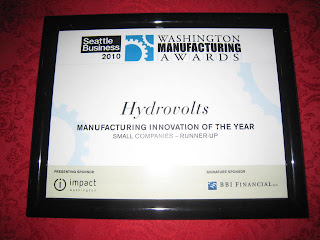
Washington Manufacturing Awards

Certificate of Award
The inaugural Washington Manufacturing Awards were held this evening in Seattle, and Hydrovolts finished as the first runner-up for Manufacturing Innovation of the Year in the Small Company category.

Nearly 100 companies were nominated for awards, and Hydrovolts was one of three finalists for the Innovation award. Companies were chosen
...by a panel of experts based on criteria that [included] revenue growth (relative to the industry), capital investments, leadership, employee training programs, production quality, productivity, energy conservation and other factors.
John Vicklund of Impact Washington helped emcee the awards sponsored by Seattle Business Magazine and RBI Financial. The reception and dinner was held in the Columbia Tower Club, high atop Seattle's tallest building with a sweeping view of the city and Puget Sound.

Rogers Weed, Director of the Washington State Department of Commerce gave the keynote address on the state and future of manufacturing in Washington. He has a dual focus on aerospace manufacturing because of its size and historical importance and on cleantech "because the Governor told me to" (laughter.) Rogers noted that the economy was improving and recovering from the loss of 190,000 jobs in the state. GDP has grown in Washington for the past 3 quarters, and he sees no likelihood of a "double-dip" recession. Asia remains huge to the state's economy and our export economy remains a national trend-setter not only in exports, but in manufacturing and manufacturing "value-add." Rogers believes and expects Washington to be a leader in the global economy.

In all, a fun evening with good food, a crisp program and great networking with old friends and new acquaintances. Thanks to Impact Washington and the sponsors for the recognition, and hearty congratulations to our friends at MicroGREEN Polymers, who won the top prize!

Thursday, May 20, 2010

Ice to Eskimos

Benson Bubbler in downtown Portland Oregon
In 2008 the average American consumed 30 gallons of bottled water, primarily from single-serving, single-use plastic bottles. That's 320 12-ounce bottles, or nearly one every day. It's obsessive.

There are many reasons not to drink bottled water.

Bottled water costs more than gasoline. It costs up to 10,000 times more than tap water. It uses 2,000 time as much energy. It has 100 times the life cycle costs.

Monday, May 10, 2010

Micro Loans for Micro Power

Installation of Solar Home System in Bangladesh
Hundreds of thousands of people have electricity because of distributed generation from small renewable energy systems financed by micro lending:
The Solar Home System (SHS) dissemination programme in Bangladesh is considered to be one of the most successful of its kind in the world, bringing power to rural areas where grid electricity supply is neither available nor expected in the medium term.
The program started in January 2005 and nearly 350,000 SHSs were installed by last summer, most of which had a rated power output of 50W. Systems came with 3-4 compact flourescent light bulbs. Owners benefit from lighting, especially in their kitchens and courtyards, and also use the systems to charge batteries, power radios, and even run 12V televisions. While statistics are lacking, it appears that some owners are using the power in their small stores and restaurants, boosting their income.

This is a great program beautifully suited to regions without existing electrical grid infrastructure, and has the potential to have a lasting and powerfully positive impact on the energy poverty that afflicts much of the developing world. Even small amounts of electricity can change lives for the better by providing lighting for reading, heating and cooking that doesn't burn nasty fuels with toxic byproducts, and the ability to create a business, boosting the local economy.

Such an approach could work with micro hydropower too.

Sunday, May 2, 2010

Laissez Failure

BP oil platform burns in the Gulf of Mexico
The slow-motion ecological catastrophe in the Gulf of Mexico is horrifying.

The oil slick is now the size of Ohio, and growing by the hour. Edges of it are now reaching land and all along the Gulf coast residents wait with deep foreboding and growing anger as the dimensions of the disaster become clear.

This is not an oil spill, but an oil spilling, as more ruptures from the sea floor, surfaces, and spreads its devastating reach towards shore. 40% of the coastal wetlands in the United States are under threat, as are the majority of the country's oyster and shrimp fisheries. Local fishermen have moved quickly through the 5 stages of grieving as they face the imminent destruction of their livelihood, economic security, their way of life, and their future.

Emergency response began quickly and broad efforts at mitigation are underway. The Obama Administration formed a National Response Team, Louisiana Governor Bobby Jindal is mobilizing the state's National Guard, and locals are taking to their boats to deploy booms to intercept the sprawling slick. Dealing with the immediate crisis is paramount now, yet soon hard questions must be asked, and honestly answered. The critical questions are:

Why did this happen? How do we prevent it happening again?

Friday, April 30, 2010

Hydrovolts is a B Corporation

Certified B Corporation Seal
Hydrovolts has achieved certification from B Labs as a B Corporation--one of only 285 companies in the United States, and one of only 10 in Washington State.

Certification as a B Corporation attests to the values of a business, including those summarized in the B Corporation Declaration of Interdependence:
We envision a new sector of the economy which harnesses the power of private enterprise to create public benefit.

This sector is comprised of a new type of corporation, the B Corporation, which is purpose-driven and creates benefit for all stakeholders, not just shareholders.

Thursday, April 22, 2010

Energy Security

Earth Day turned 40 today. For many Earth Day is an occasion to think green, hope for a less polluted future, advocate for renewable energy and perhaps push for a solution to climate change.

Others dismiss Earth Day as a symbol of mushy-minded ecomania that elevates the environment over the economy. It's a false choice, but the notion that doing something about the environment will cost the economy persists. Those who are skeptical about climate change are generally the same as those who are negative about renewable energy.

However, there are other reasons to support and promote renewable energy, and a big one is energy security. If it's renewable we don't need to rely on the supply of something like oil or uranium that has to come from somewhere else, possibly a country or region hostile to us.

Energy security matters. Most casualties in Iraq and Afghanistan come from the necessity of fuel transport--the supply chain is long and highly vulnerable.

Failing to make the speediest transition to renewable energy is bad policy for many reasons. It costs lives. It costs money. It funds those hostile to us. And it's futile, because the current energy model is not sustainable. Even the military recognizes that we need to get beyond oil because we're running out of the stuff.

Sunday, April 4, 2010

I Guess They Didn't Need a Weatherman

Strata SE1 artist's depiction of integrated wind turbines
Interesting.

A London developer will complete construction this June on the Strata SE1, which it claims "is the first development in the world where wind turbines have been integrated within the fabric of the building."

How much power will these turbines make?
The three five bladed nine metre diameter wind turbines are rated at 19kW each and are anticipated to produce 50MWh of electricity per year... approximately 8% of Strata SE1's estimated total energy consumption.
Hmm. To achieve 50MWh of output, the turbines must generate a continuous average over the year of about 1.9kW each. So Brookfield Europe, the developer, apparently infers that the actual generation will be a mere 10% of the "rated" output, which is really rather poor. A nice round figure of 10% also sounds like a guess:

Monday, March 29, 2010

Tea Power

Tea factory in Papua New Guinea
The Kenya Tea Development Agency (KTDA) has a massive power bill from over 60 factories that process tea from 500,000 farmers. The supply from the national grid is costly and erratic, so last summer the KTDA created an energy subsidiary to pursue locally generated hydropower, reducing factory costs and boosting farmers' incomes. The Kenyan Ministry of Energy identified 12 sites for the KTDA to develop distributed hydropower generation. Two of these sites are now under development:
Imenti Tea Factory Company is already generating 1 megawatt through the Imenti mini-hydro project. Last June, the factory signed a power purchase agreement (PPA) with the Kenya Power and Lighting Company to supply surplus power to the national grid. The second project still under construction at Gura river in Nyeri is a four-factory partnership that will serve the KTDA factories at Gitugi, Iriani, Chinga and Gathuthi.

Sunday, March 28, 2010

Conservatives Announce Plan to Promote Renewable Energy

Nate Beeler: Energy Policy Stopgap
Conservatives recently announced a 12-point action plan to boost renewable energy and nuclear power. The plan would also entail a substantial change to the energy sector. The plan recognizes the historical abundance of oil and gas in the country as well as the relatively recent rise of concern over pollution, resource depletion, and the green house gases emissions that are fueling climate change.

Some of the specific initiatives include:
  • A Green Investment Bank to provide public funding for new energy technologies
  • Establishing a "floor" price for carbon and an upstream tax
  • Accelerated demonstration projects for energy storage and carbon capture
  • Establishing an "energy internet", including distributed generation and a smart grid
  • Household incentives for energy efficiency
  • Electrifying the transport system
  • Implementing national feed-in tariffs
The current energy approach is "out of date"; what is needed are:

Friday, March 19, 2010

A Full Accounting

How much environmental damage results from business as usual? According to a forthcoming United Nations report about $2.2 trillion in 2008--from the activities of just the 3,000 largest global corporations. This amount is larger than the national economies of all but 7 countries in the world.
The report comes amid growing concern that no one is made to pay for most of the use, loss and damage of the environment, which is reaching crisis proportions in the form of pollution and the rapid loss of freshwater, fisheries and fertile soils.

Later this year, another huge UN study - dubbed the "Stern for nature" after the influential report on the economics of climate change by Sir Nicholas Stern - will attempt to put a price on such global environmental damage, and suggest ways to prevent it. The report, led by economist Pavan Sukhdev, is likely to argue for abolition of billions of dollars of subsidies to harmful industries like agriculture, energy and transport, tougher regulations and more taxes on companies that cause the damage.

Sunday, March 14, 2010

Enough Science, We Need More Marketing

Woman listening to an iPod, talking on a cell phone and holding a Starbucks coffee
Eric Roston at Grist considers the problem that renewable energy and other green technologies can be more expensive than the fossil/nuclear infrastructure we've used until now, and suggests some companies that might lead public opinion to the cleantech future:
I can’t help but wonder if the wrong companies are on the case. Shouldn’t Starbucks (which more than doubled the price of coffee), Apple (whose iPod delivers a tenth the sound quality of analog music at four times the cost), and AT&T (more dropped calls) get to work on making expensive-but-clean tech a style-driven phenomenon?
Sadly, he's on to something.

Saturday, February 13, 2010

Climate Insurance

Polar bears threatened by thaw across the Arctic
On Monday at the Harvesting Clean Energy Conference Claudio Stockle made the reasonable observation that the severely negative outcomes of climate change, if they occur which are happening everywhere one looks, demand action just for their possibility: it is "prudent to start taking some action, not to ignore it."

Just the day before Kurt Cobb made a similar point in discussing the need for "vigorous preparations" on climate change, even if the worst scenario is only 5% likely:
If you were told that the trans-Atlantic flight you were about to board only crashes 5 percent of the time, would you still board that plane? My guess is that you would change your reservations. Even with a 95 percent chance of surviving the flight, you would find the risk of death too high.

Tuesday, February 9, 2010

HCE Day 2

Hal Calborn
Day 2 of the Harvesting Clean Energy Conference kicked off at 8:00 a.m. here in Kennewick. There were quite a few more people in attendance than on Day 1, no doubt due to the full-day schedule, its being a Monday, and there being no distracting sporting events. Hal Calborn, Conference Emcee, summarized one of yesterday's key messages, that the focus on many attendees was on energy security being the key economic and policy driver and the need to create jobs in the burgeoning global clean energy economy. However, "it doesn't mean that climate change is not an issue."


Next up was US Representative Doc Hastings (R-WA) and the contrast of his "special remarks" to those yesterday by US Representative Jay Inslee (D-WA) was stark. Inslee supported the Waxman-Markey and Stimulus bills; Hastings opposed them. Inslee is one Congress' most impassioned and articulate champions of renewable energy and clean technology; Hastings said he is "in favor" of renewables, but spent most of his time advocating for the primacy of oil and gas.

Monday, February 8, 2010

HCE Day 1

US Representative Jay Inslee (D-WA) and Rogers Weed, Washington State Director of the Department of Commerce
US Representative Jay Inslee (D-WA) gave the keynote at today's opening session of the Harvesting Clean Energy Conference. He had many interesting things to say, and the predominantly friendly audience was liking what they heard.

His most important point: There will be clean energy jobs--lots of them--in the future. It is not a question of whether, but where.

While he was also quick to praise Washington State's largest trade partner in general, he was pointed in his criticism of how they were competing and had harsh words for what he called their "strange attitudes about trade." They trade from us, "reverse engineer" it, then close their market as they create their own competitive products. It is "unacceptable and non-sustainable." We cannot allow them to "illegally dominate the clean energy future."

Significantly, the fault is squarely our own: we have yet to aggressively compete in return. The Chinese have a "national goal" to dominate the cleantech sector, and the US as a nation needs to "stand up to them."

Thursday, January 28, 2010

Broad Agreement on Supporting Hydrokinetic Power

Hydrovolts CEO Burt Hamner was one of several leaders to testify yesterday before the Washington State House Technology, Energy & Communications (TEC) Committee on HB 2869 [pdf]. The bill would provide "an investment cost recovery incentive for hydrokinetic energy" as we reported last week.

Organizations that frequently stake out opposing positions were united in their support. It's rare that utilities, business advocacy groups and environmental groups all agree, but it happened in Olympia as Puget Sound Energy, The Association of Washington Business and Climate Solutions all spoke in favor.

Members of the TEC appeared broadly supportive of the measure. If all goes well, HB 2869 will be reported out of the committee next week, and will be sent on to the House Ways and Means Committee.

Contact your state legislators and ask them to support HB 2869, and please forward this message to other supporters of renewable energy and ask for their support as well.

UPDATE: fixed typo

Wednesday, January 20, 2010

Washington Production Incentives for Hydrokinetic Power


Under HB 2869 canals in Washington State could generate renewable energy from Hydrovolts turbines with a capital payback of less than 2 years

Representative John McCoy, Chair of the Washington House Technology, Energy & Communications (TEC) Committee has introduced HB 2869 [pdf], to provide "an investment cost recovery incentive for hydrokinetic energy." Similar incentives are currently only available for electricity generation from solar and wind.

The bill would amend the language of RCW 82.16.110-120 to add a hydrokinetic energy system manufactured in Washington State to the list of sources of "customer-generated electricity" that qualify for the incentive program. According to the bill, a "hydrokinetic energy system" means
a device that generates electricity from waves or directly from the flow of water in ocean currents, tides, inland waterways, nonfish-bearing canals, or irrigation districts, that does not require the impoundment or diversion of water. [emphasis added]
The proposed hydrokinetic incentives are $0.15/kWh for hydrokinetic energy systems, and increasing to $0.36/kWh if manufactured in Washington State. Since the maximum benefit per installing customer is $5,000 per year; the impact on utilities will be relatively minor for several years at least.

The benefit to customers would be significant, accelerating the typical capital payback period from a Hydrovolts turbine from 4 years to less than 2.

These incentives would be available until June 30, 2020, the same as from other sources, unless extended.

The bill has been referred to the TEC Committee, and a public hearing is scheduled for January 27. The legislature in Olympia has an extremely heavy lift ahead of it to bridge a multi-billion dollar budget gap, which means many other worthy bills will struggle for attention. This bill is one that merits consideration and enactment, since its budget cost is de minimus and the benefits in stimulating clean technology, sustainability and job creation are compelling.

Please contact your state legislators and urge support for this worthy legislation, and forward this message to other supporters of renewable energy and ask for their support as well.

UPDATE: fixed wacky formatting issues

Wednesday, January 6, 2010

Peak Oil Refuted


We will never run out of oil.

This according to Peter Davies, Chief Economist at BP. Why?
...ideas of peak oil supply are not true. Doomsayers have exaggerated the issue. The bell-shaped curve of production over time does not apply to the world's oil resources.
Because the rules don't apply to oil! Apparently you just can't use up all of the stuff, even if it is in finite supply and even if, as he admits, "a barrel can only be produced once."

The reason of course is faith in technology and markets. Davies believes that as long as demand doesn't slacken, the economic benefit of increased production and the marvels of ever-better (and ever more feasible) extraction technology imply that there will always be supply to meet any demand:
Those who believe in peak oil tend to believe that technology and economics don't matter, and I think this is false. The application of technology, the innovation of new technology and economic forces especially mean that recoverable oil resources can increase. If there is a peak in oil, it will come from the demand side.
Well, of course technology and economics matter, but then, so does geology.

Future technological advances and oil selling for $500 per barrel have a high likelihood of allowing more production from reserves not currently feasible. But so what? They won't, as Davies laughably asserts, increase "oil resources." There is only so much oil in the ground, and no amount of money or technological innovation will create more to meet relentlessly and arbitrarily increasing demand. It's a bit like Peak Buffalo.

Perhaps Davies misunderstands the concept of peak oil. (This is not unlikely given his antiquated economist's viewpoint that EROEI is "meaningless.") It is not about using up the last drop. Instead, we pass (or have passed) the point where the easy oil has been had, and what remains is increasingly hard to find, hard to reach, poor quality, in smaller concentrations and, critically, enormously expensive. The limits of technology are pushed and the economics become infeasible, but the driver is geology--there's a finite amount of oil, only a fraction of which will ever be plausibly produced and used. The idea that future technology will enable a never-ending cornucopia is absurd. Moon rocks can be obtained using technology, but no one will ever bring them to Earth to make a garden wall.

Peak oil will not be caused by demand. Slackening of demand will occur, but as demand destruction, a symptom of soaring prices caused by shrinking production at escalating cost.

I found Davies' rationalizations in a piece from Emirates Business 24/7 (via). The author, one Nadim Kawach, clearly also a true believer in a permanent Age of Oil, dismisses claims of any eventual peak:
...such scenarios have been refuted by most oil producers, mainly the Arab countries on the grounds their region actually contains much more oil, which could be extracted by advanced technology in the future.
Can more oil be produced in future? Quite possibly. At endlessly affordable cost? Unlikely. Peak oil refuted? Only if you believe in magic ponies.

Saturday, December 19, 2009

Distributed Hydropower for Resource Exploration


Hydrovolts turbines provide distributed generation from hydropower, a great benefit to those who live in remote areas where no grid exists to deliver centrally produced electricity. These people need a distributed, i.e. locally produced and used, energy generation technology which works when and where they need it, and is portable, rugged, and cost-effective.

Another example of an off-grid need for electricity is remote resource exploration, such as for mining. Almost all mining operations use quite a bit of water; feasibility of a particular mine site is dependent in part on the availability of a reliable water supply, generally from a natural watercourse such as a river. Consequently, such sites are well-suited for power generation using a Hydrovolts turbine.

The existing solution in almost all cases is a diesel generator. It has the advantage of providing steady power when and where needed, but has several serious drawbacks, including smell and noise, but most especially cost. In most remote locations the fuel must be brought in by truck, sometimes on very bad roads that can take days to navigate. In extreme cases, fuel must be flown in by helicopter. As a result, the effective cost of the generated electricity can be $1.00/kWh and up, compared to the average US retail price of $0.11/kWh, and less than $0.02/kWh from a Hydrovolts turbine.

Many companies engaged in resource exploration, including mining companies, are acutely sensitive to the needs and values of the communities in which they operate. Commonly such companies will build infrastructure (sometimes as part of their operations) which they will leave to community ownership upon project completion. According to one potential Hydrovolts customer, such infrastructure helps satisfy the "social license" companies crave to smooth the acceptance of their operations by local populations. In creating a "prideful and positive experience" they gain support of communities, reduce conflict and lower costs. Mining companies seek a social license when starting a new project or entering a new community not only because it is a best practice in sustainability, but because it increases the prospects for a successful project:
In 2003 Pierre Lassonde drew attention to the observation that “Without local community support, your project is going nowhere.” He described social license as “…the acceptance and belief by society, and specifically our local communities, in the value creation of our activities, such as we are allowed to access and extract mineral resources. … You don’t get your social licence by going to a government ministry and making an application or simply paying a fee. … It requires far more than money to truly become part of the communities in which you operate” (Lassonde 2003). A primary objective of gaining a Social License is to minimize project risk.
Hydrovolts turbines are an excellent choice for mining companies in the exploration phase of projects, as they are easily and rapidly deployed at modest cost. Hydrovolts turbines in larger numbers are also appropriate to the production phase, where they can save in overall capital costs as well as reduce costs during operation. Companies leaving the turbines behind for community would cement the social license and generate the goodwill and positive reputation that could aid in future projects. Creative partnering may also allow sharing the capital cost with NGOs or even the community itself.