Showing posts with label trains. Show all posts

Wednesday, June 9, 2010

Training Commuters is Difficult

Caltrain in Menlo Park
California Bay Area train system Caltrain has received approval from the Federal Railroad Administration to run electric locomotives on the same tracks as their current diesel stock. Apparently this is the first time such approval has been given to any system in the United States. The business case to save the struggling Caltrain was the decisive argument, according to Robert Doty, director of the Peninsula Rail Program which championed the move.

Doty suggested that this result moves the state closer to running high-speed trains on the same tracks:
The same equipment standards that we have qualified for, the equipment we're looking for, are the same equipment standards for high speed rail. So in effect what we've done is we found the process that needs to be followed and we've done it successfully. Now, they can take our process and expand it for high speed rail, so it is absolutely a precursor for high speed rail.
Well, that's a bit like saying that building a Volkswagon Bug paves the way to building a Porsche Carrera.

Wednesday, June 2, 2010

Hear My Train A-Comin'

Would you take a high-speed train that doesn't stop?

The video shows the "non-stop MRT system" of its Taiwanese inventor Peng Yu-lun and is (I think) in Mandarin, but you can get a pretty good idea nonetheless of how passengers use ingenious reusable shuttles to get on and off a high speed train without it stopping or even (much?) slowing down:


English explanation here.

Possible problems:
  • Trains are taller, so existing bridges might need to be rebuilt
  • Not everyone in the train can fit in the shuttles, so they couldn't all get off en masse at the stadium station to go to the ball game
  • Acceleration of the shuttle may be too exciting for those with heart problems or other health issues
  • Most people are too terrified of derailments anyway
  • US patent 4,425,851 from 1984. Why did no one do this already?
  • A great Peter Tosh tune would be obsolete:


    Update: A friend, working in the PRC for many years writes:
    It is Mandarin. The platform announcer tells travellers that train 168 non-stop from Beijing to Guangzhou is approaching the station. Passengers travelling in the direction of Guangzhou are to board the shuttle. Then the train's announcer tells passengers disembarking at Wuchang to board the train's shuttle. Lastly there is a welcome to Wuchang station announcement. The inventor explains that he has put together a simple mechanical frame just to demonstrate the basic concept. He then describes the passenger movement for boarding and exiting the non-stop train from Beijing to Guangzhou.

    This is very interesting!

    Saturday, May 8, 2010

    National Train Day

    National Train Day
    In the United States it's National Train Day. I like rail travel, and I prefer it to flying or driving.

    Train travel in the US has its good and less good aspects. Here are 10 of each:

    10 good things about traveling by train:
    1. Great scenery through large windows
    2. Electrical outlets for laptops or other equipment
    3. Lots of room (more in coach than airlines have in first class)
    4. A dining car with good-sized tables
    5. A lounge car
    6. TSA doesn't do trains
    7. Show up 5 minutes before departure and get on easily
    8. No jet engine roar, no seatbelts
    9. Cheaper than cars or airplanes
    10. Much smaller carbon footprint

    Saturday, January 30, 2010

    Riding the Rails

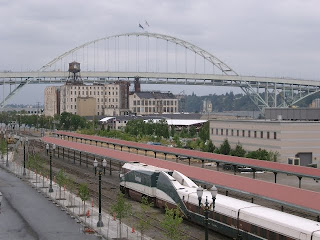
    Amtrak Cascades at Portland's Union Station
    I choose public transit. Not always, but as much as I can.

    Late last summer I had a 1:00 Friday meeting with a seed-stage venture fund in Vancouver, BC. By car it's about 110 miles up I-5 to the border crossing at Blaine, and another 30 miles further on BC Provincial highway 99.

    It's a tedious drive. Scenery punctuates monotony infrequently.

    I took the train instead. The timing works well--there's a 7:40 a.m. departure from Seattle's King Street station getting into Vancouver somewhat before noon. A pleasant bus ride for another $2.50 brought me within a block and a half of the downtown office for my meeting. Afterward, I visited an old friend over some Granville Island IPAs and was back to the station in time for the 5:45 back to Seattle. The beautiful evening provided pleasing views across the water towards Vancouver Island and the Olympic Peninsula, bathed in the soft sunset hues of an early autumn evening, and dotted with boaters seizing an early start to a long weekend laze. Outside the opposite windows was a dense metal caravan of single-occupant vehicles snailing their way out of town to the nightly bottleneck at the tunnel under the Fraser River.

    Sunday, December 27, 2009

    Moving Quickly on Trains


    Even as the Eurostar has "fluffy" moisture problems, stranding people in the Chunnel for up to 16 hours, over in China people Saturday started taking trips on the fastest high-speed train in the world.

    The new line is 664 miles long, connecting Guangzhou to Wuhan, and will eventually extend all the way to Beijing. Trains average 217 mph, faster even than France's TGV and Japan's Shinkansen.

    Here in the United States high-speed rail remains a distant hope. It was 50 years ago that Japan started work on the original Tokaido Shinkansen high-speed train, at 130 mph slow by modern standards, but still faster then than anything built in the US since. The American Recovery and Reinvestment Act (ARRA, the "Stimulus Bill") allocated starting funding, but it won't get much built. Washington, New York, California and other states are fighting over scraps of it and asking for funding well beyond the $8B specifically allocated by ARRA. California voters approved a visionary project with a currently estimated cost of $45B.

    Current European problems are somewhat anomalous. High speed trains have been operating for many years throughout Europe with few problems and heavy ridership. The system is extensive.


    As as is implied by the color-coded segments of European high-speed trains, most passenger trips are of a few hundred miles rather than intercontinental. Trains don't replace airplane trips; they replace car trips because they are faster, cheaper, and more comfortable. Airline travel is increasingly unpleasant, and new security measures are likely to make it more so. In the high-travel transportation corridors especially trains are looking better and better:
    ...rail has several advantages that make it worth taking even if the terminal-to-terminal time is considerably longer than on air: less time on security lines; arrival in the city center, which is usually closer to where you want to go; electrical outlets!; and 3G internet as I travel.
    I'd also add the obvious: you don't need to tuck your knees under your chin to fit in the seat, and you're pretty much free to get up and move around as much as you'd like.

    The new Chinese line was built in 4 years. 42 more lines are planned by 2012.