Sunday, March 22, 2009

"But This Ship Can't Sink!"

Course correction neededClimate Progress is, without exception, the best source for factual information on the science and politics of climate change.

However, Joe Romm, the former Department of Energy official who largely is Climate Progress, says we shouldn't call it "climate change" anymore, since that is too unalarming a euphemism for the dire future that will arrive later this century:

  • Staggeringly high temperature rise, especially over land — some 15°F over much of the United States
  • Sea level rise of 5 feet, rising some 6 to 12 inches (or more) each decade thereafter
  • Widespread desertification — as much as one-third of the land
  • Massive species loss on land and sea — 50% or more of all life
  • Unexpected impacts — the fearsome “unknown unknowns”
  • More severe hurricanes — especially in the Gulf
Read the post. It's an excellent and succinct summary, with references. The consequences of not stabilizing atmospheric carbon levels are growing more severe. The costs of mitigation are today still relatively modest, but increasing; the costs of adapting in later decades to a changed world and coping with multiple failures of economic systems, the environment, and public health will be substantial.
Now if only the scientific community and environmentalists and progressives could start articulating this reality cogently.
If only.

The problem is that the timescales are enormously long compared to the attention spans or even the planning horizons of most people. We live in times that emphasize the short-term in everything. Quarterly earnings reports. This year's model. Spring fashions. Low teaser rates. 90 days, no interest. How do you galvanize people to respond to an emergency they can't see and which takes decades to wreak its havoc? I am reminded of a scene from the movie Titanic, after the iceberg has struck and gashed the hull: the naval architect, Thomas Andrews, breaks the bad news to Captain Edward J. Smith and Cunard Line honcho J. Bruce Ismay:
Thomas Andrews: ...As she goes down by the head, the water will spill over the tops of the bulkheads at E deck from one to the next. Back and back. There's no stopping it.

Smith: The pumps... if we opened the doors...

Thomas Andrews: [interrupting] The pumps buy you time, but minutes only. From this moment, no matter what we do, Titanic will founder.

Ismay: [incredulously] But this ship can't sink!

Thomas Andrews: She's made of iron, sir! I assure you, she can... and she will. It is a mathematical certainty.
Meanwhile the passengers continue on, unaware that their current experience is not their future--the ship is doomed. The lights are still on, the music is still playing; to them, the ship looks just the same. The fleeting concern of the moneyed and comfortable is quickly allayed by those for whom reassurance is their job. Steward: "I shouldn't worry ma'am. We've likely thrown a propeller blade, that's the shudder you felt. May I bring you anything?" While it is yet level, anyone hurtling about the deck screaming that the ship is sinking would be ignored or dismissed out of hand (as Ismay does: "This ship can't sink!")

This Titanic scene is a parable for us passengers on the Earth. For the most part, everything looks OK, but we are taking on water. People with expertise, who are knowledgeable on the particulars, are sounding the alarm, and urging response and preparation. Others, who may be experts in their own fields, insist that nothing is amiss. Maybe in our case we can buy enough time with the pumps, and the repairs, and the ship needn't sink. Denial and delay, however, ensures a steep plunge, and an ugly lifeboat exercise where none of money, status or morality will hold much sway.

Ismay's incredulous outburst, "But this ship can't sink!" comes from his belief, not his expertise. He lacks the understanding of engineering and physics to make such a statement of fact; instead it is a desperate attempt to arrest the vanishing permanence of a state of mind: too much would change or be lost were it to happen, so the ship can't be allowed to sink. But of course, it can, and it does.

The biggest impediment to acceptance of, and action upon climate change, the sinking of our ship, is the inchoate belief that it is unsinkable.

Sunday, March 8, 2009

Why We Are Going Quietly Nuts

Ken Ward:

If we accept the worst, or precautionary assessment, then U.S. environmentalists have perhaps a year to avert cataclysm, and nothing we are doing now will work. We are dealing with this terrible situation in a very ordinary and human way: by denying it.

Our denial comes in a variety of forms: we believe that President Obama can and will solve the problem; we ignore Jim Hansen's assessment and timeline; we concentrate on our jobs and organization agendas and pass over the big picture; we focus on the molehill of climate policy rather than tackle the mountain of climate politics; we assess our efforts by looking back on how far we have come and do not measure the distance still to be traveled; we scrupulously avoid criticizing each other, lacking conviction in our own courses of action and not wishing to invite criticism in turn; and we are irrationally committed to antique approaches that are self-evidently inadequate.

In our hearts we know that what we are doing is futile, but we do not know what else we should or could be doing. The constraints within which we work feel so intractable and out of human scale that we cannot imagine how to break them. Despite our best efforts, Americans just don't seem to get it or they don't care, and we are at a loss to explain this. Unable to influence our own nation, we are further dismayed by the far vaster challenge of altering the trajectory of China, India, Brazil, and the rest of the world.

Nothing we now confront should be a surprise. We have known for more than thirty years that the world was bound to reach this state (with twenty years specific warning on climate). The purpose of environmentalism was to alter the self-destructive parabola of growth by introducing new values and sensibilities, which, as has been clear for some time, we have manifestly failed to do.

<snip>

If we continue down our present road, we will leap from foggy thinking into pure madness, there being no other means of keeping reality at bay.

OK, back to work.

Saturday, March 7, 2009

The Fiction of Michael Crichton

A new Florida coast?I remember reading The Andromeda Strain as a teenager and finding it both engrossing and morbidly enjoyable. The original film (haven't seen the remake) was good too, and of course, Jurassic Park has become a modern Hollywood classic.

Thus it was disappointing for me to discover that Michael Crichton's enormous talent for fiction was not confined to his novels. A little knowledge is a dangerous thing and the damage done is magnified through celebrity and a media that shirks its most noble purpose if not its basic duty [pdf]. Instead of questioning what it is told it slavishly parrots discredited viewpoints, creating a faux equivalence between credentialed experts and peer-reviewed science on one hand, and a legion of poseurs, cranks and industry shills on the other. The result is to foster a "controversy" not to provide a forum for a debate on the merits, but out of laziness, naivete and simple commercialism:

Of course we must not forget that the bottom line with media is sales, not truth (or accuracy). Stories of scientific certainty are only interesting once, controversy is eternally newsworthy.
Until George Will's recent, error-filled and much-ridiculed column denying the reality of climate change, Crichton was the poster boy for the deniers. The points Crichton makes have been repeatedly debunked as they have been made many times before. Crichton merely reiterates shopworn mendacity.

The argument that climate change is unproven because there is no "scientific consensus" is both grossly inaccurate and betrays a fundamental ignorance about the scientific method. There are others who complain of the limitations and warn of the dangers of relying on scientific consensus, repeating endlessly that such things are "unproven" because the "consensus" is not 100%. Creationists casting doubt on evolution are of this ilk, as are the deniers of everything from moon landings to the Holocaust.

Crichton is correct in that "consensus" can have a political slant, and that the existence of a consensus on a scientific theory does not constitute proof of that theory. He says instead that proof simply

...requires only one investigator who happens to be right, which means that he or she has results that are verifiable by reference to the real world. In science, consensus is irrelevant. What is relevant is reproducible results. The greatest scientists in history are great precisely because they broke with the consensus.
This is a pretty pinched view especially when he and others smugly note that no climate change theory lends itself to reproducible results because the only global experiment we have available is the Earth we live on. Reproducible results must be done on different scales and in a different manner, using proxies and building on the edifice of broader science to extrapolate to the testing of such hypotheses. There's nothing wrong or manipulative in this; scientists perforce do similarly in astronomy, human genetics, and other areas where direct experimentation is impossible, impractical, or unethical.

Climate scientists do not dogmatically cling to theories; they are testing hypotheses about climate change, and as a result the theories are constantly evolving. The broad outlines, however, are quite clear and largely settled. Greenhouse gases are concentrating in the atmosphere with a rapidity and to an extent that will cause changes to the climate, and these changes include many very negative effects for humankind, including rising sea levels, desertification, famine, habitat destruction, and likely mass ecomigration. While experiments and data collection continue, and theories are always subject to revision according to observations, the core elements of climatology in this regard are well-established.

Crichton decries the politicization of climate change questions and attacks a misguided emphasis on consensus as the culprit. However, the few climate change deniers and the vanishingly small number of sceptical climatologists don't propose credible alternative hypotheses that withstand scientific scrutiny. The fact that they trot out discredited studies, quibble about the edges of the data, savage the same strawmen and finally complain about politics for their intellectual failure shows a clear lack of scientific honesty.

I mean really, now. How much proof is needed before we act?

It's not as if the implications of responding to the reality of climate change are so terrible. The costs are actually rather modest. As I've argued before, picking between the environment and the economy is a bogus choice. The only reason to resist doing something about climate change is the disruption to the status quo, and to the vested interests that profit from it, particularly the fossil industry, which must forever deny recognition of climate change as an external cost of their business. Reluctance to act is also psychological, stemming from the a priori belief that we can despoil the environment for temporal ends because it is our birthright as homo colossus.

Great scientists, incidentally, are not great because they "broke with consensus" but because they followed their observations and revised their hypotheses diligently wherever they led without regard for the preconceptions of themselves or others. Often this did put them in a lonely place against the orthodoxy of the times. Right now, the brave adherence to wherever the facts lead is not the province of the deniers but of those warning of the impending and irreversible effects of climate change. The orthodoxy to be overcome is not the fact that the climate is changing but a contrary belief that we need do nothing as nature is cyclic, we needn't worry, and we can merrily go on changing nothing about our lives or ecohostile habits.

Nature has other ideas.

As a fellow alumnus, I regret that Crichton's evident erudition and relentless wrong-headedness reinforce the oft-told gibe: "you can always tell a Harvard man, but you can't tell him much." I loved most of your fiction, Michael Crichton. RIP.

Tuesday, March 3, 2009

Curiouser and Curiouser

Getting late to act on climate changeSaid Alice, in Wonderland:
It would be so nice if something made sense for a change.
Alice could just as easily have said this listening to any of Exxon's climate change deniers, which the oil giant, despite repeated promises to stop, continues to fund. The latest? An Ivy professor claims we are suffering from a carbon "famine". You can't make this stuff up.

Dr. William Happer of Princeton University testified last Wednesday before the Senate Environment and Public Works Committee last week. He had an utterly novel take on atmospheric CO2 levels, saying that today represents a CO2 "famine" compared to levels of "80 million" years ago. Incredibly, Happer stated that higher CO2 levels would be beneficial to humankind. More CO2, a little warming--it's really all "fine". You really have to watch the video to get the full measure of his glib fatuousity:


Senator Barbara Boxer (D-CA), chair of the committee was nonplussed at the specious comparison, but had the good sense to note afterwards that Happer is chair of the George C. Marshall Institute, which receives a large part of its funding from Exxon Mobil. Exxon is well known for its greenwashing, spin and self-serving PR. It is really laughable what that funding can buy!

Happer provided another weird equivalence: carbon restrictions and Prohibition:

Prohibition [of liquor] was a mistake and our country has probably still not fully recovered from the damage it did... Institutions like organized crime got their start in that era. Drastic limitations on CO2 are likely to damage our country in analogous ways.

Yes, I can see it now. Illicit gasoline using homemade refining techniques in backwoods stills. Carbon revenuers chasing them down. Speakeasies filled with furtive patrons giddy from the use of oil lamps. A black market for plastic packaging clamshells. Will organized crime be smuggling petrochemical fertilizers to the family farm? What "analogous ways" is Happer imagining?

What's really ridiculous about this pathetic attempt at fear-mongering is that carbon crime is already happening repeatedly.

Happer also warns about the supposedly ruinous costs of carbon restraint, again without any evidence. The costs of not dealing with the problem, including desertification, rising sea levels, etc. are not considered. In comparison, the cost of a carbon regimen seem modest.

Happer, like many denialists, has no degree or other evident credentials in climatology; instead Happer is the Cyrus Fogg Brackett "I am not a climatologist" Professor of Physics at Princeton University. In his testimony he is literally hand-waving as he throws out wild numbers of alleged CO2 concentrations of "a thousand" and "3 or 4 times" what they are today. He states without attribution that, while there has been warming historically, it has "ceased" in "the past ten years," a fabrication at odds with the data. His grasp of geologic time periods is equally reality-free. After derisively dismissing "propaganda" in children's books about climate change one wonders where he gets his information--perhaps a book showing cheerful cave dwellers gamboling about in a tropical idyll with their pet dinosaurs? Treehugger provides a snarky summary on what those times were really like. Happer's prepared text [pdf] cites Orwell and Voltaire as authorities, attacks the usual strawmen like "inaccuracies" in Al Gore's slide show, and rehashes long discredited denier talking points as if they were fresh insights. Nothing new here.

Increasing atmospheric concentrations of greenhouse gases (GHG) and especially carbon dioxide (CO2) alarm respected researchers because they believe, based on their broad, inclusive and peer-reviewed scientific assessment, that the resulting temperature increases will produce tipping point events that will be very damaging to humankind and will not be easily mitigated or reversed for many generations. There is a broad scientific consensus on climate change.

However, there will always be sceptics for whom no amount of scientific vetting will ever be enough. For these people, climate change remains and will forever remain an "unproven theory", a "hypothesis", etc. One wonders if they understand the scientific method, the way in which scientists create systems for understanding natural phenomena based on observation, hypothesis and experimental verification. If they applied the same level of scepticism to other areas of science they would be equally unconvinced by such "theories" as gravity, the roundness of the earth, or evolution. (Well, that last one is also a favorite of the "unproven!" crowd.)

Beyond the unscientific sceptics, for whom there is never enough evidence, there are also the anecdotal sceptics, for whom irrelevant data has exalted meaning. However, my favorite are the fantasy sceptics, for whom fictional data, whether derived from literature, cranks, or sheer conjecture of their own febrile imaginations ("what if!") has enough import to doubt anything.
Some of these people even get to rave to Congress as "experts". Imagine.

The George C Marshall Institution (GMI), which provides Happer's soapbox, says on its home page:

Our mission is to improve the use of science in making public policy about important issues for which science and technology are major considerations.

They go on in a very high-minded fashion about the importance of unbiased, impartial, accurate scientific fact to guide and inform policy decisions:

Where science is misused and distorted to promote special interests, GMI works to improve the situation:

  • by communicating scientific information clearly,
  • by identifying key linkages between science and policy issues,
  • and by providing balanced and accurate assessments on specific science-based
    policy issues.

The Institute's accurate and impartial analyses are designed to help policy makers distinguish between opinion and scientific fact so that decisions on public policy issues can be based on solid, factual information, rather than opinion or unproven hypotheses.

Says the George C Marshall Foundation of the former General, Cabinet Secretary and Nobel Laureate for which it is named:

His principles of honesty and truth gained the trust of millions of Americans and the respect of world leaders throughout his years of service.

Truthfully, one wonders what George C Marshall the man would make of his namesake Institute's current Chair and his bizarre claims. Honestly.

Update: Just to clarify, the George C Marshall Foundation seeks to "promote the values and beliefs that encompass George Marshall's legacy for the benefit of future generations". The George C Marshall Institute is not affiliated with the Foundation and claims to "conduct technical assessments of scientific issues with an impact on public policy."

(h/t the future is green)

Tuesday, February 24, 2009

It Begins With Energy

President Obama February 25, 2009President Obama addressed the country before a joint session of Congress tonight. It was not technically a State of the Union address, which was just as well, as it relieved Obama from the unpleasant chore of finding an suitably precipitous adjective too replace that used in the shopworn bromide, "The state of our Union is strong." Instead he said that

[The] day of reckoning has arrived, and the time to take charge of our future is here.
It was, even by his standards, an excellent speech. He deftly balanced alarm at where we are as a nation, conveyed the urgency of taking bold action, drew on relevant history and quietly reassured that American determination gives us confidence of prevailing.

Read the whole thing. Excerpts on energy:

The fact is, our economy did not fall into decline overnight. Nor did all of our problems begin when the housing market collapsed or the stock market sank. We have known for decades that our survival depends on finding new sources of energy. Yet we import more oil today than ever before.
Yes, but will we have the will to finally act? Can Obama bring the country and the Congress with him on this?

It begins with energy.

We know the country that harnesses the power of clean, renewable energy will lead the 21st century. And yet, it is China that has launched the largest effort in history to make their economy energy efficient. We invented solar technology, but we've fallen behind countries like Germany and Japan in producing it. New plug-in hybrids roll off our assembly lines, but they will run on batteries made in Korea.

Well I do not accept a future where the jobs and industries of tomorrow take root beyond our borders - and I know you don't either. It is time for America to lead again. Thanks to our recovery plan, we will double this nation's supply of renewable energy in the next three years. We have also made the largest investment in basic research funding in American history - an investment that will spur not only new
discoveries in energy, but breakthroughs in medicine, science, and technology. We will soon lay down thousands of miles of power lines that can carry new energy to cities and towns across this country. And we will put Americans to work making our homes and buildings more efficient so that we can save billions of dollars on our energy bills.

But to truly transform our economy, protect our security, and save our planet from the ravages of climate change, we need to ultimately make clean, renewable energy the profitable kind of energy. So I ask this Congress to send me legislation that places a market-based cap on carbon pollution and drives the production of more renewable energy in America. And to support that innovation, we will invest fifteen billion dollars a year to develop technologies like wind power and solar power; advanced biofuels, clean coal, and more fuel-efficient cars and trucks built right here in America.

As for our auto industry, everyone recognizes that years of bad decision-making and a global recession have pushed our automakers to the brink. We should not, and will not, protect them from their own bad practices. But we are committed to the goal of a re-tooled, re-imagined auto industry that can compete and win. Millions of jobs depend on it. Scores of communities depend on it. And I believe the nation that invented the automobile cannot walk away from it.

None of this will come without cost, nor will it be easy. But this is America. We don't do what's easy. We do what is necessary to move this country forward.

I don't buy into the fiction of clean coal, but otherwise this is a no-nonsense call to bold, direct, specific action. It's true leadership into the face of difficulty and the teeth of adversity. It's a refreshing and much needed change, and a stark contrast to everything the GOP has said and continues to say.
Louisiana Governor Bobby Jindal gave the Republican response. He attempted to use his personal story, a folksy delivery and a selective recounting of how he was doing things better in his state to reiterate core Republican concepts of less spending, more tax cuts, and limited government. Not only is the message completely out of step with the times and the mood of the country, but his presentation came across as mawkish, stilted, even canned, as if he had recorded it earlier in the day. He didn't really respond to what Obama said at all. On energy all he had to say was:

To strengthen our economy, we need urgent action to keep energy prices down. All of us remember what it felt like to pay $4 at the pump. And unless we act now, those prices will return.

To stop that from happening, we need to increase conservation, increase energy efficiency, increase the use of alternative and renewable fuels, increase our use of nuclear power, and increase drilling for oil and gas here at home.

We believe that Americans can do anything. And if we unleash the innovative spirit of our citizens, we can achieve energy independence.

The idea that we can somehow prevent gas prices from going back up is astonishingly naive. He is either woefully ignorant of the price drivers or is shamelessly pandering to his political base. Prices are low now, temporarily, because of the enormous demand destruction attending our cratering financial situation. They will stay low only in a global deflationary environment.

Increasing conservation and efficiency are excellent ideas; Jindal should focus on convincing his own party to support concrete measures to do so. "Alternative and renewable fuels"? That could mean anything from algae, possibly useful but years away to ethanol, a boondoggle that cause way more harm than help. Nuclear power? There are so many reasons why nuclear is not the answer. Lastly, there's the that old favorite, more drilling, which is a false hope.

Missing entirely from Jindal's retreads is any mention of renewable energy. No wind. No solar. No hydrokinetic generation of any kind. Only the vague "unleash the innovative spirit", a hollow piece of flattery that he probably imagines would occur through the magic of more tax cuts, which is not what we need.

The Republican idea that Jindal is a rising star and potential 2012 nominee shows both the party's intellectual bankruptcy and how frighteningly clueless they are about the deepest existential crisis the country has experienced in a generation--maybe ever--a crisis created by the same discredited policies they blithely suggest we continue.

Sunday, February 22, 2009

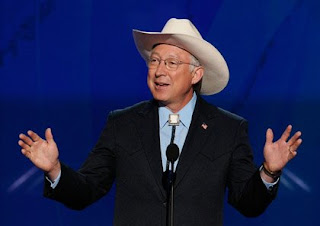
Salazar's Oil

Even-handed on energy?The appointment of former US Senator Ken Salazar (D-CO) as Interior Secretary provoked some ambivalence in both environmental and industry circles. A strong-willed and outspoken westerner, Salazar is seen as industry-friendly while still being environmentally concerned, although just not enough so to completely please either side. In office, his early actions appear consistent with his reputation. For his part, the Secretary has neither fully charmed nor alarmed. Is he a centrist such as President Obama believes will further his so-called post-partisan approach to governing?

Oil Shale


Salazar, who halted leases for oil and gas development on some federal lands in Utah earlier this month, said that while the administration will focus on energy efficiency and renewable sources, there is still room for conventional fuels. Oil shale, he added, still has "great potential," and he may revise rules on harvesting that energy source "in the near term." "We intend to move forward with a comprehensive energy plan," Salazar told a bipartisan group of Western governors huddled in Washington for a national summit. "You should take away from this conference in Washington that the Obama administration is not against developing any of those resources. … Let's put everything on the table."
Last November Salazar's predecessor as Secretary, Dirk Kempthorne, rushed through regulations under the Bureau of Land Management (BLM) to encourage oil shale development in the so-called Green River Formation, a two million acre tract of federal land straddling Colorado, Utah and Wyoming that optimists in the Fossil Industry think may contain perhaps 800 billion barrels of "recoverable" oil. As I noted at the time, Salazar was strongly opposed, concerned about scarring the land of his home state and calling the projected royalties to the government "a pittance."

He further criticized the hastiness of the decision in light of the failure by BLM to analyze the potential environmental impacts, and the additional and enormous resource contention that would ensue over dwindling water supplies:

These regulations are premature and flawed. The Bush Administration has fallen into the trap of allowing political timelines to trump sound policy. Over and over again the Administration has admitted that it has no idea how much of Colorado’s water supply would be required to develop oil shale on a commercial scale, no idea where the power would come from, and no idea whether the technology is even viable on a commercial scale.
Now he blandly calls the Bush attempt to ramrod rules merely "misplaced" and seeks simply to assess the "legal options" the Interior Department has available to it and to make his own decisions over the course of the next 6 months. Shale shills are pleased to agree: "It's foolish to dismiss any options at this point," says Utah Gov. Jon Huntsman Jr.

Offshore Oil

While giving encouragement to one oil faction, Salazar has disappointed another. Two weeks ago he put the brakes on the offshore oil and gas leasing rules promulgated by the Bush administration on its last day in office:

At a news conference in Washington, Salazar said he will move to slow the "headlong rush" to "drill, drill, drill." Salazar said Bush's midnight five year plan, which covers the years from 2013 through 2017, accelerated by two years the regular process for creating a new plan for the outer continental shelf. It "was a process rigged to force hurried decisions based on bad information," he said. "It was a process tilted toward the usual energy players while renewable energy companies and the interests of American consumers and taxpayers were overlooked." "It opened up the possibility for oil and gas leasing along the entire eastern seaboard, portions of offshore California, and the far eastern Gulf of Mexico - with almost no consideration of state, industry, and community input and, in the case of the Atlantic coast, with very limited information about the nature of offshore resources," the secretary said. Despite the sweeping proposal to open up as many as 300 million acres to new offshore oil and gas leasing, the Bush administration's notice called for the completion of scoping meetings and public hearings on the new plan for the outer continental shelf by March 23 - less than 45 days from today.
As with the oil shale, Salazar also wants a 180-day fact-finding period to reconsider the Bush decisions and intends to re-open the decision to additional comments.


The Bush administration was so intent on opening new areas for oil and gas offshore that it torpedoed offshore renewable energy efforts... This rulemaking will allow us to move from the oil and gas only approach of the previous administration to the comprehensive energy plan that we need.
Notwithstanding the intention to continue the current leasing plan, and to not reinstate any offshore drilling ban, American Petroleum Institute (API) President Jack Gerard whined:

The accelerated Outer Continental Shelf five-year plan process, which the secretary placed on hold today, was designed to address the critical energy concerns facing Americans. The draft plan already received a record 120,000 comments from states, environmental groups, industry, labor groups and members of the public - with 87,000 of those comments supporting expanded and expeditious development... Secretary Salazar's announcement means that development of our offshore resources could be stalled indefinitely.
It's not easy to please Gerard or the API. After 8 years of being given everything they wanted, their response to being told "no" is akin to a toddler denied a 9th consecutive treat. The tantrum is about not getting it right now, rather than tomorrow, as a more responsible parent might do (if he behaves!) Gerard's fear-mongering about the urgent need for energy ignore both the reduced demand at present and the inability of offshore oil to ever amount to more than the proverbial drop in the bucket. It's drill now, ask questions later.

But environmentalists are pleased with the Obama administration's new approach to offshore energy resources. Wesley Warren, director of programs for the Natural Resources Defense Council, said, "By committing to a thorough review, Salazar is demonstrating bold leadership that will offer America a new energy future that provides clean domestic energy and cuts our dependence on foreign oil."

Centrism?

The simple reading that API and others make on these developments is that the Obama Administration is hostile to oil and gas and is using review in the manner that the Bush Administration did: study and delay, doing nothing for as long as possible while greenlighting the activities of preferred industries and friendly businesses.

It's possible that the same plan is underway here, only with the sides reversed, but the approach is already too different for this interpretation. Salazar says his Department of the Interior is acting to fulfill President Barack Obama's commitment to "a government that is open and inclusive and that makes decisions based on sound science and the public interest." Salazar shows a strong preference for deliberate decision-making based on collecting all available information and using the facts to guide an even-handed application of law and policy, a significant departure from the practices of the past 8 years.
In not banning offshore oil outright, and in holding out the prospect of oil shale development, the Obama Administration goes against its supposed joined-at-the-hip environmental allies and offers the Fossil Industry a fair hearing on the merits. They may not have merit (I believe) but there will be an honest appraisal based on science rather than ideological cant. It's refreshing.
Indeed, after more review, there will likely be further offshore drilling. Said Obama:

Offshore drilling as part of a comprehensive energy strategy may make sense. In isolation, it's short-sighted. I hold out for a more comprehensive strategy before I sign off on whole-hog drilling offshore.
Colorado Governor Bill Ritter, long-aligned with Salazar on oil shale says its development should be considered but

...we should just be prudent in how we develop it. It's heartening to me that [Salazar is] going to be thoughtful and that he'll only allow oil shale to be developed when the technology is such that we can also protect our air and our water and our wildlife.
Whether all this amounts to merely a symbolic break with the secretive and science-hostile Bush Administration or a genuine and good-faith open-mindedness remains to be seen. We'll know for sure in much less than the six month period of review.

Friday, February 20, 2009

Incentivizing Distraction

OilyIn an economic environment dominated by fear incentives are needed to spur action. Creating the right incentives is critical to spurring the right actions.

Most everyone is happy that oil and gas are relatively cheap right now. Following the gyrations of oil prices and the oil market is exhausting; trying to predict them with any accuracy is nearly impossible, even for the experts and industry insiders. Now that the price appears to have stabilized at a modest level, the tendency is to exhale and relax and return to "normal." However, if you're an oil company, you never relax from the siege mentality.

Oh to be a benighted oil company, struggling against restrictive government policies and burdensome taxation. If only lawmakers would come to their senses! Why, Big Oil is heroically undertaking extraordinary financial risks to deliver fuel to thirsty consumers, and doing so in the face of pointless restrictions, crippling regulation and unfair taxation! If something isn't done, they darkly warn, exploration will atrophy, production will shrink, and the oil supply will become scarce and costly. There's really lots of oil in the US if only we could be allowed to drill it. It's an old story. Antipathy to Big Oil goes back at least to the trust-busting era, through the OPEC Oil Embargo and to the present day.

The industry is not the source of all the country’s energy problems nor is it solely to blame for the rising cost of energy.... But the companies have only themselves to thank for the low esteem in which the public presently holds them.
That was written in 1976, as Congress debated breaking up the vertical integration of the oil companies. That never happened, but Big Oil has since done little to build the public's trust, nor have they helped their image by clumsy greenwashing.

The American Petroleum Institute (API), the Grand Oil Party and others have been in high dudgeon over what they perceive as an insufficient emphasis on domestic oil exploration. Their voluble irritation has increased since the November election, and has been little mollified by signs that the Obama Administration will not return to a complete offshore drilling ban. Industry groups such as the API have long fought to preserve and expand their special-interest tax treatment, even arguing against the payment of loophole-avoided taxes because it would reduce the incentive for them "to search for new energy supplies."

To hear the flacks tell it, Big Oil is only barely making it with their marginal incentives (e.g. depletion allowances and expensing intangible drilling costs); any restrictions or reductions in their favorable tax treatment could have dramatically negative consequences. API head Jack Gerard frets that such things as a windfall profits tax will leave the industry no incentive to invest in new supply:

It creates a double disincentive. It takes [away] the potential for us to invest in the future, and it also tells us that now we have to look overseas because we have to go look at more competitive opportunities than we have here in the U.S.
That's right, give us what we want or we'll leave. However, the API may have failed to brief their members on these extraordinary risks, because Big Oil is keeping the pedal down on investment in new production. Exxon, the most profitable company in history is unequivocal:

“We intend to continue to invest at these record levels at least over the next five years,” Ken Cohen, Irving-based Exxon Mobil's vice president of public affairs, told reporters recently. The company's $26.1 billion in capital spending last year was 25 percent more than in 2007.
Chevron says nothing different:

Dave O'Reilly, Chevron's chairman and chief executive, told analysts that the San Ramon, Calif.-based company also will maintain spending levels of nearly $23 billion, focused on completing projects that have long been in the works.
Further:

Exxon Mobil and Chevron both said that while they'll keep spending on projects they had in their queues, they intend to chase every cost savings they can, including pushing oil field services providers to bring their prices in line with the fall in commodities. “Through these investments we continued to demonstrate our long-term focus throughout the business cycle,” Exxon Mobil Chairman and Chief Executive Rex Tillerson said in a statement.

And why not? Exxon has continued to set records for its quarterly earnings and the last quarter of 2008 earned $7.8B, a huge sum, but actually quite a drop from its usually lofty results. They've got the money to invest: Exxon has some $31.4B and Chevron some $9.4B in cash. It's not as if they need more taxpayer handouts to produce oil and gas; they seem to be doing very well already and there is no sign that they are poised to throw some kind of hissy fit and stop over the level of "incentives:"

Analysts largely view Exxon Mobil and Chevron as the strongest among the world's largest publicly traded oil companies, each with healthy cash on hand, low debt, a steady stream of project startups and the ability to acquire assets, including distressed companies, amid the recession.
Another area of continued investment and historically high returns their fat coffers allow is lobbying:

API began spending tens of millions of dollar a year in advertising not long after Hurricane Katrina struck in 2005 to deflect calls for a windfall-profits tax on oil companies and proposals to end billions of dollars in tax breaks for oil producers. Mr. Obama advocated a windfall-profits tax, saying he would like to subsidize renewable-energy sources with the extra revenue collected.

Mr. Gerard said he planned to continue spending significant amounts on issue advertising, but declined not give a specific number. "I think we'll play offense where we can. We'll play defense where we have to," he said.

With oil prices low right now there is worry that Big Oil has insufficient incentives to drill and produce; but apparently this is a misplaced concern since their actual investment continues apace. The reasons are not hard to discern.

Oil futures are trading much higher than today's spot price around $35 per barrel. Much higher. There are several reasons, including steadily reduced production from existing fields, oil exporters hoarding supply as they await higher prices, and a growing realization that Peak Oil is upon us:

Goldman Sachs oil analyst Jeffrey Currie issued a report yesterday predicting a, “swift and violent rise” in oil prices in the second half of 2009. Currie told a conference in London that, “Thirty dollar oil reflects the same imbalances that got us to $147 oil. The problems haven’t gone away. We still believe the day of reckoning is to come.” What problems? There are still major infrastructure bottlenecks in the global oil network. Currie says that despite the big fall off in demand, “This is not 1982-1983 all over again. The supply picture’s radically different…the demand picture’s radically different. The key difference is that today there are no large-scale next generation projects that are going to save the world. Commodity demand is exponentially higher than it was.”

There is also a lot of oil arbitrage,

...where supply is stockpiled offshore, and thus withheld from refiners, allowing existing gasoline inventories to be worked down. Then in six to twelve months time, when crude prices have moved higher, you simply park your ship at the terminal and cash in on the difference between what you paid six months ago (today) and the new market price. It is normal for the oil futures to be in cotango, where spot prices are lower than futures prices. What’s less normal is the amount of oil being stockpiled offshore. “Frontline Ltd., the world’s biggest owner of supertankers, said Jan. 14 about 80 million barrels of crude oil are being stored in tankers, the most in 20 years.”
API's Gerard says flatly that demand for oil will remain robust notwithstanding any push to reduce consumption. International Energy Agency (IEA) Executive Director Nobuo Tanaka foresees a "crunch" in oil supply with recovering demand as early as 2010 unless investments are made now. The IEA suggests that while demand destruction may already have caused oil demand to have peaked, much more oil would be needed even in a scenario of no growth in oil demand--as much as 45 million barrels per day of new oil production by 2030. The cotango says clearly that oil is going to get much more expensive again, and the amount of oil sitting in storage represents the speculators' confidence that buying now and paying for storage will yield nice profits against the locked-in future price. In this environment is it any wonder that Big Oil continues to both produce and aggressively invest in new capacity?

Contrast this with the grim mood in the orders-of-magnitude smaller renewable energy industry. Investment capital has dried up and companies have nothing close to the kind of cash on hand or profitable cash flows of Big Oil. At last week's Offshore Wind Financing Conference in San Diego the only deals getting done were for projects in the final stages with permits in hand, supply chain commitments, and signed power purchase agreements. Anything in any earlier stage cannot get funded in this investment climate.

IEA's Tanaka also noted the urgent need to invest in renewables:

Unfortunately we are seeing a deceleration occurring in the switch to renewables... While the economic slowdown itself serves to reduce CO2 emissions, if we don't invest now we will have serious problems in the future.
How much investment is needed? Jack Gerard:

"Oil and gas is the backbone of the American economy. It has been for many years; it will continue to be for many more years," said Mr. Gerard, who has been at API for just a few weeks. "We could quadruple what we're talking about in the area of alternatives and renewables that were doing today, and what would that give us? About 3 percent of our energy production."
Gerard is right. 3% just isn't very much. Finding massive new oil fields to sustain even current consumption is highly unlikely; the future belongs to renewables. Clearly investment in renewable sources will be needed on a much more massive scale than is even now being discussed. Government needs to play at least as strong role there as it has done throughout the history of the creation and nurture of the oil industry.

The bold and smart move is to take advantage of today's temporarily cheap oil to build the future energy economy as quickly as possible. Incentives are urgently needed, not by Big Oil, which already has all they need, but by renewable energy, which is critical to our future but lacks the broad infrastructure that allows rapid monetizing of its capital investment.

Saturday, February 14, 2009

Auto Pilot Programs

The next generation of classic American cars awaitsI wondered if the federal government was planning to cajole both the buyers and sellers of the US auto industry to move to a more fuel-efficient future. It appears that Congress has found money for some R&D carrots even as the US automakers are being shown the stick.

Speaker Nancy Pelosi and Financial Services Chairman Barney Frank sent a letter on Friday to Robert L. Nardelli, Chairman and CEO of Chrysler, and Rick Wagoner Jr., Chairman and CEO of General Motors, regarding their company restructuring plans, due Tuesday. The lawmakers provide a list of 6 items that "must" be a part of their submitted plans; the last is:
A demonstration of your ability to achieve or exceed the fuel efficiency requirements set forth in the Energy Independence and Security Act of 2007, and the emissions standards adopted by California and other states, if they receive Federal approval, and become a long-term global leader in the production of fuel-efficient and advanced technology vehicles.
They conclude (h/t Earth2Tech):
We trust that your restructuring plan will demonstrate to the world that you are willing to make the tough decisions that modernize your operations, restructure your debt, enhance your competitive status in the global marketplace, and protect American jobs for the future.
Meanwhile, the $789B stimulus bill passed Congress, containing $3.3B to provide incentives for vehicle-related clean technology research and development:
  • $2B for loans and grants for advanced battery research
  • $300M for the GSA to replace older vehicles with hybrids or other vehicles with lower emissions
  • $400M for "electrical infrastructure projects" to encourage plug-in hybrid electric vehicles (PHEVs)
  • $300M for a pilot grant program for alternative fuel vehicles
  • $300M for loans and grants to reduce diesel emissions

Not included were any significant incentives for buying alternative vehicles such as plug-in electric vehicles (e.g. in the form of a tax credit) beyond what current law already provides. The Senate version of the stimulus bill had more generous provisions that were mostly excised in conference committee negotiations. What's left isn't perfect. Some provisions phase out or end, starting this year, reducing the certainty auto makers have long argued they need to undertake the capital investment to develop such vehicles. The best surviving provision changes the total number of PHEVs eligible for a tax credit from a total of 250,000 to a maximum of 200,000 per manufacturer.

Automakers have clamored for a clear policy; the Obama administration has been very clear, and now there are buyer incentives to help build the market. The automakers need to get beyond timid short-term thinking and boldly build the next generation of classic American cars.

Thursday, February 12, 2009

FERC Preliminary Permits

FERCWe got a lot of comments on the applications Grays Harbor Ocean Energy Company submitted to the Federal Energy Regulatory Commission (FERC) for preliminary permits. Many were submitted to the FERC on their website; others were posted to various community sites or other blogs. Many of these comments objected to the harm the commenters anticipated would occur from the building and operation of marine energy projects as described in the permit applications.

Most of these objecting comments reveal a lack of understanding of the FERC hydrokinetic process and especially the purpose and scope of a preliminary permit. The FERC outlines the process and notes a key facet of a preliminary permit:

These permits do not authorize construction. Rather, they give the developer priority to study a project at the specified site for the duration of the permit.
The preliminary permit is different from the license required to actually build and operate a project. A developer first obtains a preliminary permit to study a site; the permit is generally good for 36 months and requires reports to the FERC twice a year. A permit holder may subsequently apply for a pilot license, good for five years, which allows the construction and testing of a single demonstration unit to further assess project impacts and feasibility. A full license requires extensive studies, coordination with other permitting agencies, and intensive stakeholder engagement throughout the process.

The FERC has expanded on what comments are relevant to a preliminary permit application when ordering their issuance. For example [pdf]:

The majority of the comments filed addressed the construction of the project, including the cable to shore, and potential impacts the project might have on fish and wildlife, aesthetics, and navigation. As noted, a preliminary permit does not authorize a permittee to undertake any construction. Furthermore, the purpose of a preliminary permit is to study the feasibility of the project, including studying potential impacts. The issues raised in the comments are premature at the permit stage, but can properly be addressed in the licensing process.
The FERC also addressed in its Order of Rehearing on the Humboldt and Mendocino preliminary permits [pdf] how it generally does not consider environmental impacts in its decision to issue a preliminary permit:

By its terms, a preliminary permit gives the permit holder no land-disturbing or other property rights, nor does it authorize the placement of any test devices. This being the case, we generally do not consider environmental issues in issuing permits.

The FERC adds that because they result in "no environmental impacts" preliminary permits are only denied for a limited number of reasons:

Because the issuance of a permit can have no environmental impacts, there are few reasons for the Commission to deny a permit application. The Commission will deny a permit where it selects one competing permit application over another. As a matter of policy, the Commission has decided not to issue permits where there is a legal bar to issuing a license for the proposed project. We have also denied permits where we had completed an environmental analysis in a previous proceeding and decided that environmental considerations had made the site in question appropriate for hydropower development, and where a permit applicant was unfit to be a licensee.

Thus comments on potential threats to wildlife, views, quietude and the rest, while raising matters of legitimate concern, do so prematurely, as the preliminary permit is specifically designed to formally evaluate and investigate those concerns. That's what it is for.

Wednesday, February 11, 2009

Short Term Thinking, Short Term Results

Glub glubShort-term thinking dominates the analysis of our auto industry and more generally our future transportation and economic needs. By choosing short-term approaches over long-term solutions we guarantee the need for more short-term solutions.

The Automakers

There were lots of hybrid and electric vehicles at last month's North American International Auto Show (the Detroit Auto Show) and plenty of promises of more to come. The overriding theme was fuel efficiency; however, given Detroit's sometime disconnection from consumer desires, were they showing what consumers want to buy? This is a critical question for the automakers because they have been wrong in the past, producing the wrong kind of vehicle and being caught flat as consumer desires shifted. Following the oil shock years of the early 1970s the industry started building larger, heavier, and higher-powered vehicles culminating with the SUV craze of the last many years. Small, fuel-efficient car development atrophied and Detroit was unprepared for the shift to smaller, thriftier vehicles. Six months ago SUVs were shunned; now with gas at $2 per gallon, SUV sales have perked up while compacts and pricier hybrids have slumped.

Bob Lutz, General Motor's vice-chair of global product development saw a direct correlation between gas prices and consumer interest in the GM Cobalt, one of their more fuel-efficient vehicles at 30 mpg highway:

When it was $4 a gallon, we couldn't make enough... Now we have trouble pushing the Cobalts out to the dealers.

His difficulty with mercurial buyers was exceeded only by his exasperation with the demands from lawmakers that Detroit further increase fleet fuel efficiency:

It put us in the industry in the position where we are at war with the customer. Because the customer, given the gas prices, is going to want one thing. And we're going to be forced by regulation to produce something entirely different.

Ah, regulation, that bane of right-thinking industry executives everywhere. Uncertainty about government action weighs on auto executives:

“To really ramp up volume, we need a clear energy policy,” said Ford executive board chairman William Clay Ford at a private dinner during the show’s press previews. Without that, he said, “It’s really difficult to plan the volumes for our new models, and to know what product mix to offer.”

How clear must it be?

Three factors drive President Obama's emerging energy policy: reducing foreign oil dependence, creating more domestic energy jobs, and addressing climate change. All three lead to a bias towards high fuel efficiencies in domestic vehicles and the advancement of alternative methods of propulsion, such as biofuels and especially electrically-powered vehicles. While short-term specifics matter at the margins, the broad long-term direction of better fleet fuel economy could hardly be more clear.

The automakers could have and should have been leading this change, and they have only themselves to blame. Ray LaHood, the Secretary of Transportation designee, a Republican, states the obvious:

The car manufacturers knew this was coming. I don't think you're going to see them get a lot of heartburn over this.

LaHood may nonetheless want to send antacids to some of them, particularly GM, which seems to already being having problems digesting some of this. Regulations requiring the development and production of gas-stingy cars, says GM's Lutz, will be no more effective than combating obesity by forcing clothing manufacturers to make only small sizes. Yes, that probably doesn't work, but, to use Lutz' analogy, what will those who successfully lose weight wear? There is a market for fuel-efficient vehicles today, even with (temporarily) cheaper gas. Won't this market continue to grow and take market share from the gas guzzlers as oil and gasoline inevitably climb back and beyond higher levels?

Frank Klegon, head of product development at Chrysler foresees greater demand for more efficient cars not merely to respond to regulation but to "create a portfolio of cars that pull the market." Ford also sees what must be done:

Frankly, I think it’s a gamble not to do it. It’s clear that society is headed down this road.

They know that this is the future direction of the market, but are too timid to commit: Ford plans to build only about 10,000 electric vehicles per year to start. The fear certainly comes from not knowing how well the cars will sell in the short-term, which has become very hard to predict accurately. The fluctuating demand for the Cobalt is not unusual anymore. The car companies are less confident predicting market trends and market demand for their models than they have been since the Edsel.

In the long-term, however, the direction is clear. This will be the last time we see gas selling at $2 per gallon; the demand for more fuel-efficient vehicles is an upward trend. No company has the clairvoyance to perfectly predict future sales of a new product, but if you have a well-differentiated product that fills (and will fill) a real and compelling need--build it. And be ready with plans to rapidly ramp production when it takes off.

Are US automakers earnest about changing our transportation infrastructure, our transportation economy? Letting others seize the high ground of bold innovation has cost American competitiveness dearly in the automotive industry. What is needed is not larger engines or larger cup holders or cars that turn us on, but instead larger value as a transportation choice.

Happy Motoring

Short term thinking is not just the fault of Detroit; the car buyer also shares a large part of the blame, by making purchase decisions for ephemeral or emotional reasons. With gasoline low again, buyers have again forsaken long-term prudence for the seductive pleasures of massive engines with gas guzzling appetites. Who needs a hybrid now that Happy Motoring days are here again?

In December, sales of Toyota’s Prius—the standard bearer of all hybrids—fell by a whopping 45%. In November, sales were off 48%. During those two months, gasoline prices plummeted below $2 a gallon. This proves that America hasn’t turned truly green. More likely, they turned red at the pump back in July when gasoline prices topped $4 a gallon. People fled their suvs and bought smaller cars and hybrids like there was a fuel shortage.
But once gasoline prices fell back to levels that Americans have normally paid, they pulled back on hybrid purchases. Toyota has indefinitely delayed its plans for a Prius plant in Mississippi. Toyota isn’t the only company feeling a pinch. Ford’s Escape hybrid and the competing Saturn Vue hybrid both saw sales sink by more than 40% last month. And the hybrid Civic? Off almost 70%. Ouch.
In tough times economic pessimism trumps green idealism, at least for most. Demand for pricey cars using advanced technology is strong at the high-end of the market:

Another brave approach to green is being taken by small-volume, luxury automakers Fisker and Tesla. Fisker will start selling its $87,900 plug-in hybrid sports car at the end of this year. Henrik Fisker told Yale Environment 360 that more than 1,000 customers have put down $5,000 deposits, and that the recession—and low gas prices—have so far not dampened demand. Franz von Holzhausen of Tesla said in an interview that the company has delivered 160 of its $109,000 electric roadsters, and is aiming to sell 1,200 cars a year.
Buyers of these cars are perhaps less affected by broader economic concerns, and can afford to pay such sums. At the lower end, buyers are much more price-sensitive. When it comes to making cars that burn less gas, however, asking most consumers to do a careful analysis of the capital cost versus the operating cost of different vehicles is probably expecting too much. Hybrids cost more because they are more complex and because the battery technology is relatively new. R&D costs for battery development have not been recouped through sales and lower costs through manufacturing scale will not be significant until there is a much higher sales rate. Manufacturers hesitate to commit because the demand changes rapidly and unpredictably.

Even with lower oil and gas prices pocketbook issues have more of an impact on the behavior of manufactures and buyers than does economic policy. Economics professor John Whitehead emphasizes market forces:

During the summer of 2008, we were oh-so-achingly close to what economists call the Hotelling switch point. Named after the great economist Harold Hotelling, the switch point occurs when rising nonrenewable energy prices meet falling renewable energy prices and energy users switch from dirty nonrenewable energy (i.e., oil, coal) to cleaner renewable energy (i.e., wind, solar). In theory, nonrenewable energy prices are expected to rise over time as the available reserves begin to run out. Renewable energy prices are expected to fall as the technology available to harness energy from the wind and sun improves and reduces the costs of renewable-energy production. Rising incomes might also increase the demand for clean energy relative to dirty energy, further encouraging the switch.
Whitehead notes that we are farther now from the Hotelling switch point and that the price gap between renewable and non-renewable energy has widened. This is a short-term and temporary phenomenon which obscures the longer term reality: whether most consumers know it (or will admit it) the era of cheap Happy Motoring is over, and this is true regardless of whether one's wheels run on fossils or renewables. The issue is not how to find a cheaper ride because all rides will cost more.

Driving on Both Sides of the Street

Must government prop up both the supply and the demand side of the industry?

The reluctant support of the Big Larger-Than-They-Should-Be 3 by the US taxpayer necessitates support also for the auto buyer. One main reason (among many) that Detroit has struggled has been that other auto makers have built products better matched to buyer preferences. Saving Detroit (for now) does little to encourage people to buy their products. So the US taxpayer (via government at various levels) must now also support the buyer, e.g. by offering incentives in the form of rebates and tax credits to buy hybrid or electric vehicles.

However, before as we commit the US taxpayer to open-ended financial support of both the manufacturers and the buyers of the US auto industry the question needs to be asked: what is the industry that we are committing to support? It is a staple of business school instruction to know what business you are in: many railroads failed with the advent of commercial trucking because they believed they were in the railroad business rather than the transportation business. (Today we see some companies realizing they are in the energy business, e.g. Conoco Philips and BP, and some forever grounded in the oil business, e.g. ExxonMobil, who pursues their own unique and, for now, highly profitable short-term strategy.)

The US auto industry is endangered:

Like much of the rest of the world, Americans know that the U.S. automotive industry is in the grips of what may be a fatal decline. Unless it receives emergency financing and undergoes significant reform, it is undoubtedly headed for the graveyard in which many American industries are already buried, including those that made televisions and other consumer electronics, many types of scientific and medical equipment, machine tools, textiles, and much earth-moving equipment -- and that's to name only the most obvious candidates. They all lost their competitiveness to newly emerging economies that were able to outpace them in innovative design, price, quality, service, and fuel economy, among other things.
We can save our transportation sector, including our transportation industry and transportation economy without saving the Big Larger-Than-They-Should-Be 3. To do so, however, requires thinking about our needs as a country for transportation over the next several decades rather than thinking about the needs of the workers over the next several paychecks, of the suppliers over the next several invoices and of the executives over the next several quarters of Wall Street judgement. This is not to say that the needs of these latter groups are not important or should be ignored. Quite the contrary, they will be critical to the success of any recapitalization or restructuring of the automotive industry (although new leadership in the C-suite might be salutary.)

Desperate for Vision: Can our Future Survive our Present?

What's needed is long-term, strategic thinking about what our transportation infrastructure could and should be in 20 years, the role the automotive industry will play, and how we get from here to there. What's not needed is short-term, politically timid bailouts that simply feed the beast, elevating hope over reason in thinking that this squall will pass and we all go back to the way it was.

The decision of what to do is further distorted by fundamental disagreement over what the future looks like. While some cling to the belief that this is just another cyclical disturbance on our way back to the same old normal, others see the mounting evidence that the Age of Oil is ending, and disagree only about how precipitous that end will be.

T. Boone Pickens looks to energy policy to lead: “The free market is fine, but waiting on the free market sometimes can be disastrous.” Sadly, we have seen again in the past week that government action may not be any better when it is dominated by short-term thinking and the mindless idolatry of tax cuts and automobile worship.

Tuesday the US Senate (the so-called "World's Greatest Deliberative Body") produced its latest link in a chain of sausages, a stimulus bill with some decidedly unsavory ingredients. Any bill of this size will have elements that are wasteful or feckless; this bill has some which are both, such as auto supports, which additionally represent lazy thinking by lawmakers:

Take the $11.5 billion in tax incentives for automobile purchases. As Ryan Avent argues, "the attempt to support automobile purchases is regressive -- if you're comfortable enough to buy a new car in these economic times, you probably aren't among the most in need of scarce government assistance. It will also fare poorly as stimulus. It's unclear how many sales might be generated by the plan or whether the number will be large enough to increase production or will merely serve to draw down the massive automobile inventory overhang already sitting on lots."

It's also dangerous as a long-term measure: It accelerates the purchase of cars with no requirements for fuel efficiency. Limiting the assistance to extremely efficient automobiles would have at least pushed the industry in the right direction. Using a cash-for-clunkers approach -- where the credit is for those who turn in old, inefficient cars and purchase new, highly efficient vehicles -- would have ensured the credit proved both progressive and environmentally sane. As it is, the $11.5 billion -- more than transit receives in the whole bill -- will go to subsidize the well-off and worsen our carbon problem. It's two counterproductive policies for the price of one!

Today's action to meld the House and Senate versions of the stimulus has apparently watered down some of the automotive inducements and has further reduced the amount of the "infrastructure" spending devoted to public transit. The lion's share of the transportation dollars go once again to highway construction and the Cult of Happy Motoring.

There are some signs that the stirrings of real leadership may come from the states. Texas Republican Governor Rick Parry, hardly a fan of government regulation or climate change activism isn't waiting on the federal government to take the right action; he's supporting the automotive future himself:

Rather than wait for more mandates and punishments for environmental non-attainment, let’s continue encouraging innovation. I support giving Texans ... a $5,000 incentive towards a purchase of Plug-In Hybrid Electric Vehicles, using the funds Texans have already paid to reduce emissions.

This approach, while not perfect, at least creates incentives to build part of what must be the future of our transportation infrastructure.

A Bad Diet

Said Goethe, allegedly:

Then indecision brings its own delays,
And days are lost lamenting over lost days.
Are you in earnest? Seize this very minute;
What you can do, or dream you can do, begin it;
Boldness has genius, power and magic in it.

Congress, and particularly the Republicans in the House really don't get it. Short-term thinking and a short-term sugar rush of stimulus may be useful to jolt the economy into action, but action without purpose is simply frenzy. And when the sugar buzz wears off, the resulting enervation will prompt calls for... more stimulus!

What the country needs instead is a coherent and cogent vision, with the long-term funding, tools, and commitment needed to achieve it. We need a bold plan, not the sad compromise emerging from Congress that sacrifices our future for the political expediency of the present. We need solid nutrition to restore the health and build the vitality of the economic body, not lollipops, sweet and giddy-making in the moment that confirm us as spoiled and indulged children, easily distracted and all too willing to eat political junk food.

Tuesday, February 10, 2009

Troubled Waters for FERC and MMS

Take no prisoners!The Federal Energy Regulatory Commission (FERC) is getting aggressive.

I posted previously how the FERC, seemingly impatient over endless negotiations with the Minerals Managment Service (MMS) went ahead and unilaterally asserted their jurisdiction over the OCS.

My co-founder at The Grays Harbor Ocean Energy Company, Burt Hamner, recognized the importance of this and the opportunity created, and quickly filed applications for 7 marine energy projects in 6 states. The FERC published and opened the applications for comment with surprising speed. At the end of January, just before the comment period closed, the MMS filed a protest to all the applications, arguing that the FERC lacks jurisdiction on the OCS.

Now the FERC has issued its first preliminary permit entirely outside state waters to a subsidiary of Ocean Power Technologies (OPT) in a move clearly in further defiance of the MMS. The FERC order [pdf] permits Oregon Wave Energy Partners II, LLC to study the feasibility of installing 200-400 PowerBuoys producing up to 100MW. The proposed project site is "located in the Pacific Ocean about 3 to 6 miles off the coast of Lincoln County, Oregon."

The MMS filed a protest against the issuance of this permit which the FERC evidently rejected early in its order:

The portion of the proposed project beyond 3 nautical miles from shore would be located on the Outer Continental Shelf (OCS). In its comments, MMS questioned the Commission’s jurisdiction over hydropower projects located on the OCS.

Section 4(f) of the FPA authorizes the Commission to issue preliminary permits for the purpose of enabling prospective applicants for a hydropower license to secure data and perform acts required by FPA section 9 which in turn sets forth the material that must accompany an application for license. The purpose of a preliminary permit is to preserve the right of the permit holder to have first priority in applying for a license for the project that is being studied. Because a permit is issued only to allow the permit holder to investigate the feasibility of a project while the permittee conducts investigations and secures necessary data to determine the feasibility of the proposed project and to prepare a license application, it grants no land-disturbing or other property rights.

Regarding the specific MMS objections to its claim of OCS jurisdiction, the FERC was terse, believing that the MMS had raised no new issues or avenues of argument not previously addressed:

As to the comments from MMS questioning the Commission’s jurisdiction to issue permits for hydropower projects on the OCS, the Commission explained in detail why its jurisdiction extends to projects located on the OCS in Pacific Gas & Electric Company. [125 FERC ¶ 61,045 (2008) [pdf]]

The PG&E decision cited above by the FERC rejected reconsideration of the earlier issuance of preliminary permits March 13, 2008 for two substantially similar projects in California off Humboldt and Mendocino counties. These wave projects were a collaborative effort by PG&E and Finavera and the sites encompassed both state and federal waters, straddling the 3-mile territorial sea boundary. (Both projects are now in question due to decisions by regulators and by Finavera.)

The FERC appears to be leaving the door open to the preliminary permit not necessarily trumping the MMS claim to preside over the issuance of leases. In the PG&E decision the FERC states:

Although the Commission’s authority to issue preliminary permits derives from its licensing authority, Interior’s rehearing request is at least arguably not ripe for review. The PG&E preliminary permits, themselves, do not affect the OCS. As discussed earlier, the issuance of the preliminary permits to PG&E does not authorize the placement of any test devices on the Pacific Ocean, including on the waters above the OCS.

It will be interesting to see whether the FERC uses similar reasoning in considering the issuance of pilot or operating permits (which would generally entail "land-disturbing rights") and whether their issuance will be conditioned on any approval by the MMS.

As they have now done in several applications before the FERC, the MMS responded to the Grays Harbor Ocean Energy Company applications with a protest. The protest appears to rehash many of the arguments made earlier and reiterates as strongly as a lawyer's treatise can do, that the MMS really really disagrees with the FERC on the latter's interpretation of key parts of the Federal Power Act and the Energy Policy Act of 2005. Trying to follow all the back-and-forth makes my head hurt, in part because it's starting to sound like a shouting match over what Congress meant when it left something out, and why it used broad rather than specific language, and whether something should be interpreted inclusively or more narrowly, and the precise definition of terms defined variously not in the laws at issue but in other laws to which they (more or less) allude.

There's plenty of scope for interpretation and litigation, and there seems little likelihood of the FERC and the MMS coming to agreement on their own.

Irrespective of the legal merits of the FERC and MMS positions a few things appear unarguably true:
  1. FERC has a permitting process and is using it to issue permits; MMS on the other hand has been promising to issues rules allowing applicants to start the permitting process on the OCS, and yet, 5 months after the close of public comment on the proposed rules, has yet to either issue any or give any guidance on which one might rely as to when they will do so.
  2. The standard MMS leasing approach puts everything to competitive auction, which fits the needs of marine energy project developers very poorly. Having undergone the time and expense of identifying a promising site and technological approach, others can swoop in and outbid for the site, leaving those who have pioneered the opportunity no compensation and no recourse.
  3. MMS leases are ill-suited also because lease payments start immediately rather than at commissioning, when a project starts producing power, hence revenue, to pay the rent. Where years of studies, analysis, stakeholder engagement (and quite likely lawsuits) await, such a fee structure is punitive, especially to a nascent industry, and will have the effect of arming opponents with a financial cudgel wielded by the tactics of delay.
  4. The ongoing spat between these two federal agencies serves no purpose beyond titillating the insatiable urge of the bureaucrat to aggregate authority. Meanwhile, the regulatory uncertainty creates confusion and further freezes any funding to advance renewable marine energy projects, in contradiction to President Obama's vision, policy and reasonable common sense.
It's worth also asking the question: exactly what minerals are the Minerals Management Service managing when it comes to marine renewable energy? The original purpose of MMS was to ensure that the public, through the government, received royalties for the extraction of mineral wealth from public lands, i.e. to compensate the public for the depletion of a finite and non-renewable resource for private gain. There's no meaningful way in which wind or waves are depleted. Charging rent for the exclusive use of some bit of ocean may make sense, but there's no compelling reason to task the MMS as landlord merely because they know how to cash the rent checks.

There needs to be one lead agency for marine renewable energy and it makes the most sense to have that be the agency that regulates and understands energy, not one that is concerned with mining and drilling. The FERC should be the lead agency on the OCS and the MMS should mind/mine their other business.

Since much of the current argument between the agencies is over differing interpretations of the statutes and the Congressional intent the best solution would be to replace those statutes with an updated Energy Policy Act. Our new energy economy and Obama's policies demand that such an Act be crafted anyway. In what may be an extended meantime, however, the Administration should take charge, at least by getting Secretaries Stephen Chu at Energy and Ken Salazar at Interior to talk to each other and make their staffs play nice. Both men clearly grasp the need for renewable energy and Salazar's comments today struck the right tone when he rejected the flawed Bush midnight regulations emphasizing a "headlong rush" to "drill, drill, drill" on the OCS in favor of a policy that would incorporate

...the great potential for wind, wave, and ocean current energy [in] our offshore energy strategy... [The Bush approach] was a process rigged to force hurried decisions based on bad information. It was a process tilted toward the usual energy players while renewable energy companies and the interests of American consumers and taxpayers were overlooked.

Resolving the turf battle between the FERC and the MMS is also a national interest which cannot be overlooked a moment longer.