Showing posts with label California. Show all posts

Wednesday, June 9, 2010

Training Commuters is Difficult

Caltrain in Menlo Park
California Bay Area train system Caltrain has received approval from the Federal Railroad Administration to run electric locomotives on the same tracks as their current diesel stock. Apparently this is the first time such approval has been given to any system in the United States. The business case to save the struggling Caltrain was the decisive argument, according to Robert Doty, director of the Peninsula Rail Program which championed the move.

Doty suggested that this result moves the state closer to running high-speed trains on the same tracks:
The same equipment standards that we have qualified for, the equipment we're looking for, are the same equipment standards for high speed rail. So in effect what we've done is we found the process that needs to be followed and we've done it successfully. Now, they can take our process and expand it for high speed rail, so it is absolutely a precursor for high speed rail.
Well, that's a bit like saying that building a Volkswagon Bug paves the way to building a Porsche Carrera.

Tuesday, December 29, 2009

Distributed Hydropower for Irrigation Districts


Irrigation districts can be found in nearly every state in the US. Operated, and often owned, like any other utility, irrigation districts provide water for crops, orchards, vineyards spread along the length of their maintained canals.

For many irrigation districts, electricity, primarily to power water pumps, is a significant cost--sometimes the second largest line item in their operating budgets, costing $1,000,000 or more every year.

Hydrovolts turbines can halve the cost of electricity in gravity-fed irrigation canals, providing a capital ROI to the districts of less than 5 years in Washington state. Because Washington State has the cheapest electricity in the entire US, the payback period in other states is even better. In California the expected capital ROI is 2-3 years.

These payback periods compare very well to other forms of distributed renewable energy generation--wind at 10+ years and solar at nearly 20. Plus, Hydrovolts turbines run continuously with the flow of the water; the power is neither intermittent nor variable.

One can think of an irrigation canal as a water terrace system, or a series of long shallow steps. Maintaining each "tread" at a specified height is very important to allow the pumps along the banks to have their intakes properly positioned, ensuring steady delivery of water to the fields.


The height in each tread of the canal is controlled by a check weir, the "riser" in this metaphorical water staircase. Each check weir has one or more adjustable sluice gates that control the flow of water from one canal section to the next. By raising or lowering the gate, the water behind (upstream from) the check weir can be kept to a specific level with great accuracy.

Just below the check weir the water is moving fast and has a lot of power. We have measured many flows in eastern Washington canals at greater than 10 knots (5 m/s) where even a small Hydrovolts turbine could generate 20kW, enough to run five 5 h.p. pumps. Many such locations would accommodate multiple turbines, as many as 6-10 in the larger canals.


A typical irrigation canal may stretch for 50-100 miles and typically has scores of check weirs. Each irrigation district is a potential customer for hundreds of turbines.

Many foreign countries also have extensive canals and irrigation systems well-suited to the Hydrovolts turbine.

There are many kinds of canals other than those in irrigation districts which could host turbines to create power. Transit canals, systems of locks, aqueducts and other fresh water supply systems could all be customers for new, distributed hydropower.

See also: Distributed hydropower for

Sunday, December 27, 2009

Moving Quickly on Trains


Even as the Eurostar has "fluffy" moisture problems, stranding people in the Chunnel for up to 16 hours, over in China people Saturday started taking trips on the fastest high-speed train in the world.

The new line is 664 miles long, connecting Guangzhou to Wuhan, and will eventually extend all the way to Beijing. Trains average 217 mph, faster even than France's TGV and Japan's Shinkansen.

Here in the United States high-speed rail remains a distant hope. It was 50 years ago that Japan started work on the original Tokaido Shinkansen high-speed train, at 130 mph slow by modern standards, but still faster then than anything built in the US since. The American Recovery and Reinvestment Act (ARRA, the "Stimulus Bill") allocated starting funding, but it won't get much built. Washington, New York, California and other states are fighting over scraps of it and asking for funding well beyond the $8B specifically allocated by ARRA. California voters approved a visionary project with a currently estimated cost of $45B.

Current European problems are somewhat anomalous. High speed trains have been operating for many years throughout Europe with few problems and heavy ridership. The system is extensive.


As as is implied by the color-coded segments of European high-speed trains, most passenger trips are of a few hundred miles rather than intercontinental. Trains don't replace airplane trips; they replace car trips because they are faster, cheaper, and more comfortable. Airline travel is increasingly unpleasant, and new security measures are likely to make it more so. In the high-travel transportation corridors especially trains are looking better and better:
...rail has several advantages that make it worth taking even if the terminal-to-terminal time is considerably longer than on air: less time on security lines; arrival in the city center, which is usually closer to where you want to go; electrical outlets!; and 3G internet as I travel.
I'd also add the obvious: you don't need to tuck your knees under your chin to fit in the seat, and you're pretty much free to get up and move around as much as you'd like.

The new Chinese line was built in 4 years. 42 more lines are planned by 2012.

Sunday, February 8, 2009

Finavera Waves Goodbye

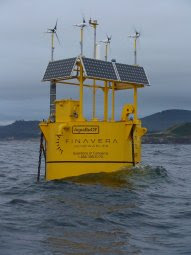
Finavera AquaBuOYFinavera Renewables appears to have given up on wave energy, focusing instead on its more successful wind project development business.

Friday it announced that it is abandoning its Makah Bay wave project off Washington state. According to the company's press release [pdf]:

The decision allows the Company to focus its resources on enhancing its near-term wind project portfolio and provide shareholders with a clearer path to revenue in this challenging economic environment.
The company goes on to say that it is "actively" seeking financial and technical partners for its AquaBuOY technology and is retaining all its intellectual property rights. However, after the unfortunate sinking of the AquaBuOY near Reedsport, Oregon in November 2007, and the rejection by the California Public Utilities Commission of its Humboldt County project in October last year, this week's news leaves Finavera with little motion on the wave front.

MendoCoastCurrent reports that the Company requested it be allowed to surrender its license for the project back to the Federal Energy Regulatory Commission (FERC). The reason cited by the company reflected a lack of investor and partner confidence:
Due to the current economic climate and the restrictions on capital necessary to continue development of this early-stage experimental Project, the Project has become uneconomic. Efforts by Finavera to transfer the license were not successful. Therefore, Finavera respectfully requests that the Commission allow it to surrender its license for the Project.

The investment prospects for Finavera have undulated plenty over the years. In November Finavera announced a private placement of equity primarily for its wind business and shortly after struck a deal with GE to arrange financing for some of its BC wind projects. The extension of its previously issued and now underwater warrants strongly suggested investor impatience with the pace and direction of the company's progress.

In its press release Finavera concludes by clarifying its plans as a company:

The immediate primary focus remains the continued development of the Company’s wind projects in BC and Ireland through partnerships and/or joint venture arrangements. In the medium term, the Company plans to execute on its project finance agreements and bring the wind energy assets to commercial operation. In the longer term, the Company will continue to assemble a diversified mix of revenue producing, renewable energy assets.

Only "in the longer term" would the company pursue anything other than wind. If there are no internal prospects and no external partners for the AquaBuOY technology, then development will likely cease, clearing the way for competitors such as the Pelamis, already in commercial operation, to prevail.

Thursday, November 20, 2008

Charging Ahead on Electric Vehicles in California

The three largest Bay Area cities in California have agreed to foster the infrastructure for electric vehicles.

Better Place (formerly Project Better Place) has scored a coup in the California Bay Area. The electric vehicle startup has struck a deal with the region, including the cities of San Francisco, San Jose and Oakland, to set up a $1 billion charging network for electric cars, with car availability beginning in 2012.
The cities will proide a lot of incentives and will "streamline," "expedite" and "harmonize" regulations, permitting, etc. The actual source of $1B is less clear; it sounds like mostly in-kind support and encouragement rather than cash, but that kind of support is still fantastic.

Sunday, November 16, 2008

Finavera Seeks Investor Funding

It's a tough time to be raising investor money, and no company is doing that unless they really need it.

Finavera Renewables Inc. has announced that it plans to raise US $1,002,000 through a non-brokered private placement of 20,040,000 units at a price of $0.05 per unit. Each unit consists of one common share and one-half of a share purchase warrant, with each full warrant exercisable at $0.10 for 12 months from the date of closing of the private placement.
The money will be used primarily for the company's wind rather than wave projects, particularly in the Peace River area of British Columbia where the company has 12 projects with a total potential of 1.5GW. Finavera has tested wave devices in Oregon and Washington, and recently suffered a setback by the California Public Utilities Commission on its PPA with PG&E.
The company also announced that is has applied to extend the term of all 21,000,000 share purchase warrants issued pursuant to a December 2007 private placement. The warrants, exercisable at US $0.15 per share and initially issued for a term of twelve months, have been extended an additional year.
Sounds like the investors are restless.