Showing posts with label India. Show all posts

Friday, June 4, 2010

Hydropower Potential - IV

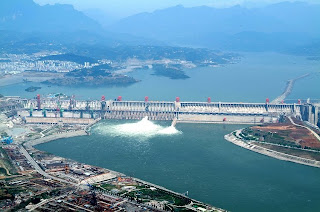
China's Three Gorges Dam, largest hydropower facility in the world
Alternative Energy eTrack aggregates multiple databases, news sources, insight from industry executives and other sources to produce data on the potential of various kinds of renewable energy. While the service is by subscription, some of the data sometimes appears elsewhere. For example, take this list of the top 10 countries for hydropower:
1. China - 179,056 MW
2. Brazil - 81,955 MW
3. United States - 78,054 MW
4. Canada - 75,287 MW
5. Russia - 46,756 MW
6. India - 39,546 MW
7. Norway - 29,317 MW
8. Japan - 22,089 MW
9. France - 20,850 MW
10. Sweden - 16,266 MW
It's interesting data for several reasons.

First, China's capacity is more than double that of the number two country, Brazil.

Second, all of the so-called BRIC countries (Brazil, Russia, India, and China) are in the top six; there is a good correlation of the world's fast-growing and significant economies with hydropower capacity to supply the electrical power these countries need to sustain their growth. The significant investment in renewable generation merits recognition at least as much as the opprobrium over their investment in dirty fossil energy.

Third, hydro dwarfs other renewables in the US, with only wind at the same order of magnitude:
Wind 35,296 MW
Biomass 9,391 MW
Geothermal 3,153 MW
Solar (PV) 1,488 MW
Biogas 1,047 MW
Solar (CSP) 900 MW
Fourth, comparing this data to the capacities cited by the US Energy Information Administration (EIA) shows that there has been little added hydro capacity since 2008, the last year available, but a healthy increase in wind capacity and substantial percentage increases in solar and biomass/biogas.

Finally, comparing these numbers to the overall US generating capacity of just more than a terrawatt (1,000,000 MW) shows how relatively paltry is the contribution of renewable sources to our electrical generation.

There is still a long way to go.

Friday, April 2, 2010

And An Island Never Cries

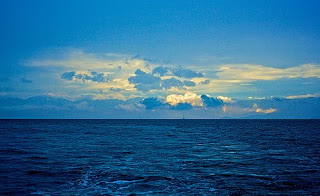
Open ocean, with no land in sight
Some continue to deny, against a flood of evidence, that ocean levels are rising. Such denial is easy if you dismiss reason and ignore your lying eyes. And that's what it takes when an entire island is swallowed by the sea:
A tiny island claimed for years by India and Bangladesh in the Bay of Bengal has disappeared beneath the rising seas, scientists in India say.

The uninhabited territory south of the Hariabhanga river was known as New Moore Island to the Indians and South Talpatti Island to the Bangladeshis.

Recent satellites images show the whole island under water...

[snip]

"What these two countries could not achieve from years of talking, has been resolved by global warming," said Professor Sugata Hazra of the School of Oceanographic Studies at Jadavpur University in Calcutta.
Professor Hazra added that sea level rise in the Bay of Bengal  has accelerated over the past decade and the overtopping of other islands in the region in the next decade is likely. No one lives on these islands. Others are not so lucky.

Monday, March 29, 2010

Tea Power

Tea factory in Papua New Guinea
The Kenya Tea Development Agency (KTDA) has a massive power bill from over 60 factories that process tea from 500,000 farmers. The supply from the national grid is costly and erratic, so last summer the KTDA created an energy subsidiary to pursue locally generated hydropower, reducing factory costs and boosting farmers' incomes. The Kenyan Ministry of Energy identified 12 sites for the KTDA to develop distributed hydropower generation. Two of these sites are now under development:
Imenti Tea Factory Company is already generating 1 megawatt through the Imenti mini-hydro project. Last June, the factory signed a power purchase agreement (PPA) with the Kenya Power and Lighting Company to supply surplus power to the national grid. The second project still under construction at Gura river in Nyeri is a four-factory partnership that will serve the KTDA factories at Gitugi, Iriani, Chinga and Gathuthi.

Monday, January 18, 2010

Hydrovolts Featured on Seattle's KING 5 TV

Local NBC affiliate KING 5 television broadcast a 2-minute piece on Hydrovolts during this evening's newscast:


Environmental reporter Gary Chittim interviewed Hydrovolts CEO and Co-founder Burt Hamner Thursday in Ballard. As seen in the video, Burt manually turns the Company's small prototype to show how the spinning rotor can make power, in this case to light a conventional 60-watt bulb. Laughs Burt, "I feel like a trained seal!" In the water the turbine spins continuously, and power output is much more stable.

Hydrovolts Director of Engineering Brian Peithman is also shown with the small prototype during an in-water test from last summer. With the larger demonstration unit Burt explains the Flipwing's blade configuration which allows it to spin underwater. Hydrovolts advisor and UW Professor Bruce Adee shows the test tank that he and some of his students used for measurement and performance validation.


Hydrovolts CEO Burt Hamner crouches to check the hinge mechanism
of one of the Flipwing rotor blades. Steady Flux principal Brian Bloudek
and Hydrovolts Director of Engineering Brian Peithman look on.


The demonstration unit is being built under contract with Steady Flux, and will undergo initial in-water tests within the week.


More video of various turbine tests can be found on the Hydrovolts YouTube channel.

Learn more about the Hydrovolts Flipwing turbine on our web site or other posts in this blog.