Wednesday, June 16, 2010
Hydrovolts Named 2010 Cleantech Open Semifinalist
Last year Hydrovolts was one of the winners in the Pacific Northwest Region and went on to win the National Sustainability Award at the finals in San Francisco.
Leading this year's Hydrovolts team are Brian Peithman, Director of Engineering, and James Marvin, Director of Field Operations and Business Development. Hydrovolts continues to focus on irrigation canals and other constructed watercourses for initial turbine deployments, but also sees great value in applying the Flipwing technology to military applications where distributed renewable energy provides many benefits to national security and saves lives.
Thursday, May 27, 2010
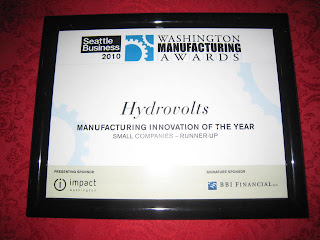
Washington Manufacturing Awards
Nearly 100 companies were nominated for awards, and Hydrovolts was one of three finalists for the Innovation award. Companies were chosen
...by a panel of experts based on criteria that [included] revenue growth (relative to the industry), capital investments, leadership, employee training programs, production quality, productivity, energy conservation and other factors.John Vicklund of Impact Washington helped emcee the awards sponsored by Seattle Business Magazine and RBI Financial. The reception and dinner was held in the Columbia Tower Club, high atop Seattle's tallest building with a sweeping view of the city and Puget Sound.
Rogers Weed, Director of the Washington State Department of Commerce gave the keynote address on the state and future of manufacturing in Washington. He has a dual focus on aerospace manufacturing because of its size and historical importance and on cleantech "because the Governor told me to" (laughter.) Rogers noted that the economy was improving and recovering from the loss of 190,000 jobs in the state. GDP has grown in Washington for the past 3 quarters, and he sees no likelihood of a "double-dip" recession. Asia remains huge to the state's economy and our export economy remains a national trend-setter not only in exports, but in manufacturing and manufacturing "value-add." Rogers believes and expects Washington to be a leader in the global economy.
In all, a fun evening with good food, a crisp program and great networking with old friends and new acquaintances. Thanks to Impact Washington and the sponsors for the recognition, and hearty congratulations to our friends at MicroGREEN Polymers, who won the top prize!
Friday, May 14, 2010
At the McKinstry Innovation Center
The third floor lobby entrance--where innovation begins!
Sunday, April 18, 2010
Hydrovolts Expands Leadership Team
James Marvin, a former U.S. Navy SEAL Commander, started this past Monday as our Director of Business Development and Field Operations.
Burt Hamner, Hydrovolts CEO was enthusiastic:
We are excited to expand our team, and James’ expertise in both federal government relations and remote field operations will be integral to the company’s evolution and growth. James will not only implement turbine demos in canals and waterways around the world, but also help Hydrovolts do business with governmental organizations that work in remote, austere environments that can benefit from Hydrovolts’ renewable, fuel-free power generation technology.James has 20 years of leadership experience in the most demanding and challenging environments around the world. His most recent assignment was Director of Operations for Naval Special Warfare Group Four (NSWG-4) where he managed maritime mobility platform operations for the U.S. Special Operations Command (USSOCOM) in riverine, coastal, and open ocean environments. He has global operational experience and has worked in the Pacific, South America, the Middle East, Europe, Africa as well as the U.S.
James and his family recently moved to the Seattle area from Virginia. The way they planned and executed the move is illustrative of both James' talents and a broader trend in relocation for top professionals. You can read more in last week's profile in the Wall Street Journal.
James has hit the ground running. Tomorrow he and Hydrovolts Director of Engineering Brian Peithman are in the field near Yakima to do some advance work ahead of deployment of our first demonstration project later this spring.
Welcome James!
Monday, March 1, 2010
The Hydrovolts Turbine - VII
Moving into the McKinstry Innovation Center in a few months is exciting, but another great reason to be there is the football field-sized workshop just downstairs. We decided there's no reason to wait until May, so we took the turbine straight from the show to the shop.
The talented staff at McKinstry got right to work.
Sunday, February 28, 2010
On the Move
On Friday we signed a Letter of Intent with McKinstry Company to be one of the first tenants in their nearly-complete McKinstry Innovation Center, whose purpose is to "bring new and emerging companies together to foster the advancement of clean, green energy technologies."
Said David Allen, McKinstry Executive Vice President, at the original announcement last October:
The opportunities before us are significant. There is great demand for new green energy efficient technologies. Companies who are developing these now have a place to collaborate and gain the momentum they need to propel this industry forward.We look forward to working with Dean, David and our many other friends at McKinstry to advance the growing bright green sector in the Pacific Northwest, and create the renewable hydropower technology of the future.
Update: The folks at McKinstry have requested a clarification on their branding: Their name is "McKinstry Company" and we're moving to the "McKinstry Innovation Center" which is a "commercialization accelerator" not an "incubator."
Thursday, February 11, 2010
HCE Day 3
I regret I missed virtually all of the Tuesday morning talks and sessions and so cannot much report on them. Instead of the conference, I drove 45 minutes away to meet with am irrigation district that has expressed some interest in hosting a demonstration. The meeting with the Board of Commissioners went well, and they asked many good questions. An announcement on this soon, perhaps.
I heard from a friend that Conference Emcee Hal Calborn gave Hydrovolts a shout-out from the podium before the morning keynote as a Cleantech Open winner. We had several people come ask us about the Cleantech Open. I strongly encourage entrepreneurs to enter this year and others to volunteer their time and expertise. Being a part of the Cleantech Open has paid and continues to pay enormous dividends to Hydrovolts.
Thanks, Hal!
My notes from earlier in the conference: Day 1 and Day 2.
As things were winding down I heard that this might be the last year for the Conference. Only 10 years and already at the end? Say it ain't so! We'll be back next year, and that was what I heard from a lot of others as well. Why argue with success?
Tuesday afternoon Brian Peithman ("the Hydrovolts Engineering Department") and I made sure the Flipwing Turbine demonstration unit was properly secured to the flat-bed truck and I drove it back west. The turbine spent the night parked in front of my house in Bellevue's Somerset neighborhood, where it aroused some interest from the neighbors. A few had heard it about from the TV, and had many questions, including whether it was going to stay on the street for a while. Yesterday morning, however, I drove it to its new home, a great location with great resources and great people, and where we will be able to advance the Hydrovolts mission dramatically. I can't say just yet more about this, but look for an announcement next week.
Tuesday, February 9, 2010
HCE Day 2
Next up was US Representative Doc Hastings (R-WA) and the contrast of his "special remarks" to those yesterday by US Representative Jay Inslee (D-WA) was stark. Inslee supported the Waxman-Markey and Stimulus bills; Hastings opposed them. Inslee is one Congress' most impassioned and articulate champions of renewable energy and clean technology; Hastings said he is "in favor" of renewables, but spent most of his time advocating for the primacy of oil and gas.
Monday, February 8, 2010
HCE Day 1
His most important point: There will be clean energy jobs--lots of them--in the future. It is not a question of whether, but where.
While he was also quick to praise Washington State's largest trade partner in general, he was pointed in his criticism of how they were competing and had harsh words for what he called their "strange attitudes about trade." They trade from us, "reverse engineer" it, then close their market as they create their own competitive products. It is "unacceptable and non-sustainable." We cannot allow them to "illegally dominate the clean energy future."
Significantly, the fault is squarely our own: we have yet to aggressively compete in return. The Chinese have a "national goal" to dominate the cleantech sector, and the US as a nation needs to "stand up to them."
Saturday, February 6, 2010
10th Annual Harvesting Clean Energy Conference & Exhibition
Harvesting Clean Energy
February 7-9, 2010
Kennewick, WA
Thursday, January 28, 2010
Broad Agreement on Supporting Hydrokinetic Power
Organizations that frequently stake out opposing positions were united in their support. It's rare that utilities, business advocacy groups and environmental groups all agree, but it happened in Olympia as Puget Sound Energy, The Association of Washington Business and Climate Solutions all spoke in favor.
Members of the TEC appeared broadly supportive of the measure. If all goes well, HB 2869 will be reported out of the committee next week, and will be sent on to the House Ways and Means Committee.
Contact your state legislators and ask them to support HB 2869, and please forward this message to other supporters of renewable energy and ask for their support as well.
UPDATE: fixed typo
Wednesday, January 20, 2010
Washington Production Incentives for Hydrokinetic Power

Representative John McCoy, Chair of the Washington House Technology, Energy & Communications (TEC) Committee has introduced HB 2869 [pdf], to provide "an investment cost recovery incentive for hydrokinetic energy." Similar incentives are currently only available for electricity generation from solar and wind.
The bill would amend the language of RCW 82.16.110-120 to add a hydrokinetic energy system manufactured in Washington State to the list of sources of "customer-generated electricity" that qualify for the incentive program. According to the bill, a "hydrokinetic energy system" means
a device that generates electricity from waves or directly from the flow of water in ocean currents, tides, inland waterways, nonfish-bearing canals, or irrigation districts, that does not require the impoundment or diversion of water. [emphasis added]The proposed hydrokinetic incentives are $0.15/kWh for hydrokinetic energy systems, and increasing to $0.36/kWh if manufactured in Washington State. Since the maximum benefit per installing customer is $5,000 per year; the impact on utilities will be relatively minor for several years at least.
The benefit to customers would be significant, accelerating the typical capital payback period from a Hydrovolts turbine from 4 years to less than 2.
These incentives would be available until June 30, 2020, the same as from other sources, unless extended.
The bill has been referred to the TEC Committee, and a public hearing is scheduled for January 27. The legislature in Olympia has an extremely heavy lift ahead of it to bridge a multi-billion dollar budget gap, which means many other worthy bills will struggle for attention. This bill is one that merits consideration and enactment, since its budget cost is de minimus and the benefits in stimulating clean technology, sustainability and job creation are compelling.
Please contact your state legislators and urge support for this worthy legislation, and forward this message to other supporters of renewable energy and ask for their support as well.
UPDATE: fixed wacky formatting issues
Tuesday, December 29, 2009
Distributed Hydropower for Irrigation Districts
For many irrigation districts, electricity, primarily to power water pumps, is a significant cost--sometimes the second largest line item in their operating budgets, costing $1,000,000 or more every year.
Hydrovolts turbines can halve the cost of electricity in gravity-fed irrigation canals, providing a capital ROI to the districts of less than 5 years in Washington state. Because Washington State has the cheapest electricity in the entire US, the payback period in other states is even better. In California the expected capital ROI is 2-3 years.
These payback periods compare very well to other forms of distributed renewable energy generation--wind at 10+ years and solar at nearly 20. Plus, Hydrovolts turbines run continuously with the flow of the water; the power is neither intermittent nor variable.
One can think of an irrigation canal as a water terrace system, or a series of long shallow steps. Maintaining each "tread" at a specified height is very important to allow the pumps along the banks to have their intakes properly positioned, ensuring steady delivery of water to the fields.
The height in each tread of the canal is controlled by a check weir, the "riser" in this metaphorical water staircase. Each check weir has one or more adjustable sluice gates that control the flow of water from one canal section to the next. By raising or lowering the gate, the water behind (upstream from) the check weir can be kept to a specific level with great accuracy.
Just below the check weir the water is moving fast and has a lot of power. We have measured many flows in eastern Washington canals at greater than 10 knots (5 m/s) where even a small Hydrovolts turbine could generate 20kW, enough to run five 5 h.p. pumps. Many such locations would accommodate multiple turbines, as many as 6-10 in the larger canals.
A typical irrigation canal may stretch for 50-100 miles and typically has scores of check weirs. Each irrigation district is a potential customer for hundreds of turbines.
Many foreign countries also have extensive canals and irrigation systems well-suited to the Hydrovolts turbine.
There are many kinds of canals other than those in irrigation districts which could host turbines to create power. Transit canals, systems of locks, aqueducts and other fresh water supply systems could all be customers for new, distributed hydropower.
See also: Distributed hydropower for
Sunday, December 27, 2009
Moving Quickly on Trains
The new line is 664 miles long, connecting Guangzhou to Wuhan, and will eventually extend all the way to Beijing. Trains average 217 mph, faster even than France's TGV and Japan's Shinkansen.
Here in the United States high-speed rail remains a distant hope. It was 50 years ago that Japan started work on the original Tokaido Shinkansen high-speed train, at 130 mph slow by modern standards, but still faster then than anything built in the US since. The American Recovery and Reinvestment Act (ARRA, the "Stimulus Bill") allocated starting funding, but it won't get much built. Washington, New York, California and other states are fighting over scraps of it and asking for funding well beyond the $8B specifically allocated by ARRA. California voters approved a visionary project with a currently estimated cost of $45B.
Current European problems are somewhat anomalous. High speed trains have been operating for many years throughout Europe with few problems and heavy ridership. The system is extensive.
As as is implied by the color-coded segments of European high-speed trains, most passenger trips are of a few hundred miles rather than intercontinental. Trains don't replace airplane trips; they replace car trips because they are faster, cheaper, and more comfortable. Airline travel is increasingly unpleasant, and new security measures are likely to make it more so. In the high-travel transportation corridors especially trains are looking better and better:
...rail has several advantages that make it worth taking even if the terminal-to-terminal time is considerably longer than on air: less time on security lines; arrival in the city center, which is usually closer to where you want to go; electrical outlets!; and 3G internet as I travel.I'd also add the obvious: you don't need to tuck your knees under your chin to fit in the seat, and you're pretty much free to get up and move around as much as you'd like.
The new Chinese line was built in 4 years. 42 more lines are planned by 2012.
Sunday, February 8, 2009
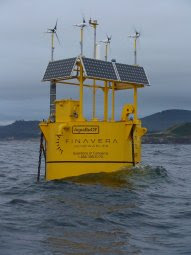
Finavera Waves Goodbye
Finavera Renewables appears to have given up on wave energy, focusing instead on its more successful wind project development business.The decision allows the Company to focus its resources on enhancing its near-term wind project portfolio and provide shareholders with a clearer path to revenue in this challenging economic environment.
Due to the current economic climate and the restrictions on capital necessary to continue development of this early-stage experimental Project, the Project has become uneconomic. Efforts by Finavera to transfer the license were not successful. Therefore, Finavera respectfully requests that the Commission allow it to surrender its license for the Project.
The investment prospects for Finavera have undulated plenty over the years. In November Finavera announced a private placement of equity primarily for its wind business and shortly after struck a deal with GE to arrange financing for some of its BC wind projects. The extension of its previously issued and now underwater warrants strongly suggested investor impatience with the pace and direction of the company's progress.
In its press release Finavera concludes by clarifying its plans as a company:
The immediate primary focus remains the continued development of the Company’s wind projects in BC and Ireland through partnerships and/or joint venture arrangements. In the medium term, the Company plans to execute on its project finance agreements and bring the wind energy assets to commercial operation. In the longer term, the Company will continue to assemble a diversified mix of revenue producing, renewable energy assets.
Only "in the longer term" would the company pursue anything other than wind. If there are no internal prospects and no external partners for the AquaBuOY technology, then development will likely cease, clearing the way for competitors such as the Pelamis, already in commercial operation, to prevail.
Sunday, November 16, 2008
Finavera Seeks Investor Funding
It's a tough time to be raising investor money, and no company is doing that unless they really need it.Finavera Renewables Inc. has announced that it plans to raise US $1,002,000 through a non-brokered private placement of 20,040,000 units at a price of $0.05 per unit. Each unit consists of one common share and one-half of a share purchase warrant, with each full warrant exercisable at $0.10 for 12 months from the date of closing of the private placement.The money will be used primarily for the company's wind rather than wave projects, particularly in the Peace River area of British Columbia where the company has 12 projects with a total potential of 1.5GW. Finavera has tested wave devices in Oregon and Washington, and recently suffered a setback by the California Public Utilities Commission on its PPA with PG&E.
The company also announced that is has applied to extend the term of all 21,000,000 share purchase warrants issued pursuant to a December 2007 private placement. The warrants, exercisable at US $0.15 per share and initially issued for a term of twelve months, have been extended an additional year.Sounds like the investors are restless.