Showing posts with label hydrokinetic. Show all posts

Wednesday, June 16, 2010

Hydrovolts Named 2010 Cleantech Open Semifinalist

Hydrovolts named a 2010 Cleantech Open semifinalist
Monday night, for the second consecutive year, Hydrovolts was named a semi-finalist in the Cleantech Open. The announcement came Monday evening in the Puget Sound Energy building in Bellevue, Washington at a convivial event attended by members of the local entrepreneur, investor, and cleantech communities.

Last year Hydrovolts was one of the winners in the Pacific Northwest Region and went on to win the National Sustainability Award at the finals in San Francisco.

Leading this year's Hydrovolts team are Brian Peithman, Director of Engineering, and James Marvin, Director of Field Operations and Business Development. Hydrovolts continues to focus on irrigation canals and other constructed watercourses for initial turbine deployments, but also sees great value in applying the Flipwing technology to military applications where distributed renewable energy provides many benefits to national security and saves lives.

Sunday, June 13, 2010

Wooden Turbines

Floating tidal turbine with wooden blades
Norwegian company Hydra Tidal plans to test a tidal turbine next month. While many are pursuing different kinds of tidal energy devices, this one is unique for its turbine blades made of wood. Says company founder and R&D director Svein D. Henriksen:
“Wood is a porous, homogeneous material — so it has better mechanical and hydrological characteristics than today’s conventional materials such as composites and steel. The major challenge is the actual assembly process, but we believe we have found a good solution.” He points out that using wood in turbine blades is also an environmentally sound choice, especially in a lifecycle perspective.
That wood is porous doesn't seem very significant, especially since the pine they plan to use is laminated. Many other materials are "homogeneous" too and the lifecycle advantages are rather minor. At 23 meters long, blade durability may be an issue too, and frequent replacement of weaker blades is no lifecycle or environmental boon. The allegedly better mechanical and hydrological aspects are not further described.

The plan to use floating deployment (as Hydrovolts does) is smart as it is faster, simpler, much cheaper, and doesn't need specialized boats. Still, the technology itself doesn't seem particularly different otherwise, apart from the wooden blades. So, why wood?
80% of the [turbine] can be recycled after its life span, which is more than 30 years. For example, our turbines are made out of glued wood. This material can handle tough ocean environments and they last very long. After the turbines' life end, they can be chopped and used in a bio energy power plant for example.

Hydra Tidal has, in cooperation with Harstad University College and Kunnskapsparken Nord AS(Science/Competence park), made a report about CO2 emissions in connection with the production of a complete Morild power plant. CO2 emissions are 40% lower than that of onshore wind power.
They've done some very clever things in Norway with renewable energy, so it will be worth watching to see how this turns out.

Tuesday, June 1, 2010

Augmenting Thermal Power Plants with Hydropower from Cooling Water

Nuclear power plants discharge a lot of cooling water
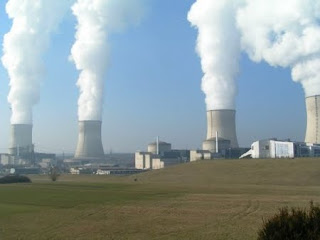
Much of our current electrical generation is done by large utilities in what are generically termed thermal power plants. Thermal power plants include those that burn coal, natural gas, biomass, or other fuels. They also include nuclear power plants. The common element to all of these is that they heat water, creating steam which is then used to drive steam turbines which turn the generators that make the electricity.

Once the steam has passed through the turbine it moves into a condenser where it is cooled back into liquid water, and circulated around to be heated again. Many of the condensers use water to cool the steam. Some plants use a closed loop of cooling water, where the cooling water is itself cooled; in nuclear plants this is the purpose of the tall cooling towers. Steam that escapes is replaced by a fresh supply of water, which is why these plants are typically sited near rivers or by the ocean where there is a large continuous water supply.

Other plants use an open loop or once-through water for their cooling, where water is drawn in continuously for cooling, then discharged back into the river or ocean. These discharges are almost always gravity flows rather than pumped, and these discharges of large amounts of water, running continuously in artificial channels, are perfect for Hydrovolts turbines to generate power, augmenting that made by the main part of the plant. Hydrovolts turbines can generate additional power at modest cost by harnessing these untapped flows; the electricity is sent via the existing transmission infrastructure.

Like most other artificial water flows in constructed waterways, little or no permitting is needed because environmental impacts are minimal. As a result, cost is low and speed of implementation is relatively rapid. This is a solution that lets us take a small, but quick step to a better energy future.

Friday, May 14, 2010

At the McKinstry Innovation Center

We moved into the McKinstry Innovation Center on Monday and we're now mostly unpacked. It's a beautiful space--light, airy and spacious. I took a few pictures today that give perhaps a sense of our new office and the various shared workspaces.

McKinstry Innovation Center third floor entrance
The third floor lobby entrance--where innovation begins!

Wednesday, May 12, 2010

Distributed Hydropower from Wastewater

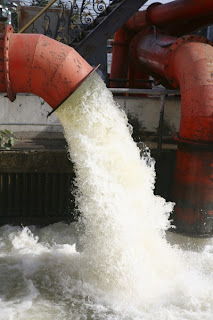
Sewage outflow
The Hydrovolts Flipwing Turbine can generate power in man-made and natural watercourses of many kinds. The initial market is irrigation canals, and there are lots of others, including resource exploration, remote ocean sensors and military uses.

Because of the ingenious cross-axis design of the Flipwing, they can also generate power even in flows that are not clean, or even free of effluvia--flows like those found in sewer and wastewater systems in nearly every community.

There are 16,583 wastewater treatment plants in the United States serving nearly 3/4 of the population. There is growing interest in treating wastewater as a resource rather than something simply to be disposed. The biosolids have obvious application as fertilizer. The sludge can potentially be turned in to energy. Sewage can produce methane for fuel. Washington the Budd Inlet Treatment Plant has a pilot program to do just this. Treatment plant sites also lend themselves to solar installations. There are lots of ways to turn this waste into economic value.

Monday, May 10, 2010

Micro Loans for Micro Power

Installation of Solar Home System in Bangladesh
Hundreds of thousands of people have electricity because of distributed generation from small renewable energy systems financed by micro lending:
The Solar Home System (SHS) dissemination programme in Bangladesh is considered to be one of the most successful of its kind in the world, bringing power to rural areas where grid electricity supply is neither available nor expected in the medium term.
The program started in January 2005 and nearly 350,000 SHSs were installed by last summer, most of which had a rated power output of 50W. Systems came with 3-4 compact flourescent light bulbs. Owners benefit from lighting, especially in their kitchens and courtyards, and also use the systems to charge batteries, power radios, and even run 12V televisions. While statistics are lacking, it appears that some owners are using the power in their small stores and restaurants, boosting their income.

This is a great program beautifully suited to regions without existing electrical grid infrastructure, and has the potential to have a lasting and powerfully positive impact on the energy poverty that afflicts much of the developing world. Even small amounts of electricity can change lives for the better by providing lighting for reading, heating and cooking that doesn't burn nasty fuels with toxic byproducts, and the ability to create a business, boosting the local economy.

Such an approach could work with micro hydropower too.

Thursday, April 29, 2010

Distributed Hydropower for Remote Ocean Devices

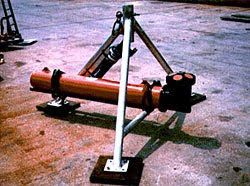
Acoustic Doppler Current Profiler
There are many users who want to place electronic devices in remote ocean locations where power is not available from the electrical grid. These remote ocean devices (often sensors of some kind) are powered by batteries; however, today's state-of-the-art solutions are expensive and inconvenient.

For example, researchers at the University of Washington frequently want to deploy Acoustic Doppler Current Profilers (ADCPs) or other devices to take measurements under water over the course of weeks, months or longer. Running power through a cable from shore is impractical and costly, but the alternative actually used has a stiff price too: a disposable battery that costs $500 and lasts a mere 10 days, after which it must be replaced. In addition to the recurring cost of replacement batteries, there is the enormous cost of a boat and crew to do the replacement--often $1,000 per hour or more. In the deeper ocean farther form shore, boat costs can easily top $100,000 per day.

For small ocean power, the Hydrovolts turbine paired with a rechargeable battery replaces the current disposable battery solution, providing a capital ROI of substantially less than one year.

Sunday, April 25, 2010

Compact

The Hydrovolts Alpha-1C Flipwing turbine prototype
The Hydrovolts Flipwing Turbine is designed to be complete, compact, modular, safe, simple and scalable.

I previously posted about how it is simple and complete.

It's also a compact solution. Other hydrokinetic turbines for micro-generation (i.e. less than 100kW) are much less so. Almost all use some kind of raft and place their generator and electronics above the water line. This solves one problem--how to keep the electronics dry--but introduces others:
  • Transmission--The rotor under water must somehow connect to the generator above it. Shafts, belts or chains can be used, but all have drawbacks, including efficiency loss, added maintenance burden, additional points of failure, and more mechanism that can entrain debris or become fouled.
  •  Efficiency--Vertical axis turbines with a lift design, (e.g. a Darrieus turbine) lose efficiency unless they are perfectly vertical, However, extending the shaft to the surface makes maintaining vertical alignment nearly impossible.
  • Adaptability--By using a raft, other turbines must be sited close to the surface.
  • Cost--Additional materials and a larger design add to the cost to build, to transport, and to deploy.
  • Sustainability--The added cost is not just in money, but also in embodied energy and carbon footprint.
All the parts of the Hydrovolts Flipwing turbine fit together neatly in one self-contained package. The generators are linked directly to the rotor and the power electronics are right there too. The compact design makes deployment very quick and easy--just lower it into the water and moor or anchor it in any of several ways. The entire turbine can be deployed at optimal depth with shorter transmission, high efficiency, adaptability, and lower costs to the buyer and to the environment.

Compact is good. Power from Water.

Tuesday, April 13, 2010

The World's Only Carbon-Negative Country

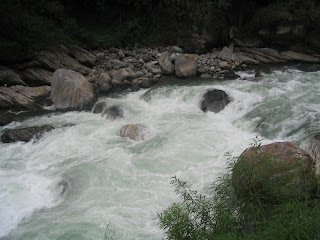
River in Bhutan
Low fossil fuel use and a strong policy to protect forests makes it unique:
Run on Buddhist principles of respect for nature, Bhutan is the only country among 194 U.N. members to have formally told the United Nations this year that it is now "climate negative" -- soaking up more greenhouse gases more than it emits.
Bhutan, a tiny Buddhist kingdom in the Himalayas is also noteworthy as the only country in the world that calculates its Gross National Happiness.

Monday, March 29, 2010

Tea Power

Tea factory in Papua New Guinea
The Kenya Tea Development Agency (KTDA) has a massive power bill from over 60 factories that process tea from 500,000 farmers. The supply from the national grid is costly and erratic, so last summer the KTDA created an energy subsidiary to pursue locally generated hydropower, reducing factory costs and boosting farmers' incomes. The Kenyan Ministry of Energy identified 12 sites for the KTDA to develop distributed hydropower generation. Two of these sites are now under development:
Imenti Tea Factory Company is already generating 1 megawatt through the Imenti mini-hydro project. Last June, the factory signed a power purchase agreement (PPA) with the Kenya Power and Lighting Company to supply surplus power to the national grid. The second project still under construction at Gura river in Nyeri is a four-factory partnership that will serve the KTDA factories at Gitugi, Iriani, Chinga and Gathuthi.

Thursday, March 25, 2010

Low-Impact Hydropower

Surveyor
The Obama administration's peripatetic interest in renewable energy focused yesterday on hydropower:
The Energy and Interior departments and the Army Corps of Engineers have agreed to create a new strategy for promoting hydropower development while reducing environmental impacts and streamlining regulations. But, the agencies caution, do not expect a proliferation of new dams.

"This is not ushering in a 21st century new dam era," Interior Secretary Ken Salazar said. "This is taking a look at existing facilities and low-impact hydro. This is an examination of what we can do with hydropower that does not necessitate the building of new dams."

Hydrokinetic power!

Tuesday, March 16, 2010

Hydropower Potential - III

Furry Creek, BC small hydro project
There is significant untapped potential for hydropower around the world, including in the UK and in Europe more generally. There's also great potential in the United States.

In 2006 the US Department of Energy (DOE) Hydropower Division conducted an assessment of the potential for new micro and small hydropower across the USA.The assessment is based on traditional hydropower potential, not hydrokinetic potential, but the values are useful to note. DOE has identified over 500,000 sites with enough water volume and head that can each generate at least 10kW, and DOE has even mapped them online for every state with its Virtual Hydropower Prospector tool. DOE further overlaid various feasibility criteria in its maps and identified approximately 130,000 sites meeting the criteria. At least 20% of these sites would be suitable for at least one Hydrovolts turbine, for a total of 26,000 sites and at least that many turbines.

Saturday, March 13, 2010

Simple

The Hydrovolts Flipwing Turbine is designed to be complete, compact, modular, safe, simple and scalable.

There are several aspects of being simple:
  1. Simple design. The Flipwing is composed of 4 basic components: the rotor, the generator, the electronics, and the deployment. Each component is built with a minimum of materials and designed to accomplish its sole primary function; respectively: spinning, converting kinetic energy to electricity, making the electricity usable, and keeping the turbine optimally positioned.
  2. Simple deployment. Being a self-contained floating unit, the Flipwing can be deployed in as little as an hour, and removed just as easily. Hook-up to equipment or to the grid uses equipment and procedures pioneered and long-used by small wind, solar and fossil fuel generators.
  3. Simple maintenance. Since it easily taken in and out, the Flipwing can be out of the water for routine maintenance and back in without significant downtime. The simple design allows routine cleaning and lubrication to be done using common hand tools and off-the-shelf supplies and equipment.
  4. Simple value. The Flipwing makes continuous, low-cost and immediately usable power, solving a basic need for business, communities and individuals world-wide.
Simple is good. Power from Water.


For your amusement, a satirical look at the perils of (large) corporations trying to do a simple design without having a simple objective in mind:

(h/t Polizeros)

Monday, March 1, 2010

The Hydrovolts Turbine - VII

The Hydrovolts Flipwing Turbine had a very successful coming out at the Harvesting Clean Energy Conference a few weeks ago. So, where does it go next?

Moving into the McKinstry Innovation Center in a few months is exciting, but another great reason to be there is the football field-sized workshop just downstairs. We decided there's no reason to wait until May, so we took the turbine straight from the show to the shop.

The Hydrovolts Flipwing Turbine arrives at McKinstry on a flatbed truck
Hydrovolts COO Chris Leyerle arrives at McKinstry
after the drive from Kennewick with the Hydrovolts Flipwing Turbine

The talented staff at McKinstry got right to work.

Sunday, February 28, 2010

On the Move

McKinstry & Company logo
Hydrovolts will be moving to Seattle's Georgetown neighborhood in May.

On Friday we signed a Letter of Intent with McKinstry Company to be one of the first tenants in their nearly-complete McKinstry Innovation Center, whose purpose is to "bring new and emerging companies together to foster the advancement of clean, green energy technologies."

Said David Allen, McKinstry Executive Vice President, at the original announcement last October:
The opportunities before us are significant. There is great demand for new green energy efficient technologies. Companies who are developing these now have a place to collaborate and gain the momentum they need to propel this industry forward.
We look forward to working with Dean, David and our many other friends at McKinstry to advance the growing bright green sector in the Pacific Northwest, and create the renewable hydropower technology of the future.

Update: The folks at McKinstry have requested a clarification on their branding: Their name is "McKinstry Company" and we're moving to the "McKinstry Innovation Center" which is a "commercialization accelerator" not an "incubator."

Monday, February 22, 2010

Distributed Solar Generation

Distributed Generation using Solar--Recurrent Energy
Earlier this month David Roberts at Grist reported that Recurrent Energy would announce a power purchase agreement (PPA) with Southern California Edison for 50MW of solar generation. The interesting part is that the deal involved three separate smaller-scale installations rather than one central array.

On their home page Recurrent says that they develop and operate solar power plants making 2-20MW. And:
Distributed-scale projects enjoy permitting and interconnection advantages that enable us to reach operating status quickly compared to central-scale projects.

We use proven solar technology to meet rising energy demand with a fleet of clean power plants located right where they’re needed most. Recurrent Energy is distributed solar power.

Tuesday, February 16, 2010

Hydropower Potential

Hydrovolts plans to install its first turbines in irrigation canals and other mandmade fresh water flows. There are many other large markets for hydrokinetic technology, including natural rivers and streams throughout the world. Small scale hydropower in the developing world has enormous potential to improve the health, education and quality of life for millions of people. Yet there is also huge potential for Hydrovolts turbines in western industrialized countries:

Potential for European Hydropower
Graphic: Hugo Ahlenius, UNEP/GRID-Arendal

Friday, February 5, 2010

The Hydrovolts Turbine - VI

The Hydrovolts Flipwing Turbine demonstration unit has had a couple of in-water tests and made power over the past few weeks. Testing was done in the Ballard ship canal under tow to simulate the turbine in water flows of different velocities.

We put casters on the bottom so we could wheel it down the road from the shop at SteadyFlux, and right down the boat ramp into the water. After ballasting the tanks and maneuvering the boat, we were underway on the first tow test:


Wednesday, January 27, 2010

Electricity in the Developing World

The need for electricity throughout the developing world is immense and will continue to grow. Unlike in the industrialized countries, much of the developing world does not have large centralized power plants and transmission lines to carry that power to widely-spread users. Nor are they likely to ever have such a system:
Building out the power grid can be prohibitively expensive, which is why in many countries, like Haiti, less than three quarters of the population have grid access. Pike Research’s Clint Wheelock says just for the transmission portion alone it can cost at least $500,000 per mile. And that’s without the distribution portion and any kind of the grid intelligence (smart grid) that is getting all of the investment this year.

Saturday, January 23, 2010

The Hydrovolts Turbine - V

Work is well along on the full-size Hydrovolts Flipwing demonstration unit shown in the video made by King5 news last week. More pictures:

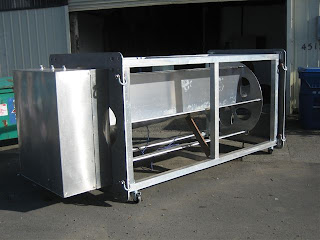
Hydrovolts Flipwing Turbine demonstration unit under construction

The box-like structure is hermetically sealed, and will provide buoyancy, allowing the turbine to float in the water.

Hydrovolts Flipwing Turbine demonstration unit under construction

The flotation end cap has not been attached to this end.

Hydrovolts Flipwing Turbine demonstration unit under construction

The four rings at the corners of the frames will be used to tow the unit through the water at carefully regulated speeds, simulating the performance of the turbine when fixed in position in a watercourse flowing at those same speeds. The data will be used for further power optimization.

Hydrovolts Flipwing Turbine demonstration unit under construction

Temporary struts and cords hold some of the Flipwing blades up or open to show how they will move in position when in a water current. The middle and bottom blades are shown flipped open.

Tow tests are scheduled for this week.


More video of various turbine tests can be found on the Hydrovolts YouTube channel.

Learn more about the Hydrovolts Flipwing turbine on our web site or other posts in this blog.