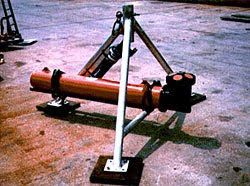
Renewable energy has many benefits, but usually saving lives isn't one of them. However, Hydrovolts turbines have the potential to do just that for the United States military.
Marine Corps Major General Richard Zilmer is based in Fallujah, Iraq, and has responsibility for
dangerous Anbar province. He and his 30,000 troops generate
electricity from diesel generators for cooking, refrigeration, communications, charging batteries and especially for cooling their tents in the 135-degree weather.
The fuel for these generators comes over land in long, snaking convoys of slow-moving and vulnerable tanker trucks. These convoys have been a repeated target of attack and, even with considerable security measures, are extremely vulnerable and
very risky for all personnel involved. In an urgent 2006 memo to commanders at the Pentagon, Zilmer warned that US forces "will remain unnecessarily exposed" and will "continue to accrue preventable ... serious and grave casualties" unless they were provided with "a self-sustainable energy solution."
The problem is not new, and dates back at least to the US military effort to drive Iraq out of Kuwait in 1990. A 2004 study by the Rocky Mountain Institute outlined how, "before the recent rise in oil prices, the U.S. Army spent some $200 million annually on fuel and paid personnel an estimated $3.2 billion to transport it. The Defense Energy Support Center reports that in 2005, the U.S. military spent around $8 billion on some 128 million barrels of fuel; in 2004, it spent $7 billion on 145 million barrels." The cost of fuel is higher now than in 2004, and will almost certainly continue to climb.
In response, the US Army's Rapid Equipping Force (REF) may soon solicit proposals from companies to supplement front line diesel generators with renewable-energy power stations using a mix of solar and wind power. Such an approach continues
a growing interest in alternative energy sources by the Pentagon.
Projected costs for a hybrid solar/wind solution are high, as much as $100,000 compared to about $20,000 for a comparable Hydrovolts turbine. Wind and solar are also inherently variable and intermittent, and so still require a ready supply of diesel fuel and the risks that entails.
Notes Zilmer: "Continued casualty accumulation exhibits potential to jeopardize mission success." A Hydrovolts turbine solution could provide electrical power in deployments near moving water without an expensive and dangerous supply chain and the mortal risk to soldiers and civilians it entails.Adds Al Shaffer, the executive director of
the Pentagon's Energy Security Task Force about efficiency from renewable energy: "We save money; we simplify our logistics supply line, which makes us a more effective fighting force; we free ourselves from dependence on oil controlled by our adversaries; and above all we save lives."
Weaning the military, however partially, from oil dependence also has strategic value long term.