Showing posts with label China. Show all posts

Friday, June 4, 2010

Hydropower Potential - IV

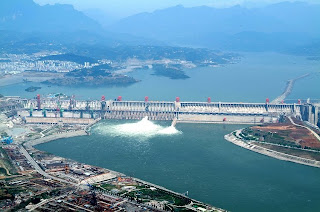
China's Three Gorges Dam, largest hydropower facility in the world
Alternative Energy eTrack aggregates multiple databases, news sources, insight from industry executives and other sources to produce data on the potential of various kinds of renewable energy. While the service is by subscription, some of the data sometimes appears elsewhere. For example, take this list of the top 10 countries for hydropower:
1. China - 179,056 MW
2. Brazil - 81,955 MW
3. United States - 78,054 MW
4. Canada - 75,287 MW
5. Russia - 46,756 MW
6. India - 39,546 MW
7. Norway - 29,317 MW
8. Japan - 22,089 MW
9. France - 20,850 MW
10. Sweden - 16,266 MW
It's interesting data for several reasons.

First, China's capacity is more than double that of the number two country, Brazil.

Second, all of the so-called BRIC countries (Brazil, Russia, India, and China) are in the top six; there is a good correlation of the world's fast-growing and significant economies with hydropower capacity to supply the electrical power these countries need to sustain their growth. The significant investment in renewable generation merits recognition at least as much as the opprobrium over their investment in dirty fossil energy.

Third, hydro dwarfs other renewables in the US, with only wind at the same order of magnitude:
Wind 35,296 MW
Biomass 9,391 MW
Geothermal 3,153 MW
Solar (PV) 1,488 MW
Biogas 1,047 MW
Solar (CSP) 900 MW
Fourth, comparing this data to the capacities cited by the US Energy Information Administration (EIA) shows that there has been little added hydro capacity since 2008, the last year available, but a healthy increase in wind capacity and substantial percentage increases in solar and biomass/biogas.

Finally, comparing these numbers to the overall US generating capacity of just more than a terrawatt (1,000,000 MW) shows how relatively paltry is the contribution of renewable sources to our electrical generation.

There is still a long way to go.

Tuesday, February 9, 2010

HCE Day 2

Hal Calborn
Day 2 of the Harvesting Clean Energy Conference kicked off at 8:00 a.m. here in Kennewick. There were quite a few more people in attendance than on Day 1, no doubt due to the full-day schedule, its being a Monday, and there being no distracting sporting events. Hal Calborn, Conference Emcee, summarized one of yesterday's key messages, that the focus on many attendees was on energy security being the key economic and policy driver and the need to create jobs in the burgeoning global clean energy economy. However, "it doesn't mean that climate change is not an issue."


Next up was US Representative Doc Hastings (R-WA) and the contrast of his "special remarks" to those yesterday by US Representative Jay Inslee (D-WA) was stark. Inslee supported the Waxman-Markey and Stimulus bills; Hastings opposed them. Inslee is one Congress' most impassioned and articulate champions of renewable energy and clean technology; Hastings said he is "in favor" of renewables, but spent most of his time advocating for the primacy of oil and gas.

Sunday, December 27, 2009

Moving Quickly on Trains


Even as the Eurostar has "fluffy" moisture problems, stranding people in the Chunnel for up to 16 hours, over in China people Saturday started taking trips on the fastest high-speed train in the world.

The new line is 664 miles long, connecting Guangzhou to Wuhan, and will eventually extend all the way to Beijing. Trains average 217 mph, faster even than France's TGV and Japan's Shinkansen.

Here in the United States high-speed rail remains a distant hope. It was 50 years ago that Japan started work on the original Tokaido Shinkansen high-speed train, at 130 mph slow by modern standards, but still faster then than anything built in the US since. The American Recovery and Reinvestment Act (ARRA, the "Stimulus Bill") allocated starting funding, but it won't get much built. Washington, New York, California and other states are fighting over scraps of it and asking for funding well beyond the $8B specifically allocated by ARRA. California voters approved a visionary project with a currently estimated cost of $45B.

Current European problems are somewhat anomalous. High speed trains have been operating for many years throughout Europe with few problems and heavy ridership. The system is extensive.


As as is implied by the color-coded segments of European high-speed trains, most passenger trips are of a few hundred miles rather than intercontinental. Trains don't replace airplane trips; they replace car trips because they are faster, cheaper, and more comfortable. Airline travel is increasingly unpleasant, and new security measures are likely to make it more so. In the high-travel transportation corridors especially trains are looking better and better:
...rail has several advantages that make it worth taking even if the terminal-to-terminal time is considerably longer than on air: less time on security lines; arrival in the city center, which is usually closer to where you want to go; electrical outlets!; and 3G internet as I travel.
I'd also add the obvious: you don't need to tuck your knees under your chin to fit in the seat, and you're pretty much free to get up and move around as much as you'd like.

The new Chinese line was built in 4 years. 42 more lines are planned by 2012.