Showing posts with label Hydrovolts. Show all posts

Wednesday, June 30, 2010

Hiatus

red traffic light
Thank you to all of our readers.

Taking a break from blogging to focus on other things...

Will return to posting after a while.


Update: I am no longer with Hydrovolts. Check out my new blog.

Wednesday, June 16, 2010

Hydrovolts Named 2010 Cleantech Open Semifinalist

Hydrovolts named a 2010 Cleantech Open semifinalist
Monday night, for the second consecutive year, Hydrovolts was named a semi-finalist in the Cleantech Open. The announcement came Monday evening in the Puget Sound Energy building in Bellevue, Washington at a convivial event attended by members of the local entrepreneur, investor, and cleantech communities.

Last year Hydrovolts was one of the winners in the Pacific Northwest Region and went on to win the National Sustainability Award at the finals in San Francisco.

Leading this year's Hydrovolts team are Brian Peithman, Director of Engineering, and James Marvin, Director of Field Operations and Business Development. Hydrovolts continues to focus on irrigation canals and other constructed watercourses for initial turbine deployments, but also sees great value in applying the Flipwing technology to military applications where distributed renewable energy provides many benefits to national security and saves lives.

Tuesday, June 1, 2010

Augmenting Thermal Power Plants with Hydropower from Cooling Water

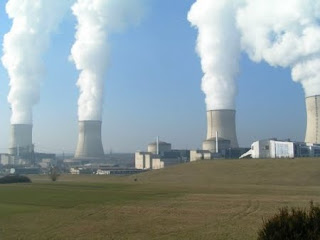
Nuclear power plants discharge a lot of cooling water
Much of our current electrical generation is done by large utilities in what are generically termed thermal power plants. Thermal power plants include those that burn coal, natural gas, biomass, or other fuels. They also include nuclear power plants. The common element to all of these is that they heat water, creating steam which is then used to drive steam turbines which turn the generators that make the electricity.

Once the steam has passed through the turbine it moves into a condenser where it is cooled back into liquid water, and circulated around to be heated again. Many of the condensers use water to cool the steam. Some plants use a closed loop of cooling water, where the cooling water is itself cooled; in nuclear plants this is the purpose of the tall cooling towers. Steam that escapes is replaced by a fresh supply of water, which is why these plants are typically sited near rivers or by the ocean where there is a large continuous water supply.

Other plants use an open loop or once-through water for their cooling, where water is drawn in continuously for cooling, then discharged back into the river or ocean. These discharges are almost always gravity flows rather than pumped, and these discharges of large amounts of water, running continuously in artificial channels, are perfect for Hydrovolts turbines to generate power, augmenting that made by the main part of the plant. Hydrovolts turbines can generate additional power at modest cost by harnessing these untapped flows; the electricity is sent via the existing transmission infrastructure.

Like most other artificial water flows in constructed waterways, little or no permitting is needed because environmental impacts are minimal. As a result, cost is low and speed of implementation is relatively rapid. This is a solution that lets us take a small, but quick step to a better energy future.

Thursday, May 27, 2010

Washington Manufacturing Awards

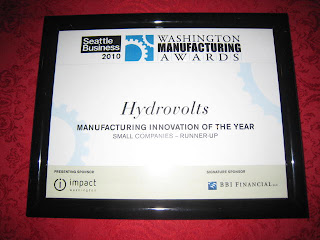
Certificate of Award
The inaugural Washington Manufacturing Awards were held this evening in Seattle, and Hydrovolts finished as the first runner-up for Manufacturing Innovation of the Year in the Small Company category.

Nearly 100 companies were nominated for awards, and Hydrovolts was one of three finalists for the Innovation award. Companies were chosen
...by a panel of experts based on criteria that [included] revenue growth (relative to the industry), capital investments, leadership, employee training programs, production quality, productivity, energy conservation and other factors.
John Vicklund of Impact Washington helped emcee the awards sponsored by Seattle Business Magazine and RBI Financial. The reception and dinner was held in the Columbia Tower Club, high atop Seattle's tallest building with a sweeping view of the city and Puget Sound.

Rogers Weed, Director of the Washington State Department of Commerce gave the keynote address on the state and future of manufacturing in Washington. He has a dual focus on aerospace manufacturing because of its size and historical importance and on cleantech "because the Governor told me to" (laughter.) Rogers noted that the economy was improving and recovering from the loss of 190,000 jobs in the state. GDP has grown in Washington for the past 3 quarters, and he sees no likelihood of a "double-dip" recession. Asia remains huge to the state's economy and our export economy remains a national trend-setter not only in exports, but in manufacturing and manufacturing "value-add." Rogers believes and expects Washington to be a leader in the global economy.

In all, a fun evening with good food, a crisp program and great networking with old friends and new acquaintances. Thanks to Impact Washington and the sponsors for the recognition, and hearty congratulations to our friends at MicroGREEN Polymers, who won the top prize!

Tuesday, May 25, 2010

Scalable

Size matters for turbines too
The Hydrovolts Flipwing Turbine has many compelling advantages compared to other hydro turbines and to other kinds of electricity generators. It has many features, including being complete, compact, modular, safe, simple and scalable.

The Hydrovolts turbine is scalable in two fundamental ways.

First, the Hydrovolts turbine can be built in nearly any size, from very small to quite large. More importantly, the turbine's cross-axis design is rectangular, so it can be built in a broad range of different dimensions. Turbines can be built that are very wide but not very high, or they can be built more squarely. Propeller-type axial turbines always have a circular swept area, so they are ill-suited to water channels that are, for example, broad and shallow. Even with a cowling such turbines are not as adaptable because they cannot scale to arbitrary dimensions like the Hydrovolts turbine.

Second, the typical Hydrovolts turbine is a micro-scale device, and will generate 5-20kW in typical water flows. In very large channels multiple turbines can be deployed side-by-side in the channel, scaling up the power produced by deploying multiple turbines together. Where the water course is deep, turbines can also be positioned one above the other to take advantage of the height of the water column. Turbines can also be spaced one after the other down a water course. Even though any turbine slows the water as it extracts energy, gravity re-accelerates the water as the channel slopes away. Hydrovolts expects turbines typically can be placed 10 per mile, but the maximum rate will depend on the specific watercourse geometry.

Scalable is good. Power from Water.

Friday, May 14, 2010

At the McKinstry Innovation Center

We moved into the McKinstry Innovation Center on Monday and we're now mostly unpacked. It's a beautiful space--light, airy and spacious. I took a few pictures today that give perhaps a sense of our new office and the various shared workspaces.

McKinstry Innovation Center third floor entrance
The third floor lobby entrance--where innovation begins!

Wednesday, May 12, 2010

Distributed Hydropower from Wastewater

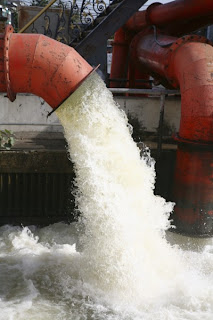
Sewage outflow
The Hydrovolts Flipwing Turbine can generate power in man-made and natural watercourses of many kinds. The initial market is irrigation canals, and there are lots of others, including resource exploration, remote ocean sensors and military uses.

Because of the ingenious cross-axis design of the Flipwing, they can also generate power even in flows that are not clean, or even free of effluvia--flows like those found in sewer and wastewater systems in nearly every community.

There are 16,583 wastewater treatment plants in the United States serving nearly 3/4 of the population. There is growing interest in treating wastewater as a resource rather than something simply to be disposed. The biosolids have obvious application as fertilizer. The sludge can potentially be turned in to energy. Sewage can produce methane for fuel. Washington the Budd Inlet Treatment Plant has a pilot program to do just this. Treatment plant sites also lend themselves to solar installations. There are lots of ways to turn this waste into economic value.

Friday, May 7, 2010

Hydrovolts Moves to McKinstry Innovation Center

Monday is moving day!

We've been at our current office for more than a year, but are in the final stages of making our move to the McKinstry Innovation Center down in Georgetown. Our time at WRF has been great and the people--including Ron, John, Loretta, Kim, Thong, Morgan, Dale, and Britt--fantastic. Thanks to all of our friends at WRF for being part of our growth and progress!

Hydrovolts is one of two initial tenants at the McKinstry Innovation Center along with General Biodiesel.

Our new address is

Hydrovolts
210 South Hudson Street
Suite 330
Seattle, WA 98134-2417

Phone number TBA 206-658-4380. Our website, social media channels, emails, etc. remain unchanged.

Some press on the move here, here, here, and here.

Update: Added phone number and zip+4

Friday, April 30, 2010

Hydrovolts is a B Corporation

Certified B Corporation Seal
Hydrovolts has achieved certification from B Labs as a B Corporation--one of only 285 companies in the United States, and one of only 10 in Washington State.

Certification as a B Corporation attests to the values of a business, including those summarized in the B Corporation Declaration of Interdependence:
We envision a new sector of the economy which harnesses the power of private enterprise to create public benefit.

This sector is comprised of a new type of corporation, the B Corporation, which is purpose-driven and creates benefit for all stakeholders, not just shareholders.
Thursday, April 29, 2010

Distributed Hydropower for Remote Ocean Devices

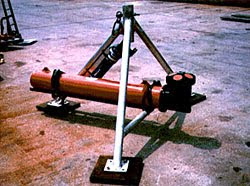
Acoustic Doppler Current Profiler
There are many users who want to place electronic devices in remote ocean locations where power is not available from the electrical grid. These remote ocean devices (often sensors of some kind) are powered by batteries; however, today's state-of-the-art solutions are expensive and inconvenient.

For example, researchers at the University of Washington frequently want to deploy Acoustic Doppler Current Profilers (ADCPs) or other devices to take measurements under water over the course of weeks, months or longer. Running power through a cable from shore is impractical and costly, but the alternative actually used has a stiff price too: a disposable battery that costs $500 and lasts a mere 10 days, after which it must be replaced. In addition to the recurring cost of replacement batteries, there is the enormous cost of a boat and crew to do the replacement--often $1,000 per hour or more. In the deeper ocean farther form shore, boat costs can easily top $100,000 per day.

For small ocean power, the Hydrovolts turbine paired with a rechargeable battery replaces the current disposable battery solution, providing a capital ROI of substantially less than one year.

Sunday, April 25, 2010

Compact

The Hydrovolts Alpha-1C Flipwing turbine prototype
The Hydrovolts Flipwing Turbine is designed to be complete, compact, modular, safe, simple and scalable.

I previously posted about how it is simple and complete.

It's also a compact solution. Other hydrokinetic turbines for micro-generation (i.e. less than 100kW) are much less so. Almost all use some kind of raft and place their generator and electronics above the water line. This solves one problem--how to keep the electronics dry--but introduces others:
  • Transmission--The rotor under water must somehow connect to the generator above it. Shafts, belts or chains can be used, but all have drawbacks, including efficiency loss, added maintenance burden, additional points of failure, and more mechanism that can entrain debris or become fouled.
  •  Efficiency--Vertical axis turbines with a lift design, (e.g. a Darrieus turbine) lose efficiency unless they are perfectly vertical, However, extending the shaft to the surface makes maintaining vertical alignment nearly impossible.
  • Adaptability--By using a raft, other turbines must be sited close to the surface.
  • Cost--Additional materials and a larger design add to the cost to build, to transport, and to deploy.
  • Sustainability--The added cost is not just in money, but also in embodied energy and carbon footprint.
All the parts of the Hydrovolts Flipwing turbine fit together neatly in one self-contained package. The generators are linked directly to the rotor and the power electronics are right there too. The compact design makes deployment very quick and easy--just lower it into the water and moor or anchor it in any of several ways. The entire turbine can be deployed at optimal depth with shorter transmission, high efficiency, adaptability, and lower costs to the buyer and to the environment.

Compact is good. Power from Water.

Tuesday, April 20, 2010

Hydrovolts RFP

Hydrovolts Flipwing Turbine Prototype Alpha-1C during tow test near the Port of Seattle
Yesterday we put out an RFP for the design and realization of a sensor system on our Alpha-1C prototype.

Summary:
Hydrovolts is seeking a Contractor to design and install sensor and data collection capability on a submersible hydrokinetic turbine to measure rotor torque and rpm while operating in water flow rates between 1 and 8 knots of current speed. The deadline for Proposals is April 30, 2010 and the selected Proposal will be announced May 3, 2010 with work to begin immediately.
We expect a lot more work of this kind in the future as well; the ideal solution will be reusable on this and future machines. See the RFP for more details or contact Hydrovolts Director of Engineering' Brian Peithman at 206-336-5560.

Sunday, April 18, 2010

Hydrovolts Expands Leadership Team

Hydrovolts executive James Marvin
We're really pleased to announce a new addition to our team!

James Marvin, a former U.S. Navy SEAL Commander, started this past Monday as our Director of Business Development and Field Operations.

Burt Hamner, Hydrovolts CEO was enthusiastic:
We are excited to expand our team, and James’ expertise in both federal government relations and remote field operations will be integral to the company’s evolution and growth. James will not only implement turbine demos in canals and waterways around the world, but also help Hydrovolts do business with governmental organizations that work in remote, austere environments that can benefit from Hydrovolts’ renewable, fuel-free power generation technology.
James has 20 years of leadership experience in the most demanding and challenging environments around the world. His most recent assignment was Director of Operations for Naval Special Warfare Group Four (NSWG-4) where he managed maritime mobility platform operations for the U.S. Special Operations Command (USSOCOM) in riverine, coastal, and open ocean environments. He has global operational experience and has worked in the Pacific, South America, the Middle East, Europe, Africa as well as the U.S.

James and his family recently moved to the Seattle area from Virginia. The way they planned and executed the move is illustrative of both James' talents and a broader trend in relocation for top professionals. You can read more in last week's profile in the Wall Street Journal.

James has hit the ground running. Tomorrow he and Hydrovolts Director of Engineering Brian Peithman are in the field near Yakima to do some advance work ahead of deployment of our first demonstration project later this spring.

Welcome James!