Judge Feldman not only held numerous oil and gas interest stocks, but was trading them up to and including the morning of his fateful decision, and doing so out of an admitted realization that he had an appearance of ethical conflict. Feldman owned and was trading Exxon stock, a company whose Gulf of Mexico rigs were losing money at the rate of a half million dollars a day due to the moratorium, during the entire time he was assigned the case. Yet, failing to disclose his appearance of conflict on the record or recuse, Feldman nevertheless proceeded to issue a questionable decision clearly benefitting the oil and exploration industry he is so invested in.So why, when the Government appealed this decision, did they not raise the glaring conflicts of interest?
[snip]
Even more distressing is the fact that it has now been revealed from Judge Feldman’s 2009 financial disclosure, literally just filed and only released this week after demand resulting from his questionable ruling, that Feldman is very heavily invested in Blackrock Financial products. Blackrock is, of course, the single biggest shareholder in BP.
Showing posts with label fossil fuel. Show all posts
Monday, June 28, 2010
Crude Behaviors
The Obama Administration's attempt to halt deepwater oil drilling temporarily with a six-month moratorium is, unsurprisingly, under attack. Federal district court judge Martin Feldman of the Eastern District of Louisiana overturned it last week, but his motives are clearly suspect:
Labels:
energy policy,
fossil fuel,
Lousiana,
politics,
regulation
Tuesday, June 22, 2010
Eight Is Enough
Jon Stewart in one of his typically acerbic pieces on the promise of oil independence:
Coming on the heels of President Obama's speech on the BP spill, and with video clips detailing 4 decades of imprecations and high-minded exhortations from 8 presidents, Stewart complains, roughly, "Fool me once, shame on you. Fool me twice, shame on me. Fool me 8 times, I am a freaking idiot."
We fail to demand real action from our leaders, or to hold them accountable for mouthing bromides. With our current president, I fear the audacity hope has become the folly of wishful thinking. As Pogo said, originally in a poster for Earth Day 1970, "We have met the enemy, and he is us."
Video here.
(h/t earth2tech)
Wednesday, June 9, 2010
Training Commuters is Difficult
California Bay Area train system Caltrain has received approval from the Federal Railroad Administration to run electric locomotives on the same tracks as their current diesel stock. Apparently this is the first time such approval has been given to any system in the United States. The business case to save the struggling Caltrain was the decisive argument, according to Robert Doty, director of the Peninsula Rail Program which championed the move.
Doty suggested that this result moves the state closer to running high-speed trains on the same tracks:
The same equipment standards that we have qualified for, the equipment we're looking for, are the same equipment standards for high speed rail. So in effect what we've done is we found the process that needs to be followed and we've done it successfully. Now, they can take our process and expand it for high speed rail, so it is absolutely a precursor for high speed rail.Well, that's a bit like saying that building a Volkswagon Bug paves the way to building a Porsche Carrera.
Labels:
California,
economics,
fossil fuel,
population,
public transit,
trains,
transportation
Monday, June 7, 2010
A Sad Day for Our Oceans
Tomorrow is World Oceans Day. Although proposed by Canada at the Earth Summit in 1992, it was made official only last year.
Tomorrow is also Day 50 of the the worst ecological disaster in US history. (My opinion--there is some depressing competition.)
This year's Oceans Day theme, ironically enough, is "Oceans of Life."
Meanwhile, back at the Wingnut Wurlitzer: Jindal wants to keep drilling. Chevron agrees. Murkowski worries about liability exposure for big oil. Inhofe too. Cornyn thinks we shouldn't try for bold steps on energy policy. Shell Oil says drilling in ANWR is safe. Palin asserts the spill validates "drill, baby, drill." BP remains a corporate psychopath.
Words fail.
Sunday, June 6, 2010
Permitting Insanity
Why does it take more than 9 years and endless anguish to allow wind turbines in Nantucket Sound, but deepwater oil drilling routinely has environmental impact studies waived, supposedly because massive oil spills are unlikely? The oil industry has received approvals with potentially severe environmental impacts in as little as 10 minutes. Contrast the (over-)abundance of caution for wind and the cozy practice of superficial scrutiny for oil. Recent events make the dissonance especially jarring.
The Cape Wind offshore wind farm is closer than ever to the start of construction. Just more than a week after the explosion of BP's Deepwater Horizon platform, US Interior Secretary Ken Salazar gave formal approval, saying:
After careful consideration of all the concerns expressed during the lengthy review and consultation process and thorough analyses of the many factors involved, I find that the public benefits weigh in favor of approving the Cape Wind project at the Horseshoe Shoal location. With this decision we are beginning a new direction in our Nation’s energy future, ushering in America’s first offshore wind energy facility and opening a new chapter in the history of this region.
Friday, June 4, 2010
Hydropower Potential - IV
Alternative Energy eTrack aggregates multiple databases, news sources, insight from industry executives and other sources to produce data on the potential of various kinds of renewable energy. While the service is by subscription, some of the data sometimes appears elsewhere. For example, take this list of the top 10 countries for hydropower:
First, China's capacity is more than double that of the number two country, Brazil.
Second, all of the so-called BRIC countries (Brazil, Russia, India, and China) are in the top six; there is a good correlation of the world's fast-growing and significant economies with hydropower capacity to supply the electrical power these countries need to sustain their growth. The significant investment in renewable generation merits recognition at least as much as the opprobrium over their investment in dirty fossil energy.
Third, hydro dwarfs other renewables in the US, with only wind at the same order of magnitude:
Finally, comparing these numbers to the overall US generating capacity of just more than a terrawatt (1,000,000 MW) shows how relatively paltry is the contribution of renewable sources to our electrical generation.
There is still a long way to go.

1. China - 179,056 MWIt's interesting data for several reasons.
2. Brazil - 81,955 MW
3. United States - 78,054 MW
4. Canada - 75,287 MW
5. Russia - 46,756 MW
6. India - 39,546 MW
7. Norway - 29,317 MW
8. Japan - 22,089 MW
9. France - 20,850 MW
10. Sweden - 16,266 MW
First, China's capacity is more than double that of the number two country, Brazil.
Second, all of the so-called BRIC countries (Brazil, Russia, India, and China) are in the top six; there is a good correlation of the world's fast-growing and significant economies with hydropower capacity to supply the electrical power these countries need to sustain their growth. The significant investment in renewable generation merits recognition at least as much as the opprobrium over their investment in dirty fossil energy.
Third, hydro dwarfs other renewables in the US, with only wind at the same order of magnitude:
Wind 35,296 MWFourth, comparing this data to the capacities cited by the US Energy Information Administration (EIA) shows that there has been little added hydro capacity since 2008, the last year available, but a healthy increase in wind capacity and substantial percentage increases in solar and biomass/biogas.
Biomass 9,391 MW
Geothermal 3,153 MW
Solar (PV) 1,488 MW
Biogas 1,047 MW
Solar (CSP) 900 MW
Finally, comparing these numbers to the overall US generating capacity of just more than a terrawatt (1,000,000 MW) shows how relatively paltry is the contribution of renewable sources to our electrical generation.
There is still a long way to go.
Labels:
Brazil,
BRIC,
China,
energy policy,
fossil fuel,
India,
renewable energy,
Russia,
water,
wind
Tuesday, June 1, 2010
Augmenting Thermal Power Plants with Hydropower from Cooling Water
|
Once the steam has passed through the turbine it moves into a condenser where it is cooled back into liquid water, and circulated around to be heated again. Many of the condensers use water to cool the steam. Some plants use a closed loop of cooling water, where the cooling water is itself cooled; in nuclear plants this is the purpose of the tall cooling towers. Steam that escapes is replaced by a fresh supply of water, which is why these plants are typically sited near rivers or by the ocean where there is a large continuous water supply.
Other plants use an open loop or once-through water for their cooling, where water is drawn in continuously for cooling, then discharged back into the river or ocean. These discharges are almost always gravity flows rather than pumped, and these discharges of large amounts of water, running continuously in artificial channels, are perfect for Hydrovolts turbines to generate power, augmenting that made by the main part of the plant. Hydrovolts turbines can generate additional power at modest cost by harnessing these untapped flows; the electricity is sent via the existing transmission infrastructure.
Like most other artificial water flows in constructed waterways, little or no permitting is needed because environmental impacts are minimal. As a result, cost is low and speed of implementation is relatively rapid. This is a solution that lets us take a small, but quick step to a better energy future.
Labels:
Flipwing,
fossil fuel,
hydrokinetic,
Hydrovolts,
nuclear,
renewable energy
Saturday, May 22, 2010
Deepwater Horizon Causes and Lessons
Many investigations lie ahead. President Obama has appointed a commission of inquiry. Industry shills have been hard at work for a month, unhampered by pesky facts. In the interim one of the most detailed analyses I have yet seen is posted at The Oil Drum. The author, a long-time oil and gas geologist, notes that the causes and lessons may change as more facts come to light. The analysis is aided by contibutions from offshore oil industry engineers, bit is also colored in its conclusions by their understandable bias towards perpetuating the industry that sustains their professional standing and provides their economic livelihood.
The principal conclusion pulls no punches:
Offshore oil drilling is not the solution to our energy problems. It is a reckless attempt to perpetuate our failing energy system, a system which cannot be sustained. It stands in the way of advancing real energy solutions. Time grows short.
The principal conclusion pulls no punches:
What can be addressed now is the larger issue that a flawed, risky well plan for the MC 252 well was approved by the MMS, and BP, Anadarko and Mitsui management. Similar or identical plans were undoubtedly approved and used by many operators on other wells drilled in the Gulf of Mexico. A plan that does not include enough cement to overlap the final and previous casing strings, and that does not require running a cement-bond log to ensure the integrity of the seal is a defective plan. The fact that there have not been blowouts on previous wells does not justify the approval and use of an unsafe plan.Similar or identical plans. There are currently 3,858 other offshore platforms in the Gulf of Mexico, each of which can have as many as 20 wells.
Offshore oil drilling is not the solution to our energy problems. It is a reckless attempt to perpetuate our failing energy system, a system which cannot be sustained. It stands in the way of advancing real energy solutions. Time grows short.
Friday, May 21, 2010
Spewing Nonsense
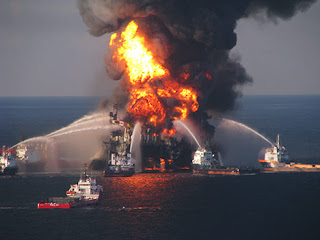
How much oil is spewing from the underwater volcano a mile under the Gulf of Mexico? More than a month after the Deepwater Horizon platform exploded on April 20, then burned and sank two days later, there is still no actual measurement. That there is none is troubling. How the estimates have changed is both instructive and even more disturbing. What might once have been considered spin is now revealed as outright lying. With this latest debacle BP has reached a new nadir in their long history of accidents, lying and greenwashing.
Tuesday, May 18, 2010
Crude Strategies
The situation in the Gulf is so grim humor can't rise above the sardonic. Thank goodness the problem is relatively small.
Wednesday, May 5, 2010
Idle Plans
In my home town of Toronto, the Board of Health is pushing for legislation to reduce the permitted idling of motor vehicle engines from the current 3-minute limit to one minute. People idling their engines longer face a $125 fine.
The Board acted in part on a report from Dr. David McKeown, Toronto’s medical officer of health, which stated:
Added McKeown, “I understand why people want to get into a warm car, but the price we pay for that is our health.”
The shorter limit was previously adopted by the Ontario city of Burlington, but is "widely ignored" and sporadically enforced.
The Board acted in part on a report from Dr. David McKeown, Toronto’s medical officer of health, which stated:
For every litre of gasoline used, about 2.4 kg of CO2 are produced; for every litre of diesel fuel consumed, about 2.7 kg of CO2 are produced. The Clean Air Partnership estimated that idling in the GTA [Greater Toronto Area] wastes 90 million litres of fuel each year, suggesting that over 215 million tonnes of CO2 are emitted in the GTA each year as a result of idling. Assuming that vehicle ownership is distributed evenly across the GTA, Toronto’s contribution could be 105 million tonnes of CO2 each year as a result of idling.The cars of yesteryear needed warming up because they used heavier motor oil which needed warming to fully lubricate the engine. Modern cars with computer controls need at most 10 seconds before they are ready to drive. Shutting off an engine if it would idle more than 30 seconds will save gas, although there are more effective eco-friendly driving steps.
Added McKeown, “I understand why people want to get into a warm car, but the price we pay for that is our health.”
The shorter limit was previously adopted by the Ontario city of Burlington, but is "widely ignored" and sporadically enforced.
Sunday, May 2, 2010
Laissez Failure
The slow-motion ecological catastrophe in the Gulf of Mexico is horrifying.
The oil slick is now the size of Ohio, and growing by the hour. Edges of it are now reaching land and all along the Gulf coast residents wait with deep foreboding and growing anger as the dimensions of the disaster become clear.
This is not an oil spill, but an oil spilling, as more ruptures from the sea floor, surfaces, and spreads its devastating reach towards shore. 40% of the coastal wetlands in the United States are under threat, as are the majority of the country's oyster and shrimp fisheries. Local fishermen have moved quickly through the 5 stages of grieving as they face the imminent destruction of their livelihood, economic security, their way of life, and their future.
Emergency response began quickly and broad efforts at mitigation are underway. The Obama Administration formed a National Response Team, Louisiana Governor Bobby Jindal is mobilizing the state's National Guard, and locals are taking to their boats to deploy booms to intercept the sprawling slick. Dealing with the immediate crisis is paramount now, yet soon hard questions must be asked, and honestly answered. The critical questions are:
Why did this happen? How do we prevent it happening again?
Labels:
Alaska,
economics,
energy policy,
environment,
fossil fuel,
Lousiana,
nuclear,
ocean energy,
offshore wind,
politics,
regulation,
renewable energy,
solar,
sustainability,
Texas,
wind
Tuesday, April 27, 2010
Time Grows Short
Oil is a finite resource.
Production peaked in the US decades ago, and the global peak is happening now, if it hasn't already. The transition to a new energy economy must happen because our ability to produce fresh supply will decline, even as economic development quickens throughout the developing world, boosting demand. There are other reasons too: climate change, energy security, and addressing energy poverty, the root of poverty generally throughout the world.
Making the transition is an urgent need:
The most critical question is how much time we have to make the transition. A fully equipped hospital with on-duty surgeons and staff may be the ideal technology for a critically injured patient. But they mean little to such a patient if we are in the position of having to build the hospital and train the surgeons and staff before administering treatment. I think this analogy aptly describes our current predicament. If you miscalculate concerning the time question, it will not matter how clever human beings are.Our Earth, the patient, suffers from a growing number and severity of injuries. Delivering the cure will take substantial time and investment. What are we waiting for?
Thursday, April 22, 2010
Energy Security
Earth Day turned 40 today. For many Earth Day is an occasion to think green, hope for a less polluted future, advocate for renewable energy and perhaps push for a solution to climate change.
Others dismiss Earth Day as a symbol of mushy-minded ecomania that elevates the environment over the economy. It's a false choice, but the notion that doing something about the environment will cost the economy persists. Those who are skeptical about climate change are generally the same as those who are negative about renewable energy.
However, there are other reasons to support and promote renewable energy, and a big one is energy security. If it's renewable we don't need to rely on the supply of something like oil or uranium that has to come from somewhere else, possibly a country or region hostile to us.
Energy security matters. Most casualties in Iraq and Afghanistan come from the necessity of fuel transport--the supply chain is long and highly vulnerable.
Failing to make the speediest transition to renewable energy is bad policy for many reasons. It costs lives. It costs money. It funds those hostile to us. And it's futile, because the current energy model is not sustainable. Even the military recognizes that we need to get beyond oil because we're running out of the stuff.
Wednesday, March 31, 2010
Our Energy Future - II
Where will our energy come from in the future? Peak oil is upon us, even if the exact date is not yet conclusively known. Nuclear power is at best a transitional step, and quite costly when factoring in construction and external costs. What's left?
How about 100% from renewable sources? A new report by PriceWaterhouseCoopers suggests Europe could be powered entirely by renewable sources, albeit at substantial cost of transition, especially on inter-continental transmission:
Thus, today's announcement by President Obama to expand off-shore oil drilling in the United States is especially disappointing.
How about 100% from renewable sources? A new report by PriceWaterhouseCoopers suggests Europe could be powered entirely by renewable sources, albeit at substantial cost of transition, especially on inter-continental transmission:
A "super-smart" grid powered by solar farms in North Africa, wind farms in northern Europe and the North Sea, hydro-electric from Scandinavia and the Alps and a complement of biomass and marine energy could render carbon-based fuels obsolete for electricity by 2050, said the report.While the costs and challenges are great, those of clinging to the fossil economy would be much greater. But what is remarkable, of course, is that the modern industrial economy of Europe, roughly the same size as that of the United States, could be run entirely on renewable energy.
The goal is achievable even without the use of nuclear energy, the mainstay of electricity in France.
Thus, today's announcement by President Obama to expand off-shore oil drilling in the United States is especially disappointing.
Labels:
carbon footprint,
climate change,
environment,
Europe,
fossil fuel,
France,
nuclear,
ocean energy,
politics,
renewable energy,
solar,
wave,
wind
Friday, March 12, 2010
The Power of the Open Road
What will power our transportation future? The Korea Advanced Institute of Science and Technology (KAIST) has built a prototype magnetic train that runs on an electrical road:
On Tuesday researchers launched an environmentally friendly public transport system using a "recharging road"-- with a vehicle sucking power magnetically from buried electric strips.
The Online Electric Vehicle (OLEV), towing three buses, went into service at an amusement park in southern Seoul. If the prototype proves successful, there are plans to try it out on a bus route in the capital.
Thursday, March 4, 2010
Who Speaks for Business?
Who speaks for business? Who advocates for business and articulates their views on public policy? Businesses and their leaders do of course. They just don't always speak with one voice.
For example, a recent survey commissioned by international renewable energy group NTR Foundation and conducted by the Brunswick Group found more than half of the largest US companies wanting an end to the ambiguity surrounding climate change legislation.
About 50 per cent of America’s top business leaders believe a lack of clarity on climate legislation is negatively impacting upon the ability of the US to compete in the global market.
Seventy per cent of the respondents said climate change would be an important part of their commercial decision-making within five years. But almost three in four of the business leaders said security of energy supply was a more “pressing issue” for them than climate change.
Labels:
climate change,
energy policy,
fossil fuel,
nuclear,
politics,
sustainability
Saturday, February 20, 2010
The ARPA-E Pipeline and the Three Sputniks
Arun Majumdar, Director of ARPA-E, spoke to about 150 people in the atrium of the Paul Allen Computer Science & Engineering Building at the University of Washington on Thursday. Dr. Majumdar provided a detailed explanation of the role of his agency in building a technology "pipeline" connecting the creators of new solutions to the integrators searching for solutions to the "three Sputniks" of energy security, green house gas (GHG) emissions, and US global technological leadership. He sees these as all connected, composing three axes of the same 3-D reality. We must stop importing 60% of our oil from "places hostile to us" and then burning it, exacerbating damage from climate change. Finding other ways to create the energy we need that are clean and renewable will also power US innovation, economic prosperity, and global leadership. Tackling these Three Sputniks is the Congressional directive to ARPA-E.
Tuesday, February 9, 2010
HCE Day 2
Day 2 of the Harvesting Clean Energy Conference kicked off at 8:00 a.m. here in Kennewick. There were quite a few more people in attendance than on Day 1, no doubt due to the full-day schedule, its being a Monday, and there being no distracting sporting events. Hal Calborn, Conference Emcee, summarized one of yesterday's key messages, that the focus on many attendees was on energy security being the key economic and policy driver and the need to create jobs in the burgeoning global clean energy economy. However, "it doesn't mean that climate change is not an issue."
Next up was US Representative Doc Hastings (R-WA) and the contrast of his "special remarks" to those yesterday by US Representative Jay Inslee (D-WA) was stark. Inslee supported the Waxman-Markey and Stimulus bills; Hastings opposed them. Inslee is one Congress' most impassioned and articulate champions of renewable energy and clean technology; Hastings said he is "in favor" of renewables, but spent most of his time advocating for the primacy of oil and gas.
Monday, February 1, 2010
Why Clean Energy Matters
It's a significant part of the greenhouse gas emissions problem:
What part of this surprises you the most?
Learn more about the UN Environmental Programme here.
Download high-resolution versions of this graphic here.
Graphic by Emmanuelle Bournay, UNEP/GRID-Arendal
What part of this surprises you the most?
Learn more about the UN Environmental Programme here.
Download high-resolution versions of this graphic here.
Subscribe to:
Posts (Atom)