Showing posts with label energy policy. Show all posts

Monday, June 28, 2010

Crude Behaviors

Marty Feldman googly eyes
The Obama Administration's attempt to halt deepwater oil drilling temporarily with a six-month moratorium is, unsurprisingly, under attack. Federal district court judge Martin Feldman of the Eastern District of Louisiana overturned it last week, but his motives are clearly suspect:
Judge Feldman not only held numerous oil and gas interest stocks, but was trading them up to and including the morning of his fateful decision, and doing so out of an admitted realization that he had an appearance of ethical conflict. Feldman owned and was trading Exxon stock, a company whose Gulf of Mexico rigs were losing money at the rate of a half million dollars a day due to the moratorium, during the entire time he was assigned the case. Yet, failing to disclose his appearance of conflict on the record or recuse, Feldman nevertheless proceeded to issue a questionable decision clearly benefitting the oil and exploration industry he is so invested in.

[snip]

Even more distressing is the fact that it has now been revealed from Judge Feldman’s 2009 financial disclosure, literally just filed and only released this week after demand resulting from his questionable ruling, that Feldman is very heavily invested in Blackrock Financial products. Blackrock is, of course, the single biggest shareholder in BP.
So why, when the Government appealed this decision, did they not raise the glaring conflicts of interest?

Tuesday, June 22, 2010

Eight Is Enough

Jon Stewart in one of his typically acerbic pieces on the promise of oil independence:

Jon Stewart reviews the energy independence promises of the last 8 US presidents

Coming on the heels of President Obama's speech on the BP spill, and with video clips detailing 4 decades of imprecations and high-minded exhortations from 8 presidents, Stewart complains, roughly, "Fool me once, shame on you. Fool me twice, shame on me. Fool me 8 times, I am a freaking idiot."

We fail to demand real action from our leaders, or to hold them accountable for mouthing bromides. With our current president, I fear the audacity hope has become the folly of wishful thinking. As Pogo said, originally in a poster for Earth Day 1970, "We have met the enemy, and he is us."

Video here.

(h/t earth2tech)

Saturday, June 19, 2010

Faint Hope

Obama as superhero
President Obama's lack of conviction on climate and energy policy is now undeniable. His vacillating remarks on off shore oil drilling over the past few months illustrate his lack of leadership on this, the most critical issue of his presidency.

Eric Pooley over at Grist has an excerpt from his forthcoming book which lucidly surveys the Obama Administration's timeline of timidity. He concludes:
It is a cruel irony that the epic disaster in the Gulf -- a wakeup call to the need to reduce our dependence on oil -- makes it harder to pass a bill that would help us do so. Expanded offshore drilling (and the revenue it would bring) was the chip Obama hoped to use to draw oil-state senators into a grand bargain that would also include subsidies for nuclear power and carbon capture and storage, with a modest carbon cap in return. The oil spill blew up that idea by taking expanded offshore drilling off the table, at least for now. With few chips left, Obama appears to be hoping that public anger over the spill can help drive a new version of the climate bill. Soon, we’ll know whether he really means it. Democratic leaders in the Senate have been floating the idea of an energy bill without a carbon cap -- which would be yet another failure of nerve by a group of legislators badly in need of adult supervision. Passing a real climate bill will be excruciatingly difficult. Waiting will only make it harder. It’s time for Obama to intervene on the Hill, silence the naysayers inside his own administration, harness the public mood, and make good on his promise to fight.
So this is what the audacity of hope looks like--wishing for the First Nerd to remove his figurative glasses and punch back at the bullies. But he won't. Ever cerebral, Obama doggedly appeals to the non-existent good intentions of his opponents, believing that reason and patience will yield agreement. In time, onlookers feel contempt, not sympathy. The notion that Obama will risk any political capital to lead a fight is not a bold hope, but a limp wish.

Pooley hopes that public anger will prod a sclerotic Congress into passing a climate bill. However, public anger is attenuating from the steady trickle of bad news and is increasingly eager to look for other targets, particularly within the federal government. The oil lobby and their drill shills in the chattering classes are working hard, incredibly, to recast the oil disaster as an example of why government involvement is bad. (The argument, in defiance of both reason and evidence is roughly: Regulatory oversight failed, thus regulation is worthless, and so government should do nothing, except perhaps foot the bill.) The mob is searching for scapegoats of which to make an example, and the focus is punitive rather than constructive. It is absurd to hope that the public, exhausted from bad news, beset by economic gloom, incited by partisan hacks, and frustrated by collective impotence will spur a Congress captive of corporate interests to do other than pander to the electorate while they stroke entrenched incumbents.

Hope is not a plan. Obama's unwillingness to articulate a bold plan (or even a bold hope) contributes to the perception that our government is adrift. Worse, it reinforces the belief that government is incapable of solving problems, in turn making bold action even harder. On energy policy, this will guarantee the decline of American competitiveness. It is well past time for Obama to be a leader, not a mediator.

Sunday, June 6, 2010

Permitting Insanity

Cape Wind location
Why does it take more than 9 years and endless anguish to allow wind turbines in Nantucket Sound, but deepwater oil drilling routinely has environmental impact studies waived, supposedly because massive oil spills are unlikely? The oil industry has received approvals with potentially severe environmental impacts in as little as 10 minutes. Contrast the (over-)abundance of caution for wind and the cozy practice of superficial scrutiny for oil. Recent events make the dissonance especially jarring.

The Cape Wind offshore wind farm is closer than ever to the start of construction. Just more than a week after the explosion of BP's Deepwater Horizon platform, US Interior Secretary Ken Salazar gave formal approval, saying:
After careful consideration of all the concerns expressed during the lengthy review and consultation process and thorough analyses of the many factors involved, I find that the public benefits weigh in favor of approving the Cape Wind project at the Horseshoe Shoal location. With this decision we are beginning a new direction in our Nation’s energy future, ushering in America’s first offshore wind energy facility and opening a new chapter in the history of this region.

Friday, June 4, 2010

Hydropower Potential - IV

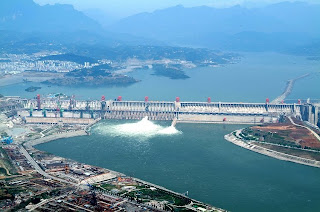
China's Three Gorges Dam, largest hydropower facility in the world
Alternative Energy eTrack aggregates multiple databases, news sources, insight from industry executives and other sources to produce data on the potential of various kinds of renewable energy. While the service is by subscription, some of the data sometimes appears elsewhere. For example, take this list of the top 10 countries for hydropower:
1. China - 179,056 MW
2. Brazil - 81,955 MW
3. United States - 78,054 MW
4. Canada - 75,287 MW
5. Russia - 46,756 MW
6. India - 39,546 MW
7. Norway - 29,317 MW
8. Japan - 22,089 MW
9. France - 20,850 MW
10. Sweden - 16,266 MW
It's interesting data for several reasons.

First, China's capacity is more than double that of the number two country, Brazil.

Second, all of the so-called BRIC countries (Brazil, Russia, India, and China) are in the top six; there is a good correlation of the world's fast-growing and significant economies with hydropower capacity to supply the electrical power these countries need to sustain their growth. The significant investment in renewable generation merits recognition at least as much as the opprobrium over their investment in dirty fossil energy.

Third, hydro dwarfs other renewables in the US, with only wind at the same order of magnitude:
Wind 35,296 MW
Biomass 9,391 MW
Geothermal 3,153 MW
Solar (PV) 1,488 MW
Biogas 1,047 MW
Solar (CSP) 900 MW
Fourth, comparing this data to the capacities cited by the US Energy Information Administration (EIA) shows that there has been little added hydro capacity since 2008, the last year available, but a healthy increase in wind capacity and substantial percentage increases in solar and biomass/biogas.

Finally, comparing these numbers to the overall US generating capacity of just more than a terrawatt (1,000,000 MW) shows how relatively paltry is the contribution of renewable sources to our electrical generation.

There is still a long way to go.

Saturday, May 29, 2010

Big Business Responds to Climate Change

Public support for addressing climate change remains strong overall
The disinformation campaign and faux controversy about climate change has shifted public opinion. The general public has become less certain about the reality of climate change over the past year and more inclined to believe that a real scientific controversy exists. However, a majority of businesses are acting as if the controversy is settled according to accounting firm Ernst & Young:
  • 70% of the world's largest companies plan to spend more on efforts to combat climate change
  • 80% plan to spend more on energy efficiency measures
  • 65% plan to develop products and services related to climate change
  • 63% pan to increase transparency of reporting on related areas such as environmental performance, energy use and carbon emissions
  • Nearly 50% plan to spend at least 0.5% of revenue on such measures as energy efficiency 
The survey of 300 businesses in the US, China and 14 other countries included a cross-section of businesses, including airlines, banks, and general industry. All had at least $1B in revenues. Noted Doug Johnston, Ernst & Young's U.K. director of climate change and sustainability:
With all the uncertainty following Copenhagen, many business commentators were expecting the momentum in climate change investments to slow. Our research has shown something very different.
It's quite surprising that business is leading the way in addressing a serious environmental problem on which the public shows increasing confusion and ambivalence. It is tempting to think that business is perhaps starting to see the costs and benefits more clearly; however, it may be more about keeping customers happy than about the operational bottom line: about 90% of the surveyed firms reported that their actions were due to customer demand.

Saturday, May 22, 2010

Deepwater Horizon Causes and Lessons

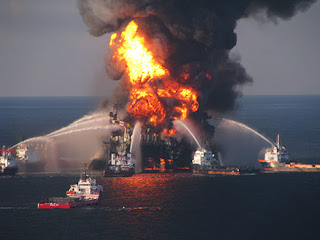
Deepwater Horizon oil platform on fire
Many investigations lie ahead. President Obama has appointed a commission of inquiry. Industry shills have been hard at work for a month, unhampered by pesky facts. In the interim one of the most detailed analyses I have yet seen is posted at The Oil Drum. The author, a long-time oil and gas geologist, notes that the causes and lessons may change as more facts come to light. The analysis is aided by contibutions from offshore oil industry engineers, bit is also colored in its conclusions by their understandable bias towards perpetuating the industry that sustains their professional standing and provides their economic livelihood.

The principal conclusion pulls no punches:
What can be addressed now is the larger issue that a flawed, risky well plan for the MC 252 well was approved by the MMS, and BP, Anadarko and Mitsui management. Similar or identical plans were undoubtedly approved and used by many operators on other wells drilled in the Gulf of Mexico. A plan that does not include enough cement to overlap the final and previous casing strings, and that does not require running a cement-bond log to ensure the integrity of the seal is a defective plan. The fact that there have not been blowouts on previous wells does not justify the approval and use of an unsafe plan.
Similar or identical plans. There are currently 3,858 other offshore platforms in the Gulf of Mexico, each of which can have as many as 20 wells.

Offshore oil drilling is not the solution to our energy problems. It is a reckless attempt to perpetuate our failing energy system, a system which cannot be sustained. It stands in the way of advancing real energy solutions. Time grows short.

Tuesday, May 18, 2010

Crude Strategies

Toles: Current Oil Spill Strategies
The situation in the Gulf is so grim humor can't rise above the sardonic. Thank goodness the problem is relatively small.

Monday, May 17, 2010

National Security Threats Too Great

Oil wells still burning in southern Iraq
The following guest post by James Marvin, Director of Field Operations and Business Development at Hydrovolts was previously published in the National Journal's Expert Blogs on Energy & The Environment. James spent 20 years as a Navy SEAL and has seen first-hand the casualties of our oil addiction.

National Security Threats Too Great
by James Marvin

The United States has to pass comprehensive climate and energy legislation. The longer we wait, the more difficult it will become to address the issue. Whether the American Power Act will carry the day, or some other legislation already introduced, remains to be seen. Doing nothing though, is not an acceptable answer and whatever the solution turns out to be it has to be pragmatic and it has to be timely.

Sunday, May 2, 2010

Laissez Failure

BP oil platform burns in the Gulf of Mexico
The slow-motion ecological catastrophe in the Gulf of Mexico is horrifying.

The oil slick is now the size of Ohio, and growing by the hour. Edges of it are now reaching land and all along the Gulf coast residents wait with deep foreboding and growing anger as the dimensions of the disaster become clear.

This is not an oil spill, but an oil spilling, as more ruptures from the sea floor, surfaces, and spreads its devastating reach towards shore. 40% of the coastal wetlands in the United States are under threat, as are the majority of the country's oyster and shrimp fisheries. Local fishermen have moved quickly through the 5 stages of grieving as they face the imminent destruction of their livelihood, economic security, their way of life, and their future.

Emergency response began quickly and broad efforts at mitigation are underway. The Obama Administration formed a National Response Team, Louisiana Governor Bobby Jindal is mobilizing the state's National Guard, and locals are taking to their boats to deploy booms to intercept the sprawling slick. Dealing with the immediate crisis is paramount now, yet soon hard questions must be asked, and honestly answered. The critical questions are:

Why did this happen? How do we prevent it happening again?

Tuesday, April 27, 2010

Time Grows Short

Gas gauge nearing empty
Oil is a finite resource.

Production peaked in the US decades ago, and the global peak is happening now, if it hasn't already. The transition to a new energy economy must happen because our ability to produce fresh supply will decline, even as economic development quickens throughout the developing world, boosting demand. There are other reasons too: climate change, energy security, and addressing energy poverty, the root of poverty generally throughout the world.

Making the transition is an urgent need:
The most critical question is how much time we have to make the transition. A fully equipped hospital with on-duty surgeons and staff may be the ideal technology for a critically injured patient. But they mean little to such a patient if we are in the position of having to build the hospital and train the surgeons and staff before administering treatment. I think this analogy aptly describes our current predicament. If you miscalculate concerning the time question, it will not matter how clever human beings are.
Our Earth, the patient, suffers from a growing number and severity of injuries. Delivering the cure will take substantial time and investment. What are we waiting for?

Thursday, April 22, 2010

Energy Security

Earth Day turned 40 today. For many Earth Day is an occasion to think green, hope for a less polluted future, advocate for renewable energy and perhaps push for a solution to climate change.

Others dismiss Earth Day as a symbol of mushy-minded ecomania that elevates the environment over the economy. It's a false choice, but the notion that doing something about the environment will cost the economy persists. Those who are skeptical about climate change are generally the same as those who are negative about renewable energy.

However, there are other reasons to support and promote renewable energy, and a big one is energy security. If it's renewable we don't need to rely on the supply of something like oil or uranium that has to come from somewhere else, possibly a country or region hostile to us.

Energy security matters. Most casualties in Iraq and Afghanistan come from the necessity of fuel transport--the supply chain is long and highly vulnerable.

Failing to make the speediest transition to renewable energy is bad policy for many reasons. It costs lives. It costs money. It funds those hostile to us. And it's futile, because the current energy model is not sustainable. Even the military recognizes that we need to get beyond oil because we're running out of the stuff.

Saturday, April 10, 2010

Partisan Challenge

A famous American, fiercely partisan on any number of policy areas, nonetheless said this:
If we've learned any lessons during the past few decades, perhaps the most important is that preservation of our environment is not a partisan challenge; it's common sense. Our physical health, our social happiness, and our economic well-being will be sustained only by all of us working in partnership as thoughtful, effective stewards of our natural resources.
Who was the speaker? This same proud conservative also took credit for his fundamentally conservative viewpoint that the economy does not utterly trump the environment:
I'm proud of having been one of the first to recognize that States and the Federal Government have a duty to protect our natural resources from the damaging effects of pollution that can accompany industrial development.

Such a viewpoint was not remotely controversial at the time. One suspects that if President Obama or most any other leader were to speak these exact words today the resulting partisan firestorm of criticism would be intense and vitriolic. Recent polling suggests that a slim majority of Americans are now willing to throw the environment under the economic bus. The anemia of the current "recovery" is doubtless responsible for much of this sentiment, but the lack of unequivocal support for environmental protection by our leaders is also to blame.

Sunday, March 28, 2010

Conservatives Announce Plan to Promote Renewable Energy

Nate Beeler: Energy Policy Stopgap
Conservatives recently announced a 12-point action plan to boost renewable energy and nuclear power. The plan would also entail a substantial change to the energy sector. The plan recognizes the historical abundance of oil and gas in the country as well as the relatively recent rise of concern over pollution, resource depletion, and the green house gases emissions that are fueling climate change.

Some of the specific initiatives include:
  • A Green Investment Bank to provide public funding for new energy technologies
  • Establishing a "floor" price for carbon and an upstream tax
  • Accelerated demonstration projects for energy storage and carbon capture
  • Establishing an "energy internet", including distributed generation and a smart grid
  • Household incentives for energy efficiency
  • Electrifying the transport system
  • Implementing national feed-in tariffs
The current energy approach is "out of date"; what is needed are:

Thursday, March 25, 2010

Low-Impact Hydropower

Surveyor
The Obama administration's peripatetic interest in renewable energy focused yesterday on hydropower:
The Energy and Interior departments and the Army Corps of Engineers have agreed to create a new strategy for promoting hydropower development while reducing environmental impacts and streamlining regulations. But, the agencies caution, do not expect a proliferation of new dams.

"This is not ushering in a 21st century new dam era," Interior Secretary Ken Salazar said. "This is taking a look at existing facilities and low-impact hydro. This is an examination of what we can do with hydropower that does not necessitate the building of new dams."

Hydrokinetic power!

Wednesday, March 10, 2010

Hydropower Potential - II

Archimedes Screw in Osbaston, Monmouthshire, UK
The potential for Hydropower is enormous throughout the world, including in Europe. France, Italy and Norway have especially good hydropower resources, as does Turkey, from which we have had several purchase and distributor inquiries for turbines. But other countries have great potential too--like in the UK:
A study commissioned by the Government body has concluded that there is vast untapped potential across the England and Wales for generating energy from rivers.

Waterways in Wales, the upper reaches of the Thames, the Humber, the Aire, Severn and the Mersey have been identified as having the most potential.

Thursday, March 4, 2010

Who Speaks for Business?

Empty podiumtitl
Who speaks for business? Who advocates for business and articulates their views on public policy? Businesses and their leaders do of course. They just don't always speak with one voice.

For example, a recent survey commissioned by international renewable energy group NTR Foundation and conducted by the Brunswick Group found more than half of the largest US companies wanting an end to the ambiguity surrounding climate change legislation.
About 50 per cent of America’s top business leaders believe a lack of clarity on climate legislation is negatively impacting upon the ability of the US to compete in the global market.

Seventy per cent of the respondents said climate change would be an important part of their commercial decision-making within five years. But almost three in four of the business leaders said security of energy supply was a more “pressing issue” for them than climate change.

Tuesday, February 23, 2010

Carbon Regulation Kabuki

US EPA Administrator Lisa Jackson
Well, the EPA got everyone's attention by announcing they were going to regulate green house gas (GHG) emissions as pollution under the Clean Air Act. Yesterday, they granted a stay. Why?
Slowing down the rules could give Congress more time to develop a legislative answer to reducing carbon pollution and avoid a lengthy legal battle over whether the agency has the authority to regulate the emissions.
This is exactly as expected; the Obama Administration doesn't really want to use the EPA to regulate GHG emissions, even though the Supreme Court cleared the way for them to do so. It's likely that such an approach wouldn't work very well anyway. What the Administration wants is to prod the Congress, and especially a dysfunctional Senate, into getting serious about crafting real climate and energy legislation.

Saturday, February 20, 2010

The ARPA-E Pipeline and the Three Sputniks

Director of ARPA-E, Dr. Arun Majumdar
Arun Majumdar, Director of ARPA-E, spoke to about 150 people in the atrium of the Paul Allen Computer Science & Engineering Building at the University of Washington on Thursday. Dr. Majumdar provided a detailed explanation of the role of his agency in building a technology "pipeline" connecting the creators of new solutions to the integrators searching for solutions to the "three Sputniks" of energy security, green house gas (GHG) emissions, and US global technological leadership. He sees these as all connected, composing three axes of the same 3-D reality. We must stop importing 60% of our oil from "places hostile to us" and then burning it, exacerbating damage from climate change. Finding other ways to create the energy we need that are clean and renewable will also power US innovation, economic prosperity, and global leadership. Tackling these Three Sputniks is the Congressional directive to ARPA-E.

Saturday, February 13, 2010

Climate Insurance

Polar bears threatened by thaw across the Arctic
On Monday at the Harvesting Clean Energy Conference Claudio Stockle made the reasonable observation that the severely negative outcomes of climate change, if they occur which are happening everywhere one looks, demand action just for their possibility: it is "prudent to start taking some action, not to ignore it."

Just the day before Kurt Cobb made a similar point in discussing the need for "vigorous preparations" on climate change, even if the worst scenario is only 5% likely:
If you were told that the trans-Atlantic flight you were about to board only crashes 5 percent of the time, would you still board that plane? My guess is that you would change your reservations. Even with a 95 percent chance of surviving the flight, you would find the risk of death too high.