Monday, June 7, 2010
A Sad Day for Our Oceans
Tomorrow is World Oceans Day. Although proposed by Canada at the Earth Summit in 1992, it was made official only last year.
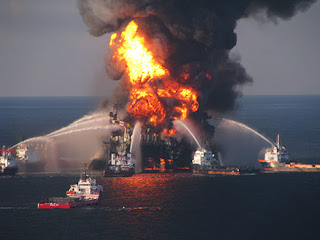
Tomorrow is also Day 50 of the the worst ecological disaster in US history. (My opinion--there is some depressing competition.)
This year's Oceans Day theme, ironically enough, is "Oceans of Life."
Meanwhile, back at the Wingnut Wurlitzer: Jindal wants to keep drilling. Chevron agrees. Murkowski worries about liability exposure for big oil. Inhofe too. Cornyn thinks we shouldn't try for bold steps on energy policy. Shell Oil says drilling in ANWR is safe. Palin asserts the spill validates "drill, baby, drill." BP remains a corporate psychopath.
Words fail.
Tomorrow is also Day 50 of the the worst ecological disaster in US history. (My opinion--there is some depressing competition.)
This year's Oceans Day theme, ironically enough, is "Oceans of Life."
Meanwhile, back at the Wingnut Wurlitzer: Jindal wants to keep drilling. Chevron agrees. Murkowski worries about liability exposure for big oil. Inhofe too. Cornyn thinks we shouldn't try for bold steps on energy policy. Shell Oil says drilling in ANWR is safe. Palin asserts the spill validates "drill, baby, drill." BP remains a corporate psychopath.
Words fail.
Sunday, June 6, 2010
Permitting Insanity
Why does it take more than 9 years and endless anguish to allow wind turbines in Nantucket Sound, but deepwater oil drilling routinely has environmental impact studies waived, supposedly because massive oil spills are unlikely? The oil industry has received approvals with potentially severe environmental impacts in as little as 10 minutes. Contrast the (over-)abundance of caution for wind and the cozy practice of superficial scrutiny for oil. Recent events make the dissonance especially jarring.
The Cape Wind offshore wind farm is closer than ever to the start of construction. Just more than a week after the explosion of BP's Deepwater Horizon platform, US Interior Secretary Ken Salazar gave formal approval, saying:
After careful consideration of all the concerns expressed during the lengthy review and consultation process and thorough analyses of the many factors involved, I find that the public benefits weigh in favor of approving the Cape Wind project at the Horseshoe Shoal location. With this decision we are beginning a new direction in our Nation’s energy future, ushering in America’s first offshore wind energy facility and opening a new chapter in the history of this region.
Friday, June 4, 2010
Hydropower Potential - IV
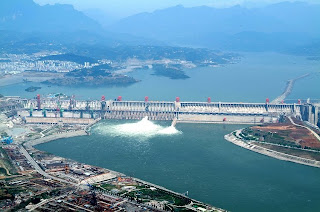
Alternative Energy eTrack aggregates multiple databases, news sources, insight from industry executives and other sources to produce data on the potential of various kinds of renewable energy. While the service is by subscription, some of the data sometimes appears elsewhere. For example, take this list of the top 10 countries for hydropower:
First, China's capacity is more than double that of the number two country, Brazil.
Second, all of the so-called BRIC countries (Brazil, Russia, India, and China) are in the top six; there is a good correlation of the world's fast-growing and significant economies with hydropower capacity to supply the electrical power these countries need to sustain their growth. The significant investment in renewable generation merits recognition at least as much as the opprobrium over their investment in dirty fossil energy.
Third, hydro dwarfs other renewables in the US, with only wind at the same order of magnitude:
Finally, comparing these numbers to the overall US generating capacity of just more than a terrawatt (1,000,000 MW) shows how relatively paltry is the contribution of renewable sources to our electrical generation.
There is still a long way to go.
1. China - 179,056 MWIt's interesting data for several reasons.
2. Brazil - 81,955 MW
3. United States - 78,054 MW
4. Canada - 75,287 MW
5. Russia - 46,756 MW
6. India - 39,546 MW
7. Norway - 29,317 MW
8. Japan - 22,089 MW
9. France - 20,850 MW
10. Sweden - 16,266 MW
First, China's capacity is more than double that of the number two country, Brazil.
Second, all of the so-called BRIC countries (Brazil, Russia, India, and China) are in the top six; there is a good correlation of the world's fast-growing and significant economies with hydropower capacity to supply the electrical power these countries need to sustain their growth. The significant investment in renewable generation merits recognition at least as much as the opprobrium over their investment in dirty fossil energy.
Third, hydro dwarfs other renewables in the US, with only wind at the same order of magnitude:
Wind 35,296 MWFourth, comparing this data to the capacities cited by the US Energy Information Administration (EIA) shows that there has been little added hydro capacity since 2008, the last year available, but a healthy increase in wind capacity and substantial percentage increases in solar and biomass/biogas.
Biomass 9,391 MW
Geothermal 3,153 MW
Solar (PV) 1,488 MW
Biogas 1,047 MW
Solar (CSP) 900 MW
Finally, comparing these numbers to the overall US generating capacity of just more than a terrawatt (1,000,000 MW) shows how relatively paltry is the contribution of renewable sources to our electrical generation.
There is still a long way to go.
Labels:
Brazil,
BRIC,
China,
energy policy,
fossil fuel,
India,
renewable energy,
Russia,
water,
wind
Wednesday, June 2, 2010
Hear My Train A-Comin'
Would you take a high-speed train that doesn't stop?
The video shows the "non-stop MRT system" of its Taiwanese inventor Peng Yu-lun and is (I think) in Mandarin, but you can get a pretty good idea nonetheless of how passengers use ingenious reusable shuttles to get on and off a high speed train without it stopping or even (much?) slowing down:
English explanation here.
Possible problems:
Update: A friend, working in the PRC for many years writes:
The video shows the "non-stop MRT system" of its Taiwanese inventor Peng Yu-lun and is (I think) in Mandarin, but you can get a pretty good idea nonetheless of how passengers use ingenious reusable shuttles to get on and off a high speed train without it stopping or even (much?) slowing down:
English explanation here.
Possible problems:
- Trains are taller, so existing bridges might need to be rebuilt
- Not everyone in the train can fit in the shuttles, so they couldn't all get off en masse at the stadium station to go to the ball game
- Acceleration of the shuttle may be too exciting for those with heart problems or other health issues
- Most people are too terrified of derailments anyway
- US patent 4,425,851 from 1984. Why did no one do this already?
- A great Peter Tosh tune would be obsolete:
Update: A friend, working in the PRC for many years writes:
It is Mandarin. The platform announcer tells travellers that train 168 non-stop from Beijing to Guangzhou is approaching the station. Passengers travelling in the direction of Guangzhou are to board the shuttle. Then the train's announcer tells passengers disembarking at Wuchang to board the train's shuttle. Lastly there is a welcome to Wuchang station announcement. The inventor explains that he has put together a simple mechanical frame just to demonstrate the basic concept. He then describes the passenger movement for boarding and exiting the non-stop train from Beijing to Guangzhou.
This is very interesting!
Tuesday, June 1, 2010
Augmenting Thermal Power Plants with Hydropower from Cooling Water
|
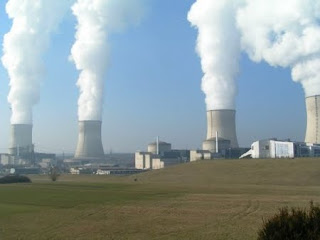
Once the steam has passed through the turbine it moves into a condenser where it is cooled back into liquid water, and circulated around to be heated again. Many of the condensers use water to cool the steam. Some plants use a closed loop of cooling water, where the cooling water is itself cooled; in nuclear plants this is the purpose of the tall cooling towers. Steam that escapes is replaced by a fresh supply of water, which is why these plants are typically sited near rivers or by the ocean where there is a large continuous water supply.
Other plants use an open loop or once-through water for their cooling, where water is drawn in continuously for cooling, then discharged back into the river or ocean. These discharges are almost always gravity flows rather than pumped, and these discharges of large amounts of water, running continuously in artificial channels, are perfect for Hydrovolts turbines to generate power, augmenting that made by the main part of the plant. Hydrovolts turbines can generate additional power at modest cost by harnessing these untapped flows; the electricity is sent via the existing transmission infrastructure.
Like most other artificial water flows in constructed waterways, little or no permitting is needed because environmental impacts are minimal. As a result, cost is low and speed of implementation is relatively rapid. This is a solution that lets us take a small, but quick step to a better energy future.
Labels:
Flipwing,
fossil fuel,
hydrokinetic,
Hydrovolts,
nuclear,
renewable energy
Saturday, May 29, 2010
Big Business Responds to Climate Change
The disinformation campaign and faux controversy about climate change has shifted public opinion. The general public has become less certain about the reality of climate change over the past year and more inclined to believe that a real scientific controversy exists. However, a majority of businesses are acting as if the controversy is settled according to accounting firm Ernst & Young:
- 70% of the world's largest companies plan to spend more on efforts to combat climate change
- 80% plan to spend more on energy efficiency measures
- 65% plan to develop products and services related to climate change
- 63% pan to increase transparency of reporting on related areas such as environmental performance, energy use and carbon emissions
- Nearly 50% plan to spend at least 0.5% of revenue on such measures as energy efficiency
With all the uncertainty following Copenhagen, many business commentators were expecting the momentum in climate change investments to slow. Our research has shown something very different.It's quite surprising that business is leading the way in addressing a serious environmental problem on which the public shows increasing confusion and ambivalence. It is tempting to think that business is perhaps starting to see the costs and benefits more clearly; however, it may be more about keeping customers happy than about the operational bottom line: about 90% of the surveyed firms reported that their actions were due to customer demand.
Thursday, May 27, 2010
Washington Manufacturing Awards
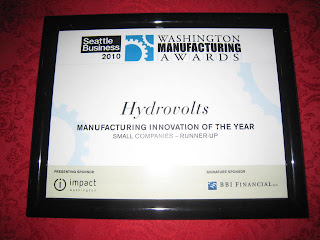
The inaugural Washington Manufacturing Awards were held this evening in Seattle, and Hydrovolts finished as the first runner-up for Manufacturing Innovation of the Year in the Small Company category.
Nearly 100 companies were nominated for awards, and Hydrovolts was one of three finalists for the Innovation award. Companies were chosen
Rogers Weed, Director of the Washington State Department of Commerce gave the keynote address on the state and future of manufacturing in Washington. He has a dual focus on aerospace manufacturing because of its size and historical importance and on cleantech "because the Governor told me to" (laughter.) Rogers noted that the economy was improving and recovering from the loss of 190,000 jobs in the state. GDP has grown in Washington for the past 3 quarters, and he sees no likelihood of a "double-dip" recession. Asia remains huge to the state's economy and our export economy remains a national trend-setter not only in exports, but in manufacturing and manufacturing "value-add." Rogers believes and expects Washington to be a leader in the global economy.
In all, a fun evening with good food, a crisp program and great networking with old friends and new acquaintances. Thanks to Impact Washington and the sponsors for the recognition, and hearty congratulations to our friends at MicroGREEN Polymers, who won the top prize!
Nearly 100 companies were nominated for awards, and Hydrovolts was one of three finalists for the Innovation award. Companies were chosen
...by a panel of experts based on criteria that [included] revenue growth (relative to the industry), capital investments, leadership, employee training programs, production quality, productivity, energy conservation and other factors.John Vicklund of Impact Washington helped emcee the awards sponsored by Seattle Business Magazine and RBI Financial. The reception and dinner was held in the Columbia Tower Club, high atop Seattle's tallest building with a sweeping view of the city and Puget Sound.
Rogers Weed, Director of the Washington State Department of Commerce gave the keynote address on the state and future of manufacturing in Washington. He has a dual focus on aerospace manufacturing because of its size and historical importance and on cleantech "because the Governor told me to" (laughter.) Rogers noted that the economy was improving and recovering from the loss of 190,000 jobs in the state. GDP has grown in Washington for the past 3 quarters, and he sees no likelihood of a "double-dip" recession. Asia remains huge to the state's economy and our export economy remains a national trend-setter not only in exports, but in manufacturing and manufacturing "value-add." Rogers believes and expects Washington to be a leader in the global economy.
In all, a fun evening with good food, a crisp program and great networking with old friends and new acquaintances. Thanks to Impact Washington and the sponsors for the recognition, and hearty congratulations to our friends at MicroGREEN Polymers, who won the top prize!
Labels:
Asia,
economics,
Hydrovolts,
jobs,
renewable energy,
Washington
Tuesday, May 25, 2010
Scalable
The Hydrovolts Flipwing Turbine has many compelling advantages compared to other hydro turbines and to other kinds of electricity generators. It has many features, including being complete, compact, modular, safe, simple and scalable.
The Hydrovolts turbine is scalable in two fundamental ways.
First, the Hydrovolts turbine can be built in nearly any size, from very small to quite large. More importantly, the turbine's cross-axis design is rectangular, so it can be built in a broad range of different dimensions. Turbines can be built that are very wide but not very high, or they can be built more squarely. Propeller-type axial turbines always have a circular swept area, so they are ill-suited to water channels that are, for example, broad and shallow. Even with a cowling such turbines are not as adaptable because they cannot scale to arbitrary dimensions like the Hydrovolts turbine.
Second, the typical Hydrovolts turbine is a micro-scale device, and will generate 5-20kW in typical water flows. In very large channels multiple turbines can be deployed side-by-side in the channel, scaling up the power produced by deploying multiple turbines together. Where the water course is deep, turbines can also be positioned one above the other to take advantage of the height of the water column. Turbines can also be spaced one after the other down a water course. Even though any turbine slows the water as it extracts energy, gravity re-accelerates the water as the channel slopes away. Hydrovolts expects turbines typically can be placed 10 per mile, but the maximum rate will depend on the specific watercourse geometry.
Scalable is good. Power from Water.
The Hydrovolts turbine is scalable in two fundamental ways.
First, the Hydrovolts turbine can be built in nearly any size, from very small to quite large. More importantly, the turbine's cross-axis design is rectangular, so it can be built in a broad range of different dimensions. Turbines can be built that are very wide but not very high, or they can be built more squarely. Propeller-type axial turbines always have a circular swept area, so they are ill-suited to water channels that are, for example, broad and shallow. Even with a cowling such turbines are not as adaptable because they cannot scale to arbitrary dimensions like the Hydrovolts turbine.
Second, the typical Hydrovolts turbine is a micro-scale device, and will generate 5-20kW in typical water flows. In very large channels multiple turbines can be deployed side-by-side in the channel, scaling up the power produced by deploying multiple turbines together. Where the water course is deep, turbines can also be positioned one above the other to take advantage of the height of the water column. Turbines can also be spaced one after the other down a water course. Even though any turbine slows the water as it extracts energy, gravity re-accelerates the water as the channel slopes away. Hydrovolts expects turbines typically can be placed 10 per mile, but the maximum rate will depend on the specific watercourse geometry.
Scalable is good. Power from Water.
Labels:
distributed generation,
Flipwing,
Hydrovolts,
renewable energy
Saturday, May 22, 2010
Deepwater Horizon Causes and Lessons
Many investigations lie ahead. President Obama has appointed a commission of inquiry. Industry shills have been hard at work for a month, unhampered by pesky facts. In the interim one of the most detailed analyses I have yet seen is posted at The Oil Drum. The author, a long-time oil and gas geologist, notes that the causes and lessons may change as more facts come to light. The analysis is aided by contibutions from offshore oil industry engineers, bit is also colored in its conclusions by their understandable bias towards perpetuating the industry that sustains their professional standing and provides their economic livelihood.
The principal conclusion pulls no punches:
Offshore oil drilling is not the solution to our energy problems. It is a reckless attempt to perpetuate our failing energy system, a system which cannot be sustained. It stands in the way of advancing real energy solutions. Time grows short.
The principal conclusion pulls no punches:
What can be addressed now is the larger issue that a flawed, risky well plan for the MC 252 well was approved by the MMS, and BP, Anadarko and Mitsui management. Similar or identical plans were undoubtedly approved and used by many operators on other wells drilled in the Gulf of Mexico. A plan that does not include enough cement to overlap the final and previous casing strings, and that does not require running a cement-bond log to ensure the integrity of the seal is a defective plan. The fact that there have not been blowouts on previous wells does not justify the approval and use of an unsafe plan.Similar or identical plans. There are currently 3,858 other offshore platforms in the Gulf of Mexico, each of which can have as many as 20 wells.
Offshore oil drilling is not the solution to our energy problems. It is a reckless attempt to perpetuate our failing energy system, a system which cannot be sustained. It stands in the way of advancing real energy solutions. Time grows short.
Friday, May 21, 2010
Spewing Nonsense
How much oil is spewing from the underwater volcano a mile under the Gulf of Mexico? More than a month after the Deepwater Horizon platform exploded on April 20, then burned and sank two days later, there is still no actual measurement. That there is none is troubling. How the estimates have changed is both instructive and even more disturbing. What might once have been considered spin is now revealed as outright lying. With this latest debacle BP has reached a new nadir in their long history of accidents, lying and greenwashing.
Thursday, May 20, 2010
Ice to Eskimos
In 2008 the average American consumed 30 gallons of bottled water, primarily from single-serving, single-use plastic bottles. That's 320 12-ounce bottles, or nearly one every day. It's obsessive.
There are many reasons not to drink bottled water.
Bottled water costs more than gasoline. It costs up to 10,000 times more than tap water. It uses 2,000 time as much energy. It has 100 times the life cycle costs.
There are many reasons not to drink bottled water.
Bottled water costs more than gasoline. It costs up to 10,000 times more than tap water. It uses 2,000 time as much energy. It has 100 times the life cycle costs.
Tuesday, May 18, 2010
Crude Strategies
The situation in the Gulf is so grim humor can't rise above the sardonic. Thank goodness the problem is relatively small.
Monday, May 17, 2010
National Security Threats Too Great
The following guest post by James Marvin, Director of Field Operations and Business Development at Hydrovolts was previously published in the National Journal's Expert Blogs on Energy & The Environment. James spent 20 years as a Navy SEAL and has seen first-hand the casualties of our oil addiction.
National Security Threats Too Great
by James Marvin
The United States has to pass comprehensive climate and energy legislation. The longer we wait, the more difficult it will become to address the issue. Whether the American Power Act will carry the day, or some other legislation already introduced, remains to be seen. Doing nothing though, is not an acceptable answer and whatever the solution turns out to be it has to be pragmatic and it has to be timely.
National Security Threats Too Great
by James Marvin
The United States has to pass comprehensive climate and energy legislation. The longer we wait, the more difficult it will become to address the issue. Whether the American Power Act will carry the day, or some other legislation already introduced, remains to be seen. Doing nothing though, is not an acceptable answer and whatever the solution turns out to be it has to be pragmatic and it has to be timely.
Friday, May 14, 2010
At the McKinstry Innovation Center
We moved into the McKinstry Innovation Center on Monday and we're now mostly unpacked. It's a beautiful space--light, airy and spacious. I took a few pictures today that give perhaps a sense of our new office and the various shared workspaces.
The third floor lobby entrance--where innovation begins!
Labels:
Flipwing,
hydrokinetic,
Hydrovolts,
renewable energy,
Washington
Wednesday, May 12, 2010
Distributed Hydropower from Wastewater
The Hydrovolts Flipwing Turbine can generate power in man-made and natural watercourses of many kinds. The initial market is irrigation canals, and there are lots of others, including resource exploration, remote ocean sensors and military uses.
Because of the ingenious cross-axis design of the Flipwing, they can also generate power even in flows that are not clean, or even free of effluvia--flows like those found in sewer and wastewater systems in nearly every community.
There are 16,583 wastewater treatment plants in the United States serving nearly 3/4 of the population. There is growing interest in treating wastewater as a resource rather than something simply to be disposed. The biosolids have obvious application as fertilizer. The sludge can potentially be turned in to energy. Sewage can produce methane for fuel. Washington the Budd Inlet Treatment Plant has a pilot program to do just this. Treatment plant sites also lend themselves to solar installations. There are lots of ways to turn this waste into economic value.
Because of the ingenious cross-axis design of the Flipwing, they can also generate power even in flows that are not clean, or even free of effluvia--flows like those found in sewer and wastewater systems in nearly every community.
There are 16,583 wastewater treatment plants in the United States serving nearly 3/4 of the population. There is growing interest in treating wastewater as a resource rather than something simply to be disposed. The biosolids have obvious application as fertilizer. The sludge can potentially be turned in to energy. Sewage can produce methane for fuel. Washington the Budd Inlet Treatment Plant has a pilot program to do just this. Treatment plant sites also lend themselves to solar installations. There are lots of ways to turn this waste into economic value.
Monday, May 10, 2010
Micro Loans for Micro Power
Hundreds of thousands of people have electricity because of distributed generation from small renewable energy systems financed by micro lending:
This is a great program beautifully suited to regions without existing electrical grid infrastructure, and has the potential to have a lasting and powerfully positive impact on the energy poverty that afflicts much of the developing world. Even small amounts of electricity can change lives for the better by providing lighting for reading, heating and cooking that doesn't burn nasty fuels with toxic byproducts, and the ability to create a business, boosting the local economy.
Such an approach could work with micro hydropower too.
The Solar Home System (SHS) dissemination programme in Bangladesh is considered to be one of the most successful of its kind in the world, bringing power to rural areas where grid electricity supply is neither available nor expected in the medium term.The program started in January 2005 and nearly 350,000 SHSs were installed by last summer, most of which had a rated power output of 50W. Systems came with 3-4 compact flourescent light bulbs. Owners benefit from lighting, especially in their kitchens and courtyards, and also use the systems to charge batteries, power radios, and even run 12V televisions. While statistics are lacking, it appears that some owners are using the power in their small stores and restaurants, boosting their income.
This is a great program beautifully suited to regions without existing electrical grid infrastructure, and has the potential to have a lasting and powerfully positive impact on the energy poverty that afflicts much of the developing world. Even small amounts of electricity can change lives for the better by providing lighting for reading, heating and cooking that doesn't burn nasty fuels with toxic byproducts, and the ability to create a business, boosting the local economy.
Such an approach could work with micro hydropower too.
Saturday, May 8, 2010
National Train Day
In the United States it's National Train Day. I like rail travel, and I prefer it to flying or driving.
Train travel in the US has its good and less good aspects. Here are 10 of each:
10 good things about traveling by train:
Train travel in the US has its good and less good aspects. Here are 10 of each:
10 good things about traveling by train:
- Great scenery through large windows
- Electrical outlets for laptops or other equipment
- Lots of room (more in coach than airlines have in first class)
- A dining car with good-sized tables
- A lounge car
- TSA doesn't do trains
- Show up 5 minutes before departure and get on easily
- No jet engine roar, no seatbelts
- Cheaper than cars or airplanes
- Much smaller carbon footprint
Labels:
carbon footprint,
public transit,
trains,
transportation
Friday, May 7, 2010
Hydrovolts Moves to McKinstry Innovation Center
Monday is moving day!
We've been at our current office for more than a year, but are in the final stages of making our move to the McKinstry Innovation Center down in Georgetown. Our time at WRF has been great and the people--including Ron, John, Loretta, Kim, Thong, Morgan, Dale, and Britt--fantastic. Thanks to all of our friends at WRF for being part of our growth and progress!
Hydrovolts is one of two initial tenants at the McKinstry Innovation Center along with General Biodiesel.
Our new address is
Hydrovolts
210 South Hudson Street
Suite 330
Seattle, WA 98134-2417
Phone numberTBA 206-658-4380. Our website, social media channels, emails, etc. remain unchanged.
Some press on the move here, here, here, and here.
Update: Added phone number and zip+4
We've been at our current office for more than a year, but are in the final stages of making our move to the McKinstry Innovation Center down in Georgetown. Our time at WRF has been great and the people--including Ron, John, Loretta, Kim, Thong, Morgan, Dale, and Britt--fantastic. Thanks to all of our friends at WRF for being part of our growth and progress!
Hydrovolts is one of two initial tenants at the McKinstry Innovation Center along with General Biodiesel.
Our new address is
Hydrovolts
210 South Hudson Street
Suite 330
Seattle, WA 98134-2417
Phone number
Some press on the move here, here, here, and here.
Update: Added phone number and zip+4
Wednesday, May 5, 2010
Idle Plans
In my home town of Toronto, the Board of Health is pushing for legislation to reduce the permitted idling of motor vehicle engines from the current 3-minute limit to one minute. People idling their engines longer face a $125 fine.
The Board acted in part on a report from Dr. David McKeown, Toronto’s medical officer of health, which stated:
Added McKeown, “I understand why people want to get into a warm car, but the price we pay for that is our health.”
The shorter limit was previously adopted by the Ontario city of Burlington, but is "widely ignored" and sporadically enforced.
The Board acted in part on a report from Dr. David McKeown, Toronto’s medical officer of health, which stated:
For every litre of gasoline used, about 2.4 kg of CO2 are produced; for every litre of diesel fuel consumed, about 2.7 kg of CO2 are produced. The Clean Air Partnership estimated that idling in the GTA [Greater Toronto Area] wastes 90 million litres of fuel each year, suggesting that over 215 million tonnes of CO2 are emitted in the GTA each year as a result of idling. Assuming that vehicle ownership is distributed evenly across the GTA, Toronto’s contribution could be 105 million tonnes of CO2 each year as a result of idling.The cars of yesteryear needed warming up because they used heavier motor oil which needed warming to fully lubricate the engine. Modern cars with computer controls need at most 10 seconds before they are ready to drive. Shutting off an engine if it would idle more than 30 seconds will save gas, although there are more effective eco-friendly driving steps.
Added McKeown, “I understand why people want to get into a warm car, but the price we pay for that is our health.”
The shorter limit was previously adopted by the Ontario city of Burlington, but is "widely ignored" and sporadically enforced.
Sunday, May 2, 2010
Laissez Failure
The slow-motion ecological catastrophe in the Gulf of Mexico is horrifying.
The oil slick is now the size of Ohio, and growing by the hour. Edges of it are now reaching land and all along the Gulf coast residents wait with deep foreboding and growing anger as the dimensions of the disaster become clear.
This is not an oil spill, but an oil spilling, as more ruptures from the sea floor, surfaces, and spreads its devastating reach towards shore. 40% of the coastal wetlands in the United States are under threat, as are the majority of the country's oyster and shrimp fisheries. Local fishermen have moved quickly through the 5 stages of grieving as they face the imminent destruction of their livelihood, economic security, their way of life, and their future.
Emergency response began quickly and broad efforts at mitigation are underway. The Obama Administration formed a National Response Team, Louisiana Governor Bobby Jindal is mobilizing the state's National Guard, and locals are taking to their boats to deploy booms to intercept the sprawling slick. Dealing with the immediate crisis is paramount now, yet soon hard questions must be asked, and honestly answered. The critical questions are:
Why did this happen? How do we prevent it happening again?
The oil slick is now the size of Ohio, and growing by the hour. Edges of it are now reaching land and all along the Gulf coast residents wait with deep foreboding and growing anger as the dimensions of the disaster become clear.
This is not an oil spill, but an oil spilling, as more ruptures from the sea floor, surfaces, and spreads its devastating reach towards shore. 40% of the coastal wetlands in the United States are under threat, as are the majority of the country's oyster and shrimp fisheries. Local fishermen have moved quickly through the 5 stages of grieving as they face the imminent destruction of their livelihood, economic security, their way of life, and their future.
Emergency response began quickly and broad efforts at mitigation are underway. The Obama Administration formed a National Response Team, Louisiana Governor Bobby Jindal is mobilizing the state's National Guard, and locals are taking to their boats to deploy booms to intercept the sprawling slick. Dealing with the immediate crisis is paramount now, yet soon hard questions must be asked, and honestly answered. The critical questions are:
Why did this happen? How do we prevent it happening again?
Labels:
Alaska,
economics,
energy policy,
environment,
fossil fuel,
Lousiana,
nuclear,
ocean energy,
offshore wind,
politics,
regulation,
renewable energy,
solar,
sustainability,
Texas,
wind
Subscribe to:
Posts (Atom)