Friday, April 30, 2010

Hydrovolts is a B Corporation

Certified B Corporation Seal
Hydrovolts has achieved certification from B Labs as a B Corporation--one of only 285 companies in the United States, and one of only 10 in Washington State.

Certification as a B Corporation attests to the values of a business, including those summarized in the B Corporation Declaration of Interdependence:
We envision a new sector of the economy which harnesses the power of private enterprise to create public benefit.

This sector is comprised of a new type of corporation, the B Corporation, which is purpose-driven and creates benefit for all stakeholders, not just shareholders.

Thursday, April 29, 2010

Distributed Hydropower for Remote Ocean Devices

Acoustic Doppler Current Profiler
There are many users who want to place electronic devices in remote ocean locations where power is not available from the electrical grid. These remote ocean devices (often sensors of some kind) are powered by batteries; however, today's state-of-the-art solutions are expensive and inconvenient.

For example, researchers at the University of Washington frequently want to deploy Acoustic Doppler Current Profilers (ADCPs) or other devices to take measurements under water over the course of weeks, months or longer. Running power through a cable from shore is impractical and costly, but the alternative actually used has a stiff price too: a disposable battery that costs $500 and lasts a mere 10 days, after which it must be replaced. In addition to the recurring cost of replacement batteries, there is the enormous cost of a boat and crew to do the replacement--often $1,000 per hour or more. In the deeper ocean farther form shore, boat costs can easily top $100,000 per day.

For small ocean power, the Hydrovolts turbine paired with a rechargeable battery replaces the current disposable battery solution, providing a capital ROI of substantially less than one year.

Tuesday, April 27, 2010

Time Grows Short

Gas gauge nearing empty
Oil is a finite resource.

Production peaked in the US decades ago, and the global peak is happening now, if it hasn't already. The transition to a new energy economy must happen because our ability to produce fresh supply will decline, even as economic development quickens throughout the developing world, boosting demand. There are other reasons too: climate change, energy security, and addressing energy poverty, the root of poverty generally throughout the world.

Making the transition is an urgent need:
The most critical question is how much time we have to make the transition. A fully equipped hospital with on-duty surgeons and staff may be the ideal technology for a critically injured patient. But they mean little to such a patient if we are in the position of having to build the hospital and train the surgeons and staff before administering treatment. I think this analogy aptly describes our current predicament. If you miscalculate concerning the time question, it will not matter how clever human beings are.
Our Earth, the patient, suffers from a growing number and severity of injuries. Delivering the cure will take substantial time and investment. What are we waiting for?

Sunday, April 25, 2010

Compact

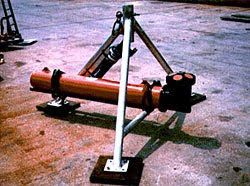
The Hydrovolts Alpha-1C Flipwing turbine prototype
The Hydrovolts Flipwing Turbine is designed to be complete, compact, modular, safe, simple and scalable.

I previously posted about how it is simple and complete.

It's also a compact solution. Other hydrokinetic turbines for micro-generation (i.e. less than 100kW) are much less so. Almost all use some kind of raft and place their generator and electronics above the water line. This solves one problem--how to keep the electronics dry--but introduces others:
  • Transmission--The rotor under water must somehow connect to the generator above it. Shafts, belts or chains can be used, but all have drawbacks, including efficiency loss, added maintenance burden, additional points of failure, and more mechanism that can entrain debris or become fouled.
  •  Efficiency--Vertical axis turbines with a lift design, (e.g. a Darrieus turbine) lose efficiency unless they are perfectly vertical, However, extending the shaft to the surface makes maintaining vertical alignment nearly impossible.
  • Adaptability--By using a raft, other turbines must be sited close to the surface.
  • Cost--Additional materials and a larger design add to the cost to build, to transport, and to deploy.
  • Sustainability--The added cost is not just in money, but also in embodied energy and carbon footprint.
All the parts of the Hydrovolts Flipwing turbine fit together neatly in one self-contained package. The generators are linked directly to the rotor and the power electronics are right there too. The compact design makes deployment very quick and easy--just lower it into the water and moor or anchor it in any of several ways. The entire turbine can be deployed at optimal depth with shorter transmission, high efficiency, adaptability, and lower costs to the buyer and to the environment.

Compact is good. Power from Water.

Thursday, April 22, 2010

Energy Security

Earth Day turned 40 today. For many Earth Day is an occasion to think green, hope for a less polluted future, advocate for renewable energy and perhaps push for a solution to climate change.

Others dismiss Earth Day as a symbol of mushy-minded ecomania that elevates the environment over the economy. It's a false choice, but the notion that doing something about the environment will cost the economy persists. Those who are skeptical about climate change are generally the same as those who are negative about renewable energy.

However, there are other reasons to support and promote renewable energy, and a big one is energy security. If it's renewable we don't need to rely on the supply of something like oil or uranium that has to come from somewhere else, possibly a country or region hostile to us.

Energy security matters. Most casualties in Iraq and Afghanistan come from the necessity of fuel transport--the supply chain is long and highly vulnerable.

Failing to make the speediest transition to renewable energy is bad policy for many reasons. It costs lives. It costs money. It funds those hostile to us. And it's futile, because the current energy model is not sustainable. Even the military recognizes that we need to get beyond oil because we're running out of the stuff.

Tuesday, April 20, 2010

Hydrovolts RFP

Hydrovolts Flipwing Turbine Prototype Alpha-1C during tow test near the Port of Seattle
Yesterday we put out an RFP for the design and realization of a sensor system on our Alpha-1C prototype.

Summary:
Hydrovolts is seeking a Contractor to design and install sensor and data collection capability on a submersible hydrokinetic turbine to measure rotor torque and rpm while operating in water flow rates between 1 and 8 knots of current speed. The deadline for Proposals is April 30, 2010 and the selected Proposal will be announced May 3, 2010 with work to begin immediately.
We expect a lot more work of this kind in the future as well; the ideal solution will be reusable on this and future machines. See the RFP for more details or contact Hydrovolts Director of Engineering' Brian Peithman at 206-336-5560.

Sunday, April 18, 2010

Hydrovolts Expands Leadership Team

Hydrovolts executive James Marvin
We're really pleased to announce a new addition to our team!

James Marvin, a former U.S. Navy SEAL Commander, started this past Monday as our Director of Business Development and Field Operations.

Burt Hamner, Hydrovolts CEO was enthusiastic:
We are excited to expand our team, and James’ expertise in both federal government relations and remote field operations will be integral to the company’s evolution and growth. James will not only implement turbine demos in canals and waterways around the world, but also help Hydrovolts do business with governmental organizations that work in remote, austere environments that can benefit from Hydrovolts’ renewable, fuel-free power generation technology.
James has 20 years of leadership experience in the most demanding and challenging environments around the world. His most recent assignment was Director of Operations for Naval Special Warfare Group Four (NSWG-4) where he managed maritime mobility platform operations for the U.S. Special Operations Command (USSOCOM) in riverine, coastal, and open ocean environments. He has global operational experience and has worked in the Pacific, South America, the Middle East, Europe, Africa as well as the U.S.

James and his family recently moved to the Seattle area from Virginia. The way they planned and executed the move is illustrative of both James' talents and a broader trend in relocation for top professionals. You can read more in last week's profile in the Wall Street Journal.

James has hit the ground running. Tomorrow he and Hydrovolts Director of Engineering Brian Peithman are in the field near Yakima to do some advance work ahead of deployment of our first demonstration project later this spring.

Welcome James!

Friday, April 16, 2010

Rapa Nui's Descent into Darkness

The moai, or stone heads of Easter Island
Many people insist, with all manner of justifications, that we can not, we should not, change the way we generate or use energy because we're not running out of oil, the climate isn't changing, and we aren't destroying our ecosystems everywhere one looks. Cornucopia forever.
What did the Easter Islander who cut down the last palm tree say while he was doing it?

[snip]

In fact, the question can be asked more broadly: “What were the thought processes and discussions amongst the inhabitants of Easter Island leading up to the removal of the last remnants of forest?” This could be seen, perhaps, as a hypothetical exploration, rooted in a real historical event, of “the psychology of resource depletion denial.”
A foreshadowing of the looming twilight of the Oil Age. The way of life on Easter Island wasn't negotiable either. The result?
As the forests shrunk in area and the annual percentage rate of depletion steadily increased, at some point, someone must have realised that the situation was not sustainable and said as much. The island is not that big and what was happening at one end would have been common knowledge at the other end.

Yet the inhabitants continued on. The forest dwindled to nothing and the soil washed away, depleted. Crop yields dropped. Felling trees destroyed animal habitat and then the animals. Food became scarce, leading to famine, inter-tribal warfare and eventually cannibalism. The population crashed in a mass die-off.

Wednesday, April 14, 2010

Let's Go LEGO

LEGO Renewable Energy Add-on Set
LEGO is equipping and stimulating the next generation of cleantech inventors. This is great, but where's the hydropower turbine?
The Renewable Energy Add-on Set is designed as an addition to the Simple & Motorized Mechanisms Set, the core set in our Machines & Mechanisms range. When the Renewable Energy Add-On Set is combined with the customized activity pack, students will explore renewable energy sources; investigate energy supply, transfer, accumulation, conversion, and consumption; and use measurements and data analysis to describe and explain outcomes through hands-on activities and exciting, real-life models.
The LEGO folks also write:
Students will experiment using energy from their own bodies and the three main energy sources – solar, wind, and water – to generate, store, and use power.
Water is one of the big three – all right! Perhaps the wind rotor disconnects from the generator so it could be placed under water and use some kind of gears or belt to turn the generator above water. I'm going to get one when it is available this Fall (in time for Christmas I suppose.)

Sadly, biomass fans are totally out of luck.

(h/t Fast Company)

Tuesday, April 13, 2010

The World's Only Carbon-Negative Country

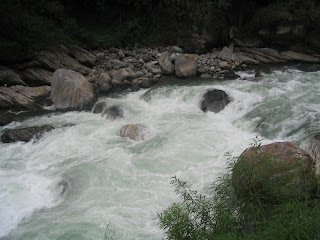
River in Bhutan
Low fossil fuel use and a strong policy to protect forests makes it unique:
Run on Buddhist principles of respect for nature, Bhutan is the only country among 194 U.N. members to have formally told the United Nations this year that it is now "climate negative" -- soaking up more greenhouse gases more than it emits.
Bhutan, a tiny Buddhist kingdom in the Himalayas is also noteworthy as the only country in the world that calculates its Gross National Happiness.

Saturday, April 10, 2010

Partisan Challenge

A famous American, fiercely partisan on any number of policy areas, nonetheless said this:
If we've learned any lessons during the past few decades, perhaps the most important is that preservation of our environment is not a partisan challenge; it's common sense. Our physical health, our social happiness, and our economic well-being will be sustained only by all of us working in partnership as thoughtful, effective stewards of our natural resources.
Who was the speaker? This same proud conservative also took credit for his fundamentally conservative viewpoint that the economy does not utterly trump the environment:
I'm proud of having been one of the first to recognize that States and the Federal Government have a duty to protect our natural resources from the damaging effects of pollution that can accompany industrial development.

Such a viewpoint was not remotely controversial at the time. One suspects that if President Obama or most any other leader were to speak these exact words today the resulting partisan firestorm of criticism would be intense and vitriolic. Recent polling suggests that a slim majority of Americans are now willing to throw the environment under the economic bus. The anemia of the current "recovery" is doubtless responsible for much of this sentiment, but the lack of unequivocal support for environmental protection by our leaders is also to blame.

Thursday, April 8, 2010

Complete

Tarot Deck Major Arcana: XXI The World
The Hydrovolts Flipwing Turbine is designed to be complete, compact, modular, safe, simple and scalable.

I previously posted about how it is simple.

It's also a complete, ready-to-use product right out of the box. Part of simple deployment, as I wrote last time, is not needing a lot of assembly or complicated hook-ups to other components. The Hydrovolts turbine arrives with all parts necessary to make power. The power cable that comes out of the turbine provides 110V or 220V depending on the prevailing standard. It can be wired straight into an electrical panel. We can even provide it with a simple power strip on the end!

It's complete in the same way that a diesel generator bought from the hardware store is. You buy it, bring it home, start it up, and start plugging things into it. Actually, it's even more complete than that: you never need to bother with fuel.

Complete is good. Power from Water.

Tuesday, April 6, 2010

Arid Sea

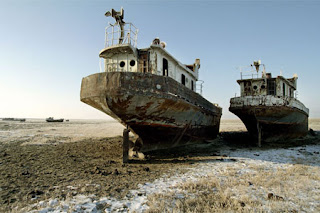
Abandoned and land-locked ships where the Aral Sea once was
How does one of the most massive bodies of water in the world vanish?

In the case of the Aral Sea, with sickening speed. What was once the world's 4th largest freshwater lake now is just 10% of its former size.

The causes are several: misguided economic development that ends up destroying, not creating jobs and economic vitality. Unsustainable practices. Grasping behaviors suggesting this may be an early harbinger of water wars to come.

Yet another example of the tragedy of the commons. The practices that are destroying the Aral Sea are not dissimilar to those that are destroying the oceans. Or the mountains. Or our climate.

Sunday, April 4, 2010

I Guess They Didn't Need a Weatherman

Strata SE1 artist's depiction of integrated wind turbines
Interesting.

A London developer will complete construction this June on the Strata SE1, which it claims "is the first development in the world where wind turbines have been integrated within the fabric of the building."

How much power will these turbines make?
The three five bladed nine metre diameter wind turbines are rated at 19kW each and are anticipated to produce 50MWh of electricity per year... approximately 8% of Strata SE1's estimated total energy consumption.
Hmm. To achieve 50MWh of output, the turbines must generate a continuous average over the year of about 1.9kW each. So Brookfield Europe, the developer, apparently infers that the actual generation will be a mere 10% of the "rated" output, which is really rather poor. A nice round figure of 10% also sounds like a guess:

Friday, April 2, 2010

And An Island Never Cries

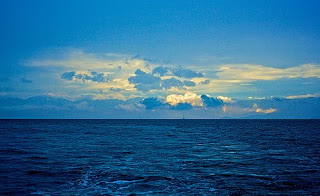
Open ocean, with no land in sight
Some continue to deny, against a flood of evidence, that ocean levels are rising. Such denial is easy if you dismiss reason and ignore your lying eyes. And that's what it takes when an entire island is swallowed by the sea:
A tiny island claimed for years by India and Bangladesh in the Bay of Bengal has disappeared beneath the rising seas, scientists in India say.

The uninhabited territory south of the Hariabhanga river was known as New Moore Island to the Indians and South Talpatti Island to the Bangladeshis.

Recent satellites images show the whole island under water...

[snip]

"What these two countries could not achieve from years of talking, has been resolved by global warming," said Professor Sugata Hazra of the School of Oceanographic Studies at Jadavpur University in Calcutta.
Professor Hazra added that sea level rise in the Bay of Bengal  has accelerated over the past decade and the overtopping of other islands in the region in the next decade is likely. No one lives on these islands. Others are not so lucky.

Wednesday, March 31, 2010

Our Energy Future - II

Peak Oil graph
Where will our energy come from in the future? Peak oil is upon us, even if the exact date is not yet conclusively known. Nuclear power is at best a transitional step, and quite costly when factoring in construction and external costs. What's left?

How about 100% from renewable sources? A new report by PriceWaterhouseCoopers suggests Europe could be powered entirely by renewable sources, albeit at substantial cost of transition, especially on inter-continental transmission:
A "super-smart" grid powered by solar farms in North Africa, wind farms in northern Europe and the North Sea, hydro-electric from Scandinavia and the Alps and a complement of biomass and marine could render carbon-based fuels obsolete for electricity by 2050, said the report.

The goal is achievable even without the use of nuclear energy, the mainstay of electricity in France.
While the costs and challenges are great, those of clinging to the fossil economy would be much greater. But what is remarkable, of course, is that the modern industrial economy of Europe, roughly the same size as that of the United States, could be run entirely on renewable energy.

Thus, today's announcement by President Obama to expand off-shore oil drilling in the United States is especially disappointing.

Monday, March 29, 2010

Tea Power

Tea factory in Papua New Guinea
The Kenya Tea Development Agency (KTDA) has a massive power bill from over 60 factories that process tea from 500,000 farmers. The supply from the national grid is costly and erratic, so last summer the KTDA created an energy subsidiary to pursue locally generated hydropower, reducing factory costs and boosting farmers' incomes. The Kenyan Ministry of Energy identified 12 sites for the KTDA to develop distributed hydropower generation. Two of these sites are now under development:
Imenti Tea Factory Company is already generating 1 megawatt through the Imenti mini-hydro project. Last June, the factory signed a power purchase agreement (PPA) with the Kenya Power and Lighting Company to supply surplus power to the national grid. The second project still under construction at Gura river in Nyeri is a four-factory partnership that will serve the KTDA factories at Gitugi, Iriani, Chinga and Gathuthi.

Sunday, March 28, 2010

Conservatives Announce Plan to Promote Renewable Energy

Nate Beeler: Energy Policy Stopgap
Conservatives recently announced a 12-point action plan to boost renewable energy and nuclear power. The plan would also entail a substantial change to the energy sector. The plan recognizes the historical abundance of oil and gas in the country as well as the relatively recent rise of concern over pollution, resource depletion, and the green house gases emissions that are fueling climate change.

Some of the specific initiatives include:
  • A Green Investment Bank to provide public funding for new energy technologies
  • Establishing a "floor" price for carbon and an upstream tax
  • Accelerated demonstration projects for energy storage and carbon capture
  • Establishing an "energy internet", including distributed generation and a smart grid
  • Household incentives for energy efficiency
  • Electrifying the transport system
  • Implementing national feed-in tariffs
The current energy approach is "out of date"; what is needed are:

Friday, March 26, 2010

New Logo

We've updated our logo:

Hydrovolts logo--Power from Water


It still has the diamond shape containing a stylized water-course with power bursting forth.

We'll be rolling it out on the web site, Twitter, Facebook, YouTube, LinkedIn and our various print pieces over the next few weeks. Also coming soon: a fresh look for our web site.

As always, we'd love to hear your comments and ideas...

Thursday, March 25, 2010

Low-Impact Hydropower

Surveyor
The Obama administration's peripatetic interest in renewable energy focused yesterday on hydropower:
The Energy and Interior departments and the Army Corps of Engineers have agreed to create a new strategy for promoting hydropower development while reducing environmental impacts and streamlining regulations. But, the agencies caution, do not expect a proliferation of new dams.

"This is not ushering in a 21st century new dam era," Interior Secretary Ken Salazar said. "This is taking a look at existing facilities and low-impact hydro. This is an examination of what we can do with hydropower that does not necessitate the building of new dams."

Hydrokinetic power!