Sunday, March 14, 2010

Enough Science, We Need More Marketing

Woman listening to an iPod, talking on a cell phone and holding a Starbucks coffee
Eric Roston at Grist considers the problem that renewable energy and other green technologies can be more expensive than the fossil/nuclear infrastructure we've used until now, and suggests some companies that might lead public opinion to the cleantech future:
I can’t help but wonder if the wrong companies are on the case. Shouldn’t Starbucks (which more than doubled the price of coffee), Apple (whose iPod delivers a tenth the sound quality of analog music at four times the cost), and AT&T (more dropped calls) get to work on making expensive-but-clean tech a style-driven phenomenon?
Sadly, he's on to something.

Saturday, March 13, 2010

Simple

The Hydrovolts Flipwing Turbine is designed to be complete, compact, modular, safe, simple and scalable.

There are several aspects of being simple:
  1. Simple design. The Flipwing is composed of 4 basic components: the rotor, the generator, the electronics, and the deployment. Each component is built with a minimum of materials and designed to accomplish its sole primary function; respectively: spinning, converting kinetic energy to electricity, making the electricity usable, and keeping the turbine optimally positioned.
  2. Simple deployment. Being a self-contained floating unit, the Flipwing can be deployed in as little as an hour, and removed just as easily. Hook-up to equipment or to the grid uses equipment and procedures pioneered and long-used by small wind, solar and fossil fuel generators.
  3. Simple maintenance. Since it easily taken in and out, the Flipwing can be out of the water for routine maintenance and back in without significant downtime. The simple design allows routine cleaning and lubrication to be done using common hand tools and off-the-shelf supplies and equipment.
  4. Simple value. The Flipwing makes continuous, low-cost and immediately usable power, solving a basic need for business, communities and individuals world-wide.
Simple is good. Power from Water.


For your amusement, a satirical look at the perils of (large) corporations trying to do a simple design without having a simple objective in mind:

(h/t Polizeros)

Friday, March 12, 2010

The Power of the Open Road

South Korean Online Electric Vehicle (OLEV)
What will power our transportation future? The Korea Advanced Institute of Science and Technology (KAIST) has built a prototype magnetic train that runs on an electrical road:
On Tuesday researchers launched an environmentally friendly public transport system using a "recharging road"-- with a vehicle sucking power magnetically from buried electric strips.

The Online Electric Vehicle (OLEV), towing three buses, went into service at an amusement park in southern Seoul. If the prototype proves successful, there are plans to try it out on a bus route in the capital.

Wednesday, March 10, 2010

Hydropower Potential - II

Archimedes Screw in Osbaston, Monmouthshire, UK
The potential for Hydropower is enormous throughout the world, including in Europe. France, Italy and Norway have especially good hydropower resources, as does Turkey, from which we have had several purchase and distributor inquiries for turbines. But other countries have great potential too--like in the UK:
A study commissioned by the Government body has concluded that there is vast untapped potential across the England and Wales for generating energy from rivers.

Waterways in Wales, the upper reaches of the Thames, the Humber, the Aire, Severn and the Mersey have been identified as having the most potential.

Saturday, March 6, 2010

The Euthanasia of Reason

Goya etching The Sleep of Reason Produces Monsters
Goya created the famous etching with the even more famous caption "The Sleep of Reason Produces Monsters." While he may perhaps have sought to convey sleep as unleashing creativity, the caption as well as the imagery of foolish owls and ignorant bats is now used mostly as metaphor for the disasters that result from a lack of critical thinking.

It is a sleeping sickness for it renders its victims at length incapable of exercising their faculties' full function. The sickness is virulent, as it is readily contagious to those with a mental immune system weakened by atrophy. Even the somewhat more hale of mind are also susceptible to those evangelizing the joys of dimwittery who are as vectors for the pathology of embraced ignorance.

Perhaps, gentle reader, you think I wax over-much and with an excess of alarm? Sadly, no. These monsters of unreason have been so widely loosed that the resulting grotesqueries are everywhere visible. For example, behold the rich vein of raw unreason displayed in this recent piece: "Darwin Foes Add Warming to Targets." (The reporter, Leslie Kaufman, does not much heap irrationality on the idiocies of those quoted, but is, alas, guilty of journalistic stenography: can not the most absurd and ridiculous of statements be tagged for the utter nonsense that it is?)

How deep is our sleep? Let's bestir ourselves and see...

Thursday, March 4, 2010

Who Speaks for Business?

Empty podiumtitl
Who speaks for business? Who advocates for business and articulates their views on public policy? Businesses and their leaders do of course. They just don't always speak with one voice.

For example, a recent survey commissioned by international renewable energy group NTR Foundation and conducted by the Brunswick Group found more than half of the largest US companies wanting an end to the ambiguity surrounding climate change legislation.
About 50 per cent of America’s top business leaders believe a lack of clarity on climate legislation is negatively impacting upon the ability of the US to compete in the global market.

Seventy per cent of the respondents said climate change would be an important part of their commercial decision-making within five years. But almost three in four of the business leaders said security of energy supply was a more “pressing issue” for them than climate change.

Monday, March 1, 2010

The Hydrovolts Turbine - VII

The Hydrovolts Flipwing Turbine had a very successful coming out at the Harvesting Clean Energy Conference a few weeks ago. So, where does it go next?

Moving into the McKinstry Innovation Center in a few months is exciting, but another great reason to be there is the football field-sized workshop just downstairs. We decided there's no reason to wait until May, so we took the turbine straight from the show to the shop.

The Hydrovolts Flipwing Turbine arrives at McKinstry on a flatbed truck
Hydrovolts COO Chris Leyerle arrives at McKinstry
after the drive from Kennewick with the Hydrovolts Flipwing Turbine

The talented staff at McKinstry got right to work.

Sunday, February 28, 2010

On the Move

McKinstry & Company logo
Hydrovolts will be moving to Seattle's Georgetown neighborhood in May.

On Friday we signed a Letter of Intent with McKinstry Company to be one of the first tenants in their nearly-complete McKinstry Innovation Center, whose purpose is to "bring new and emerging companies together to foster the advancement of clean, green energy technologies."

Said David Allen, McKinstry Executive Vice President, at the original announcement last October:
The opportunities before us are significant. There is great demand for new green energy efficient technologies. Companies who are developing these now have a place to collaborate and gain the momentum they need to propel this industry forward.
We look forward to working with Dean, David and our many other friends at McKinstry to advance the growing bright green sector in the Pacific Northwest, and create the renewable hydropower technology of the future.

Update: The folks at McKinstry have requested a clarification on their branding: Their name is "McKinstry Company" and we're moving to the "McKinstry Innovation Center" which is a "commercialization accelerator" not an "incubator."

Tuesday, February 23, 2010

Carbon Regulation Kabuki

US EPA Administrator Lisa Jackson
Well, the EPA got everyone's attention by announcing they were going to regulate green house gas (GHG) emissions as pollution under the Clean Air Act. Yesterday, they granted a stay. Why?
Slowing down the rules could give Congress more time to develop a legislative answer to reducing carbon pollution and avoid a lengthy legal battle over whether the agency has the authority to regulate the emissions.
This is exactly as expected; the Obama Administration doesn't really want to use the EPA to regulate GHG emissions, even though the Supreme Court cleared the way for them to do so. It's likely that such an approach wouldn't work very well anyway. What the Administration wants is to prod the Congress, and especially a dysfunctional Senate, into getting serious about crafting real climate and energy legislation.

Monday, February 22, 2010

Distributed Solar Generation

Distributed Generation using Solar--Recurrent Energy
Earlier this month David Roberts at Grist reported that Recurrent Energy would announce a power purchase agreement (PPA) with Southern California Edison for 50MW of solar generation. The interesting part is that the deal involved three separate smaller-scale installations rather than one central array.

On their home page Recurrent says that they develop and operate solar power plants making 2-20MW. And:
Distributed-scale projects enjoy permitting and interconnection advantages that enable us to reach operating status quickly compared to central-scale projects.

We use proven solar technology to meet rising energy demand with a fleet of clean power plants located right where they’re needed most. Recurrent Energy is distributed solar power.

Saturday, February 20, 2010

The ARPA-E Pipeline and the Three Sputniks

Director of ARPA-E, Dr. Arun Majumdar
Arun Majumdar, Director of ARPA-E, spoke to about 150 people in the atrium of the Paul Allen Computer Science & Engineering Building at the University of Washington on Thursday. Dr. Majumdar provided a detailed explanation of the role of his agency in building a technology "pipeline" connecting the creators of new solutions to the integrators searching for solutions to the "three Sputniks" of energy security, green house gas (GHG) emissions, and US global technological leadership. He sees these as all connected, composing three axes of the same 3-D reality. We must stop importing 60% of our oil from "places hostile to us" and then burning it, exacerbating damage from climate change. Finding other ways to create the energy we need that are clean and renewable will also power US innovation, economic prosperity, and global leadership. Tackling these Three Sputniks is the Congressional directive to ARPA-E.

Tuesday, February 16, 2010

Hydropower Potential

Hydrovolts plans to install its first turbines in irrigation canals and other mandmade fresh water flows. There are many other large markets for hydrokinetic technology, including natural rivers and streams throughout the world. Small scale hydropower in the developing world has enormous potential to improve the health, education and quality of life for millions of people. Yet there is also huge potential for Hydrovolts turbines in western industrialized countries:

Potential for European Hydropower
Graphic: Hugo Ahlenius, UNEP/GRID-Arendal

Saturday, February 13, 2010

Climate Insurance

Polar bears threatened by thaw across the Arctic
On Monday at the Harvesting Clean Energy Conference Claudio Stockle made the reasonable observation that the severely negative outcomes of climate change, if they occur which are happening everywhere one looks, demand action just for their possibility: it is "prudent to start taking some action, not to ignore it."

Just the day before Kurt Cobb made a similar point in discussing the need for "vigorous preparations" on climate change, even if the worst scenario is only 5% likely:
If you were told that the trans-Atlantic flight you were about to board only crashes 5 percent of the time, would you still board that plane? My guess is that you would change your reservations. Even with a 95 percent chance of surviving the flight, you would find the risk of death too high.

Thursday, February 11, 2010

HCE Day 3

The Hydrovolts Flipwing Turbine demonstration unit intrigues the neighbors in Bellevue Washington
The Harvesting Clean Energy Conference ended Tuesday. It was an excellent event and I and the rest of the Hydrovolts team really enjoyed ourselves. We made many good contacts and heard from many interesting speakers. The general proceedings finished around mid-day on Tuesday and attendees scattered to one of several field trips.

I regret I missed virtually all of the Tuesday morning talks and sessions and so cannot much report on them. Instead of the conference, I drove 45 minutes away to meet with am irrigation district that has expressed some interest in hosting a demonstration. The meeting with the Board of Commissioners went well, and they asked many good questions. An announcement on this soon, perhaps.


I heard from a friend that Conference Emcee Hal Calborn gave Hydrovolts a shout-out from the podium before the morning keynote as a Cleantech Open winner. We had several people come ask us about the Cleantech Open. I strongly encourage entrepreneurs to enter this year and others to volunteer their time and expertise. Being a part of the Cleantech Open has paid and continues to pay enormous dividends to Hydrovolts.

Thanks, Hal!


My notes from earlier in the conference: Day 1 and Day 2.


As things were winding down I heard that this might be the last year for the Conference. Only 10 years and already at the end? Say it ain't so! We'll be back next year, and that was what I heard from a lot of others as well. Why argue with success?


Tuesday afternoon Brian Peithman ("the Hydrovolts Engineering Department") and I made sure the Flipwing Turbine demonstration unit was properly secured to the flat-bed truck and I drove it back west. The turbine spent the night parked in front of my house in Bellevue's Somerset neighborhood, where it aroused some interest from the neighbors. A few had heard it about from the TV, and had many questions, including whether it was going to stay on the street for a while. Yesterday morning, however, I drove it to its new home, a great location with great resources and great people, and where we will be able to advance the Hydrovolts mission dramatically. I can't say just yet more about this, but look for an announcement next week.

Tuesday, February 9, 2010

HCE Day 2

Hal Calborn
Day 2 of the Harvesting Clean Energy Conference kicked off at 8:00 a.m. here in Kennewick. There were quite a few more people in attendance than on Day 1, no doubt due to the full-day schedule, its being a Monday, and there being no distracting sporting events. Hal Calborn, Conference Emcee, summarized one of yesterday's key messages, that the focus on many attendees was on energy security being the key economic and policy driver and the need to create jobs in the burgeoning global clean energy economy. However, "it doesn't mean that climate change is not an issue."


Next up was US Representative Doc Hastings (R-WA) and the contrast of his "special remarks" to those yesterday by US Representative Jay Inslee (D-WA) was stark. Inslee supported the Waxman-Markey and Stimulus bills; Hastings opposed them. Inslee is one Congress' most impassioned and articulate champions of renewable energy and clean technology; Hastings said he is "in favor" of renewables, but spent most of his time advocating for the primacy of oil and gas.

Monday, February 8, 2010

HCE Day 1

US Representative Jay Inslee (D-WA) and Rogers Weed, Washington State Director of the Department of Commerce
US Representative Jay Inslee (D-WA) gave the keynote at today's opening session of the Harvesting Clean Energy Conference. He had many interesting things to say, and the predominantly friendly audience was liking what they heard.

His most important point: There will be clean energy jobs--lots of them--in the future. It is not a question of whether, but where.

While he was also quick to praise Washington State's largest trade partner in general, he was pointed in his criticism of how they were competing and had harsh words for what he called their "strange attitudes about trade." They trade from us, "reverse engineer" it, then close their market as they create their own competitive products. It is "unacceptable and non-sustainable." We cannot allow them to "illegally dominate the clean energy future."

Significantly, the fault is squarely our own: we have yet to aggressively compete in return. The Chinese have a "national goal" to dominate the cleantech sector, and the US as a nation needs to "stand up to them."

Saturday, February 6, 2010

10th Annual Harvesting Clean Energy Conference & Exhibition

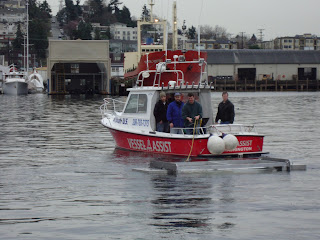
The Hydrovolts Flipwing Turbine demonstration unit being tow tested in the Ballard ship canal
In the prior post we provided some pictures and video of the Flipwing Turbine demonstration unit, which is on its way today to Hydrovolts' first public exhibition at the Harvesting Clean Energy Conference in Kennewick, WA. Come to the show and spin the turbine! There will be about 500 attendees, including Washington State's Governor Christine Gregoire and several members of the Congressional delegation (if they can get out of Washington DC!) There will be many great opportunities to learn and ask questions about renewable energy development in and for the Pacific Northwest. Join us!

Harvesting Clean Energy
February 7-9, 2010
Kennewick, WA

Friday, February 5, 2010

The Hydrovolts Turbine - VI

The Hydrovolts Flipwing Turbine demonstration unit has had a couple of in-water tests and made power over the past few weeks. Testing was done in the Ballard ship canal under tow to simulate the turbine in water flows of different velocities.

We put casters on the bottom so we could wheel it down the road from the shop at SteadyFlux, and right down the boat ramp into the water. After ballasting the tanks and maneuvering the boat, we were underway on the first tow test:


Thursday, February 4, 2010

Fiddling

We need a comprehensive climate and energy bill
President Obama never uttered the words "cap and trade" in his State of the Union address. He said only a bit more on climate change, the impetus for such legislation either, calling for passage of
...a comprehensive energy and climate bill with incentives that will finally make clean energy the profitable kind of energy in America.
An interesting rationale considering the amount of clean energy development already happening. Even with the wretched economy of 2009,  the US added more wind power capacity last year than ever, and the country now leads the world. Lots of money is already being made in clean energy.

Monday, February 1, 2010

Why Clean Energy Matters

It's a significant part of the greenhouse gas emissions problem:


Graphic by Emmanuelle Bournay, UNEP/GRID-Arendal

What part of this surprises you the most?

Learn more about the UN Environmental Programme here.
Download high-resolution versions of this graphic here.